
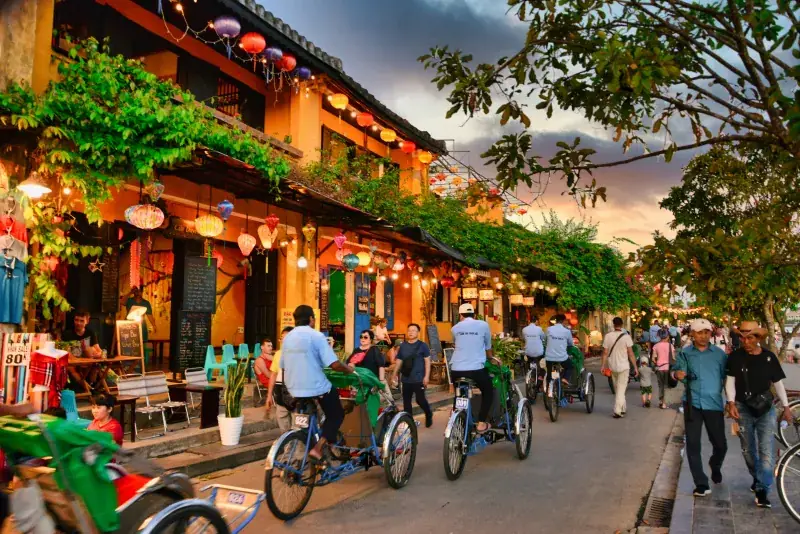

Hoi An sits on the Thu Bon River in central Vietnam, about 28 kilometers south of Da Nang — a merchant port frozen in its golden age. From the 15th to the 19th century, ships from Japan, China and Europe crowded its wharves to trade silk, ceramics and spices; when commerce moved on, the town it left behind survived almost untouched. UNESCO listed the Old Town in 1999, and today its mustard-yellow shophouses, timber merchant homes and lantern-strung lanes form one of Asia's most atmospheric places to wander — best explored slowly, with a self-guided audio tour unspooling four centuries of stories as you walk.

A port where the world once met
Known to early European traders as Faifo, Hoi An was one of Southeast Asia's busiest entrepôts, with a Japanese quarter on one bank of the town and Chinese congregations on the other. The Japanese Bridge — the covered crossing Japanese merchants built to link the two — remains the town's emblem, so beloved it appears on Vietnam's 20,000-dong banknote; its audio guide unpacks why traders far from home built a temple into a bridge. Nearby, the Old House of Tan Ky has sheltered generations of one merchant family since the 18th century, while the Fujian Assembly Hall glows with incense coils and dragon mosaics where Chinese sailors once gave thanks for safe passage. More than a thousand historic buildings still stand along the original street grid, and it was the port's very decline that saved them — stagnation kept the bulldozers of modernity away.
Lanterns, markets and the river
At dusk the Old Town turns amber. Silk lanterns light every façade, sampans drift along the Hoai River, and the night market across the water fills with lantern stalls and street kitchens. On the 14th night of each lunar month the electric lights dim so candlelight can take over — the town's signature full-moon festival. By day, browse the Central Market and the cloth stalls that keep Hoi An's centuries-old tailoring trade alive; a made-to-measure suit is still the classic souvenir.
Sông Hoài Phố Cổ Hội An
Riverside stretch of lantern boats and noodle stalls, its water long prized for a secret local dish.
Hoi An night market
Open-air riverside stalls of lanterns, silk, and street food, lit for nightly bargaining and boat-launched wish lanterns.
Central Market Hội An
Riverside covered market of fresh seafood, produce and street food unloaded straight off morning boats.
Beyond the old streets
Hoi An rewards lingering. Cycle through rice paddies to An Bang Beach, paddle a basket boat in the Bay Mau coconut forest, or take a boat to the Cham Islands for snorkeling. Inland lies My Son Sanctuary, the ruined temple complex of the ancient Champa kingdom — an easy half-day trip, and another place where an audio guide turns weathered brick into a living story.
Come for the architecture, stay for the evening: when the lanterns come on and boats drift down the river, Hoi An feels less like a museum than a memory the whole town agreed to keep.
An Bang Beach
Once-quiet fishing hamlet turned beloved beach, defended by fabric-tube dykes and offshore breakwaters against a retreating shoreline.
Bay Mau Coconut Forest Tour
Woven bamboo basket boats spin and dance through a dense water-coconut canal maze once used as wartime cover.
Chàm Islands
Cliff-rimmed islands where families harvest edible swiftlet nests from pitch-dark sea caves.
My Son Sanctuary
Cluster of mortarless red-brick Cham temple towers, sealed with tree resin and rebuilt by generations of restorers.