
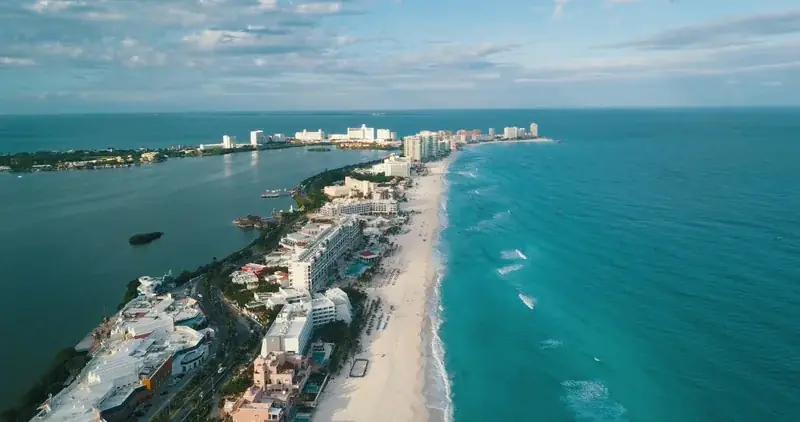
Cancún is the improbable capital of the Mexican Caribbean — a city that barely existed before January 23, 1970, when Mexico's tourism planners picked a snake-shaped sandbar with just three inhabitants and willed a resort metropolis into being. Half a century later it draws millions to its powder-white sand and impossibly turquoise water, yet it hides far more history than its reputation suggests. It's also an easy city to explore on your own terms: put in your headphones and let self-guided audio tours narrate the Maya coast concealed between the hotels.
Two cities, one sandbar
The famous Hotel Zone traces a long "7" along Boulevard Kukulcán, a 22.5-kilometer ribbon squeezed between the open Caribbean and the mangrove-fringed Nichupté Lagoon. Its beaches each have a personality — calm, family-friendly coves like Playa Langosta on the sheltered arm, and wide, wave-brushed strands facing the open sea where dolphins are regularly spotted offshore. Twenty minutes inland is the other Cancún: El Centro, a working Mexican city where evenings mean tacos and live music at Parque de las Palapas, souvenir haggling in the labyrinth of Mercado 28, and some of the best cheap eats on the peninsula at the locals' Market 23. An audio guide in your ear turns the hop between the two into a story of one of the fastest-growing cities the Americas have ever seen.
Playa Langosta
Shallow, calm cove split by a long pier once used by fishing boats hauling in lobster.
Parque de las Palapas
Downtown plaza of family food stalls, live music and a shaded stage where locals gather nightly.
Mercado 28
Sprawling craft market of over a hundred stalls where every price is just an opening bid.
Market 23
Gritty neighborhood market of produce stalls, spice vendors, and cheap taco counters, unchanged since the nineteen seventies.
Maya history between the hotels
Long before the resorts, this shore belonged to a Maya trading network of fishermen and salt merchants. Their traces survive in plain sight: the El Rey Archaeological Zone puts 47 ancient structures — plaza, temple platforms and iguana-patrolled foundations — right beside the boulevard, while the excellent Museo Maya de Cancún displays finds from across the Yucatán and backs onto San Miguelito, where a jungle path winds past an eight-meter pyramid. With a narrated guide at each stop, the ruins stop being a photo backdrop and become a thousand-year story.
The name itself is Maya — kàan kun, often translated as "nest of snakes," a fitting label for the sinuous island the Hotel Zone occupies.
Beyond the beach
Cancún is also the Riviera Maya's launchpad: swim in a freshwater cenote, catch the ferry toward the white sands of Playa Norte on Isla Mujeres or the car-free island of Holbox, then come back for a night at Coco Bongo, where acrobats fly over the dance floor until 3 a.m. Sun-soaked, historic, and louder than it looks — Cancún rewards travelers who listen.