

The City of Light, Told Story by Story
Paris has been rebuilding itself in the world's imagination for over two thousand years — from the Celtic settlement of Lutetia on the Île de la Cité, through the grand boulevards Baron Haussmann carved in the 19th century, to the gaslit streets that earned it the nickname "the City of Light." Few cities pack so much art, history, and everyday elegance into a walkable core, and few reward an audio guide the way Paris does: nearly every corner has a story worth hearing as you stand in front of it, from the engineering gossip behind a tower's rivets to the gallery politics behind a painting's frame.
Start at the Eiffel Tower
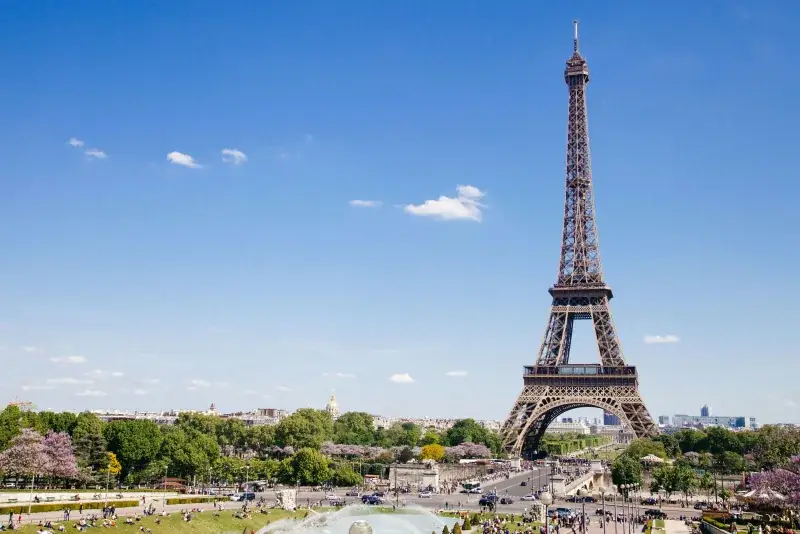
Gustave Eiffel's iron lattice was built as a temporary entrance arch for the 1889 World's Fair and was nearly torn down twenty years later — it survived because it proved useful for radio transmission. An audio guide at the base or across the river in the Jardins du Trocadéro unpacks the controversy it caused among Parisian artists and the sheer audacity of building the world's tallest structure out of puddle iron.
The Louvre and the Left Bank
Across town, the Louvre Museum holds some 35,000 works on display at any time — the Mona Lisa and Venus de Milo among them — inside a former royal palace crowned by I.M. Pei's glass pyramid. Just across the Seine, the Musée d'Orsay, a converted Belle Époque railway station, houses the world's largest collection of Impressionist and Post-Impressionist paintings. Wander south into the Jardin du Luxembourg or the Tuileries Garden and a guide can trace how these formal gardens shaped Parisian leisure for centuries.
Louvre Museum
World's largest art museum, housing thirty-five thousand works including the Mona Lisa and Venus de Milo.
Musée d'Orsay
Beaux-Arts railway terminus turned Impressionist shrine, with a soaring iron-and-glass nave and monumental clocks.
Jardin du Luxembourg
Formal Medici garden beside the French Senate, with allées, a grand fountain, and iron chairs since 1612.
Tuileries Garden
Formal royal garden stretching from the Louvre to Place de la Concorde, where a palace once stood.
Hilltop Bohemia and Medieval Streets
Up on the hill, Montmartre and the white-domed Basilique du Sacré-Cœur preserve the bohemian spirit of the artists — Picasso, Renoir, Toulouse-Lautrec — who once filled its cafés and studios. Below, Le Marais is Paris's best-preserved medieval quarter, its narrow lanes now threading between centuries-old mansions, independent galleries, and some of the city's best falafel. And the Arc de Triomphe, anchoring the top of the Champs-Élysées, tells the story of Napoleon's ambitions and France's fallen soldiers, honored beneath its eternal flame.
Montmartre
Hilltop bohemian village that shaped modern art, immortalized by Renoir, Toulouse-Lautrec, and Utrillo.
Basilique du Sacré-Cœur de Montmartre
Romano-Byzantine basilica crowning Montmartre, built as political atonement over France's most revolutionary hill.
Le Marais
Historic neighbourhood layered with royal mansions, a Yiddish-speaking past, and vivid LGBTQ+ life.
Arc de Triomphe
Triumphal arch housing the Tomb of the Unknown Soldier, with an eternal flame rekindled nightly since nineteen twenty-three.
Getting Around
Paris rewards slow exploration on foot, by Métro, or along the Seine — and a self-guided audio tour lets you set the pace, lingering at a café table in Le Marais or on a bench in the Champ de Mars just as long as the story demands.