
Hamburg calls itself the Gateway to the World, and the title is earned: the Free and Hanseatic City grew rich on shipping, and its 1241 alliance with Lübeck is regarded as the founding moment of the Hanseatic League. Today Germany's second-largest city still moves to the rhythm of Europe's third-largest port — yet it is also a place of elegant lakes, copper spires, and around 2,500 bridges, more than Venice, Amsterdam, and London combined. It rewards slow, curious exploration, and with a self-guided audio tour in your ear you can drift from quay to counting house at your own pace while each landmark tells its own story.
A port that built a city
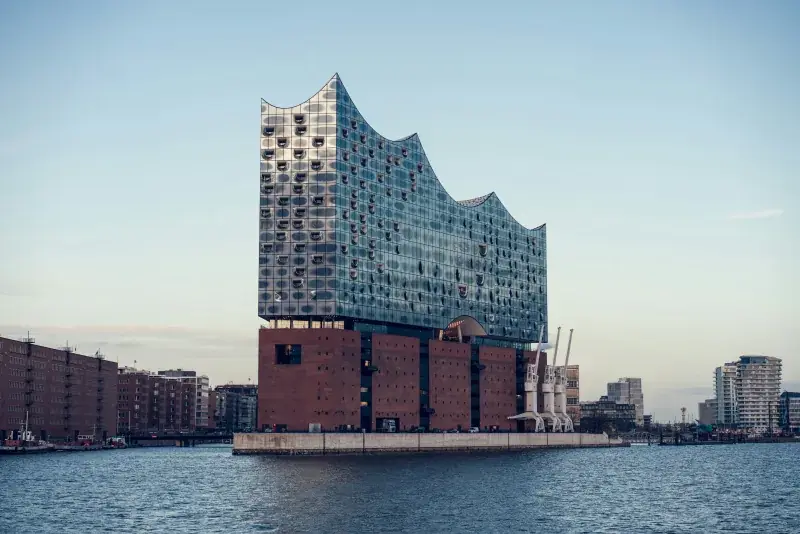
Start where Hamburg's fortune was made. The Speicherstadt, the world's largest contiguous warehouse district and a UNESCO World Heritage Site since 2015, lines its tidal canals with neo-Gothic red-brick warehouses that once held coffee, cocoa, tea, and spices — walk its bridges with the audio guide and the gables and winches overhead snap back into working life. At its western tip rises the Elbphilharmonie, Herzog & de Meuron's glassy wave crashing over a 1960s brick warehouse; ride the long curved escalator to the Plaza for a panoramic sweep of the harbor, with the story of the city's boldest building narrated as you look out.
Merchants, spires, and salt air
In the old town, the neo-Renaissance Hamburg Townhall proclaims Hanseatic self-confidence in sandstone, while the baroque tower of St. Michael's Church — the beloved "Michel" — remains the sailors' landmark it has been for centuries. Nearby, the dramatic brick prow of the Chilehaus shows how even 1920s office architecture here took the shape of a ship, and the Hamburger Kunsthalle holds one of Germany's great art collections.
Hamburg Townhall
Neo-Renaissance seat of government resting on thousands of driven oak piles above a storied council wine cellar.
St. Michael's Church
Baroque main church with a soaring copper-clad tower, twice rebuilt after fire.
Chilehaus
Ship-prowed brick office tower with a nonstop open-air lift still in daily use.
Hamburger Kunsthalle
Gothic winged altarpiece whose painted weekday panels once folded open into gilded feast-day carvings.
St. Pauli after dark (and at dawn)
Down by the water, the St. Pauli Piers hum with ferries and harbor traffic, and the century-old Elbe Tunnel still carries walkers beneath the river. The Reeperbahn — the neon artery of St. Pauli where the young Beatles played their marathon club nights — tells a rowdier chapter of the city's story, best decoded with a guide narrating the history behind the glitter. Hold out until sunrise on a Sunday and the Fischmarkt rewards you with fish sandwiches, brass bands, and pure Hamburg theater.
Salt air, red brick, world-class music, and a skyline of cranes and church towers: Hamburg is a city of stories told between water and sky — press play and follow them.
St. Pauli Piers
Floating pontoon pier engineered to rise and fall with the tidal Elbe, linked to shore by movable bridges.
Elbe Tunnel
Century-old river passage lined with ceramic fish and crabs, reached by original hydraulic lifts.
Reeperbahn
Legendary nightlife boulevard laid out by rope makers, later the training ground of a young rock band from Liverpool.
Fischmarkt Hamburg Altona
Sunday-dawn market of theatrical fish sellers and stalls, beside a restored Roman-basilica-style auction hall with live bands.