
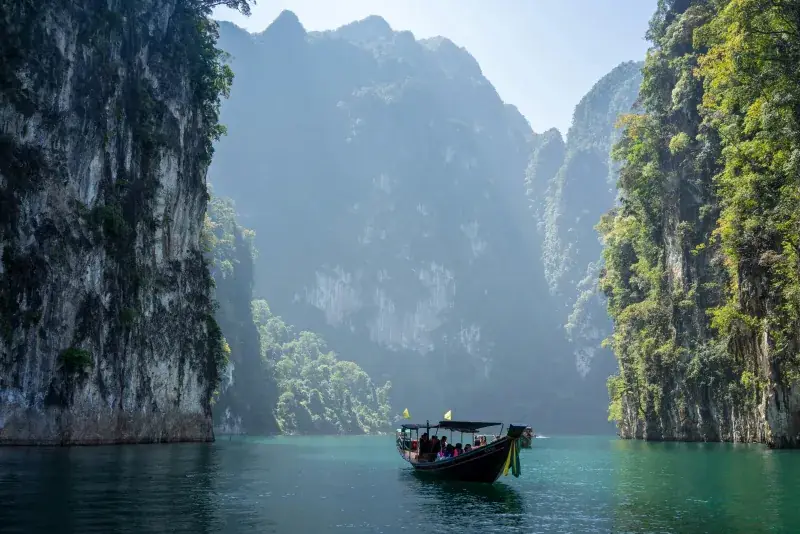

Krabi is southern Thailand's limestone kingdom — a province on the Andaman Sea where sheer karst towers rise straight out of jade-green water, mangrove channels wind toward hidden lagoons, and longtail boats shuttle between beaches no road can reach. It rewards the curious traveler: nearly every cliff, cave and shrine here has a story, and with a self-guided audio tour playing as you go, the scenery starts to explain itself — at your own pace, on a boat deck or a beach towel.
A coastline carved from limestone
The heart of it all is Railay, a peninsula so walled off by cliffs that it feels like an island — the only way in is by longtail boat from Ao Nang or Ao Nam Mao. Railay West is the sunset beach; Railay East hides the mangroves and climbers' bars; and around the headland lies Phra Nang Cave Beach, where a shrine of wooden offerings honors a legendary princess spirit — one of those tales an audio guide tells far better than a signboard. The same cliffs have made Railay a world-famous rock-climbing destination, and even non-climbers can scramble up to the East Railay viewpoint for a panorama over both bays.
Ao Nang is the province's easygoing hub — a long beachfront of restaurants, tour desks and boat queues that makes a practical base for everything else.
Railay West Beach
Golden peninsula sand reachable only by longtail boat, backed by sheer limestone climbing cliffs.
Phra nang Cave Beach
Cave shrine at a limestone headland beach, filled with wooden phallic offerings tied to a princess legend.
Ao Nang Beach
Palm-fringed limestone bay where longtail boats ferry visitors past sacred cliffside caves and islands.
Beyond the beaches
Krabi's inland is just as striking. At Wat Tham Suea, the Tiger Cave Temple, more than 1,200 steps climb to a hilltop Buddha with a 360-degree view over the karst plain — a pilgrimage with a real payoff. Deep in the Thung Teao forest, the Emerald Pool glows a surreal blue-green among the trees, fed by warm mineral springs.
Island hopping on the Andaman
From Krabi's piers, day boats fan out across some of Thailand's most photographed water: Ko Poda and the four-islands loop, the drowned lagoons of Ko Hong, laid-back Ko Lanta, and the Phi Phi archipelago — including Maya Bay, the movie-famous cove that reopened after a years-long closure to let its reefs recover. Listening to each island's story on the ride over turns a boat transfer into part of the tour.
When to go: November to April is the dry season, with calm seas ideal for boat trips; the green months of May to October bring quick downpours, fewer crowds and better prices.
Ko Poda
Uninhabited limestone island with a long powder-sand beach and calm, coral-fringed shallows off Ao Nang.
Ko Hong
Enclosed limestone lagoon reached only through a narrow sea cave, ringed by sheer karst cliffs.
Maya Bay
Sheltered limestone-cliffed cove of white sand and turquoise water, once stripped bare, now regrown coral reef by hand.