
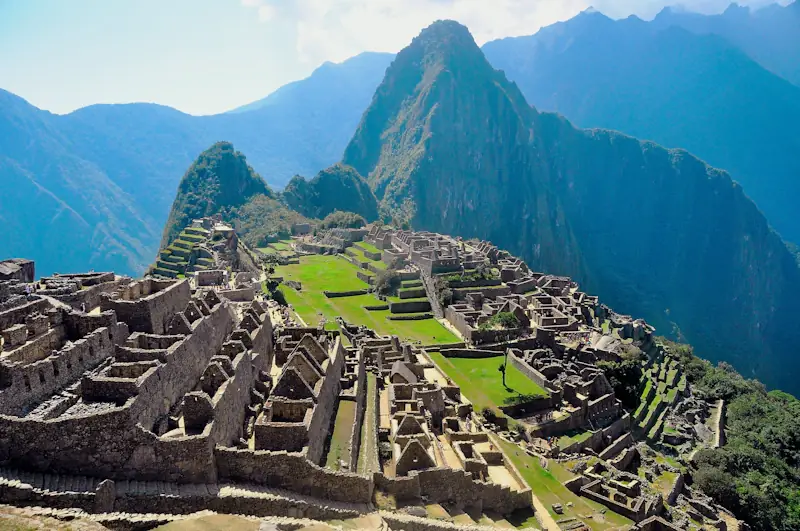

Aguas Calientes, officially Machupicchu and often called Machu Picchu Pueblo, is the small Peruvian town wedged into the gorge at the foot of the most famous Inca site on earth. It sits at about 2,040 metres beside the roaring Urubamba (Vilcanota) river, hemmed in by cloud-forest peaks, and no road reaches it: you arrive by train from Cusco or Ollantaytambo, or on foot along the tracks. Settled by a handful of farm families in 1901 and reshaped by the railway in the late 1920s, it exists for one reason, and that reason is 400 metres above your head.
That is why a self-guided audio guide makes sense here. The citadel is a maze of terraces, temples and stairways with almost no signage, and the town below has its own quiet stories. Each landmark in this catalog has an audio guide that tells its story, so you can set your own pace rather than follow a flag.

The citadel above the clouds
The Historic Sanctuary of Machu Picchu was built around 1450 as a royal estate for the emperor Pachacuti, abandoned within a century, and brought to world attention by Hiram Bingham in 1911; UNESCO listed it in 1983 as a masterpiece of urbanism and engineering. Perched at 2,430 metres, its finest work clusters around the Temple of the Sun, a curved tower of polished granite fitted over a natural rock, and the Intihuatana, the carved ritual stone whose name means "hitching post of the sun". The Temple of the Three Windows frames the eastern mountains through trapezoidal openings that have puzzled astronomers for a century.
Temple of the Sun
Semicircular granite shrine to the sun god, built over a sacred boulder with windows aligned to the solstice sunrise.
Intihuatana
Carved granite pillar used by Inca priests to track the sun at the equinoxes.
Temple of the Three Windows
Massive trapezoidal-window wall carved as a stone echo of the Inca creation myth of Tampu Toco.
Temples, plazas and the sacred stones
Beyond the showpiece temples the estate reveals itself in details: the Sacred Plaza, the ceremonial heart of the upper city; the Temple of the Condor, where two natural outcrops form a bird's wings over a carved head in the floor; and the Sacred Rock, a slab shaped to echo the mountain silhouette behind it. The House of the Guardian to the Funerary Rock, a thatched hut on the highest terraces, is where the classic postcard view is taken, and a good place to listen to how the whole site was laid out.
Sacred Plaza
Ceremonial courtyard ringed by a temple of three trapezoidal windows facing the sunrise.
The Temple of the Condor
Rock-carved condor altar with sculpted wings, a hidden cave, and channels cut for ritual offerings.
Sacred Rock at Machu Picchu
Upright granite monolith whose silhouette mirrors the sacred mountain rising behind it.
House of the Guardian to the Funerary Rock at Machu Picchu
Thatched, three-walled stone hut overlooking a carved altar rock used for Inca mummification rites.
Peaks with a view
Two mountains bracket the ruins and both need a separately reserved ticket. Huayna Picchu, the sugarloaf in every photograph, is a steep, exposed climb of about an hour that passes the Temple of the Moon, a shrine built into a cave on its far side. Montaña Machu Picchu is longer and gentler, ending on a summit high above the citadel. For a shorter option, Huchuy Picchu is a modest bump with a big panorama.
Huayna Picchu
Steep sacred summit above Machu Picchu with priestly ruins, a moon temple cave, and sweeping citadel views.
Temple of the Moon at Machu Picchu
Inca cave shrine with a rock-carved throne, trapezoidal niches and a soaring double-jamb doorway.
Montaña Machu Picchu
Steep viewpoint peak towering above the ancient citadel, reached by roughly sixteen hundred stone steps.
Huchuy Picchu
Inca stone stairway carved into a granite shoulder beside a taller neighboring peak, with sweeping citadel views.
The Inca Trail and the Sun Gate
The classic way to arrive is the Inca Trail, a multi-day trek along original paved paths through cloud forest and ruins. Its final morning passes the terraces of Intipata and the beautifully sited Winay Wayna before cresting at the Sun Gate, or Inti Punku, where the citadel appears all at once at dawn. Day visitors can walk up to the Sun Gate from inside the site for the same view in reverse.
Inca Trail
Legendary mountain footpath to Machu Picchu, where porters still carry loads weighed against a hard-won labor law.
Intipata
Steep terraced hillside above the Urubamba valley, part of the sacred Inca landscape surrounding Machu Picchu.
Winay Wayna
Terraced Inca waystation with ritual baths, hidden in the cloud forest along the classic pilgrim trail.
Sun Gate
Stone checkpoint gateway on the Inca Trail where the winter solstice sunrise aligns exactly with the doorway.
Life in the town below
Aguas Calientes is lively, a little chaotic, and built almost entirely for visitors, but it rewards an evening wander. Manco Capac Square is the compact main plaza, watched over by the Parroquia Virgen del Carmen and a statue of the first Inca. The sprawling Mercado Aguas Calientes by the tracks sells alpaca knits, carvings and hot lunches at local prices. And the town's name comes from the Machu Picchu HotSprings at the top of Avenida Pachacutec, where sulphurous pools of 38 to 46 °C soothe legs that have just climbed a mountain.
Manco Capac Square
Granite Inca statues ring a leafy plaza where the town's only street meets its old hot springs.
Parroquia Virgen del Carmen
Modest stone parish church with a squat bell tower on the town's main square.
Mercado Aguas Calientes
Covered corridor of stalls selling handwoven alpaca textiles, silver jewelry, and Andean instruments beside the train tracks.
Machu Picchu HotSprings
Steaming sulfur pools fed by a mountain spring, soaked in by railway laborers since the eighteen hundreds.
Waterfalls, orchids and butterflies
The gorge is a slice of high jungle, and short walks lead into it. The Manuel Chávez Ballón Site Museum, about a mile downriver beside the bridge, is the official museum of the site and explains Inca engineering better than any panel on the mountain; its Machupicchu Botanical Garden grows more than 200 orchid varieties. Further along the tracks, the Santuario Natural de Mandor and the three-tiered Cascadas Alcamayo offer birdsong, hummingbirds and a 30-metre fall, while the Butterfly Zoo - Mariposario of Machu Picchu shelters some 300 species. The adventurous take on Phutuq K'usi (Putucusi), a near-vertical climb of wooden ladders to a rare side view of the citadel.
Manuel Chávez Ballón Site Museum
Site museum of excavated Inca artifacts beside a botanical garden overlooking the Urubamba River.
Machupicchu Botanical Garden
Orchid-filled garden of native cloud-forest flora, fenced against illegal wild collectors.
Santuario Natural de Mandor
Cloud-forest waterfall reserve with orchid trails, hummingbirds and the elusive cock of the rock.
Cascadas Alcamayo
Jungle waterfall hike ending at a private trailside gate where an informal, cash-only toll is collected.
Butterfly Zoo - Mariposario of Machu Picchu
Cloud-forest greenhouse breeding and releasing morpho and owl butterflies through every life stage.
Phutuq K'usi
Free, unpatrolled granite peak reached by steep wooden ladders, offering a rare side-on view of the Inca citadel across the valley.
Getting there and up the hill
Trains from PeruRail and Inca Rail terminate at the Machu Picchu Pueblo station in the centre of town. From Avenida Hermanos Ayar, shuttle buses grind up the switchbacks of the Hiram Bingham road in about 20 minutes from 5:30 a.m.; the Hiram Bingham Hiking Trail to Machu Picchu shortcuts the same hairpins on foot in roughly ninety minutes. Budget travellers arrive along the railway from Hidroeléctrica, a two-to-three-hour riverside walk from the power station. Daily entry to the citadel is capped, and circuits and add-on hikes sell out well in advance, so book the ticket before the train.
Machu Picchu Pueblo
Rail terminus and only way in or out of a mountain town, once shut down by a tourism-concession revolt.
Hiram Bingham Hiking Trail to Machu Picchu
Stone pilgrim path climbing through cloud forest to a sun-aligned gateway above the Inca citadel.
Hidroeléctrica
Underground hydroelectric station on the Urubamba River, rebuilt after a catastrophic landslide buried it in mud.