

Vietnam's Thousand-Year Capital
Hanoi has been a capital for more than a millennium. In 1010, Emperor Ly Thai To moved his court to a bend in the Red River and named the new city Thang Long — the "Ascending Dragon." What has grown up around that ancient citadel is one of Asia's most atmospheric capitals: Confucian temples and French colonial villas, socialist-era monuments and streets thick with motorbikes, incense and the steam of pho stalls. It is a city of layers, and the most rewarding way to peel them back is at your own pace — wandering with a self-guided audio tour that tells each landmark's story the moment you're standing in front of it.
The Old Quarter and the Lake of the Restored Sword
The heart of the city is the Old Quarter, the oldest continuously inhabited quarter in Vietnam. Its lanes preserve the medieval guild system of the "36 streets," each once named for its trade — Hang Gai still sells silk, Lan Ong still smells of herbal medicine — and lined with narrow "tube houses" that stretch deep behind tiny storefronts. A few steps south lies Hoàn Kiếm Lake, wrapped in legend:
Emperor Le Loi is said to have received a magical sword from a golden turtle here — and after driving out the invaders, returned it to the depths, giving the lake its name: the Lake of the Restored Sword.
Cross the scarlet Huc Bridge to Ngoc Son Temple on its island, then let an audio guide walk you through the legend while the Turtle Tower floats on the water behind you.
Old Quarter
Maze of narrow lanes lined with centuries-old trade-guild streets and slender, deep tube houses.
Hoàn Kiếm Lake
Central lake wrapped in legend, its red bridge and turtle temple islet framed by old banyan trees.
Ngoc Son Temple
Red wooden bridge leading to a lake-island shrine honoring a legendary sword-bearing turtle.
A Millennium of Memory
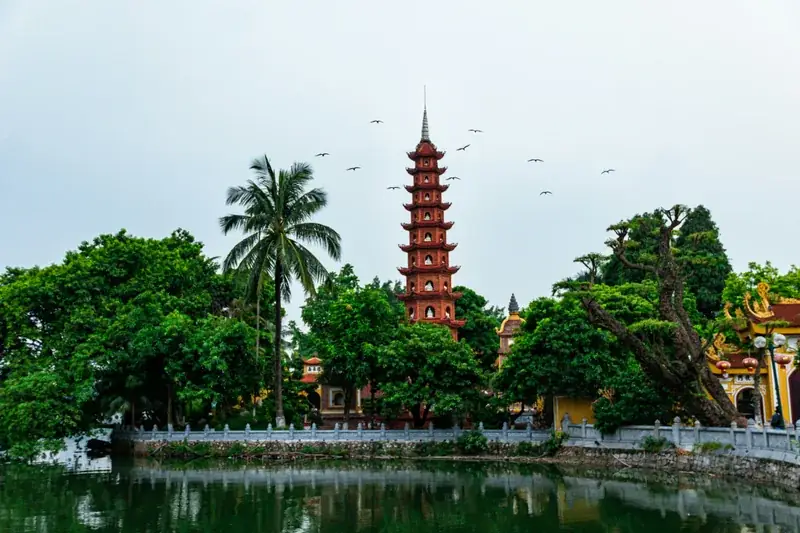
Hanoi's landmarks span thirteen centuries, and each carries a story worth hearing. The Temple of Literature, founded in 1070, housed Vietnam's first national university; its stone stelae, mounted on the backs of carved turtles, still record the names of doctoral graduates. The UNESCO-listed Imperial Citadel of Thang Long stacks eras on top of one another, from dynastic foundations to the D67 war bunker. On Ba Dinh Square, Ho Chi Minh's Mausoleum anchors modern Vietnam's founding story, while sixth-century Tran Quoc Pagoda rises serenely from West Lake and the Hoa Lo Prison relic confronts the colonial and wartime past.
Temple Of Literature
Confucian temple and stelae garden with stone turtles bearing carved doctoral honor rolls since the fifteenth century.
Imperial Citadel of Thang Long
Thousand-year royal citadel layered over ancient palace foundations and a hidden Vietnam War command bunker.
Ho Chi Minh's Mausoleum
Granite hall guarding an embalmed founding leader in a glass case, styled after Lenin's Moscow tomb.
Tran Quoc Pagoda
Island pagoda over fifteen hundred years old, moved stone by stone to escape a crumbling riverbank.
Hoa Lo Prison Relic
Former colonial-era prison and Vietnam War POW site, now a museum behind its original gatehouse.
Why Visit
- History at every corner — pagodas, a citadel, a Gothic cathedral and revolutionary monuments within walking distance of each other
- Legendary street food — pho, bun cha and egg coffee served on plastic stools
- Living traditions — water puppetry, a thousand-year-old art form, performed nightly by Hoàn Kiếm Lake
Put in your earphones, pick a direction, and let the Ascending Dragon tell you its story.