
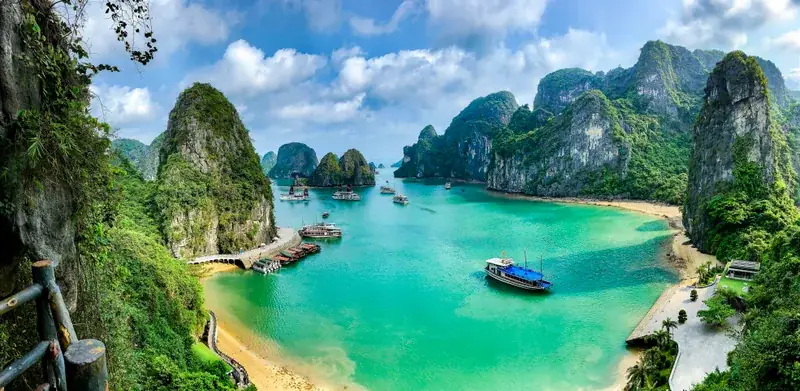

The city where the dragon descended
Ha Long, on the Gulf of Tonkin coast of Vietnam's Quảng Ninh Province, is the gateway to one of the planet's most surreal seascapes: Hạ Long Bay, where nearly two thousand limestone islands and islets rise sheer-sided from emerald water. Legend tells of a family of dragons sent down to defend Vietnam, spitting jewels that hardened into these karst towers — Hạ Long means "descending dragon." UNESCO first inscribed the bay in 1994 and has extended the listing twice since, most recently in 2023 to embrace the Cát Bà archipelago. It is a landscape made for exploring at your own rhythm, with a self-guided audio tour narrating each cave, islet and viewpoint as your boat draws near.
Out on the bay
Most visits revolve around a cruise — a day loop through the classic sights or an overnight sail that catches both sunset and sunrise among the karsts. Along the way, audio guides unfold the stories behind the icons: Sung Sot ("Surprise") Cave, the bay's largest at some 10,000 square metres of stalactite-hung chambers; the theatrically lit Thiên Cung "Heavenly Palace"; and Ti Top Island, where 400 steps climb to a panorama over the whole drowned mountain range before you cool off on its crescent beach. Kayakers slip through low tunnel caves into hidden lagoons, past the twin Trống Mái rocks that seem to kiss at sunset, while quieter Lan Ha Bay and the floating fishing villages preserve a centuries-old life lived entirely on the water.
Sung Sot Cave
Limestone cavern with a narrow entrance opening into a vast hall of stalactites shaped by legend into a horse and sword.
Động Thiên Cung
Limestone cave of soaring stalactite-hung chambers, said to be a dragon king's underground wedding palace.
Ti Top Island
Small limestone-karst island with a crescent beach and a steep summit climb over Ha Long Bay.
Hòn Trống Mái Hạ Long
Twin limestone sea stacks shaped like a rooster and hen leaning together over the water.
Lan Ha Bay
Karst islands and floating fishing villages beside a Stone Age settlement still lived in today.
Two towns, one waterfront
The city itself straddles the Cửa Lục strait: Bãi Cháy, the resort shore of hotels, night markets and the Sun World amusement park with its bay-crossing cable car, and Hòn Gai, the older harbour town beneath Bài Thơ ("Poem") Mountain, whose summit-side trails reward with rooftop-and-karst views. An audio guide here trades cruise-deck spectacle for local texture — markets, temples and the coal-port history that built the town.
Sun World Halong Park
Cable-car and theme park complex with a record-holding tower, Ferris wheel, coasters and a water park.
Queen Cable Car (Tower 2)
Double-decker aerial tramway cabin carrying over two hundred passengers on a record-height tower across a bay.
Bài Thơ Mountain
Limestone peak carved with centuries of poetry, once a wartime beacon tower above the bay.
When to go
March–May and September–November bring the clearest skies; winter wraps the karsts in painterly mist, while summer is hot, lush and prone to storms.
However you time it, Ha Long rewards the unhurried traveler — press play, let the dragon legend unspool, and watch the islands drift past.