
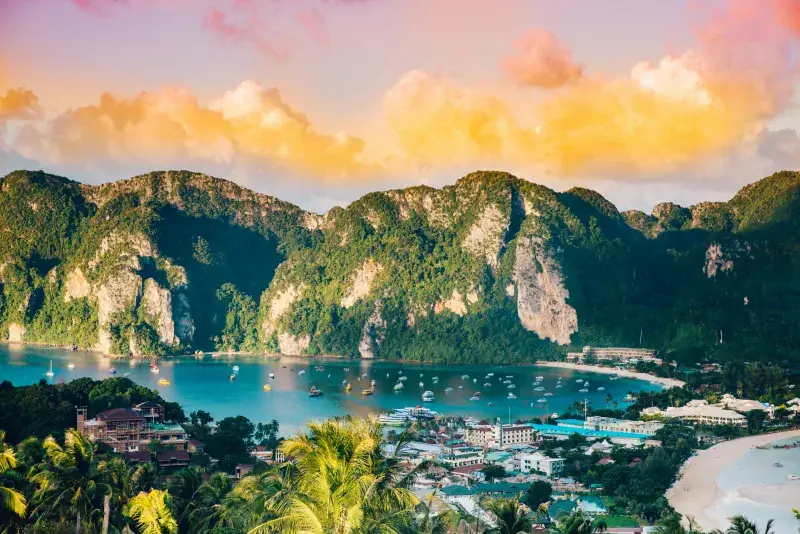
Thailand's largest island — some 543 square kilometers of green hills dropping into the Andaman Sea — Phuket is far more than a beach resort. It grew rich on tin long before tourism arrived, and that layered past of Chinese traders, Peranakan merchants and Portuguese-influenced architecture still shows through the palm trees. It is also an island made for wandering at your own pace: with self-guided audio tours you can drift from hilltop shrine to old-town shophouse and hear the story behind each stop as you go.
An island of temples and viewpoints
High on Nakkerd Hill, the Big Buddha — a 45-meter figure clad in white Burmese marble — watches over the whole south of the island, with Chalong Bay spread out below; its audio guide unpacks how a modern statue became Phuket's spiritual landmark. Down the hill, Wat Chalong, the island's largest and most revered temple, glitters with a chedi said to hold a fragment of the Buddha's bone. At the island's southern tip, Promthep Cape is where everyone gathers at dusk — Phuket's classic sunset stage — while the Karon Viewpoint frames three bays of the west coast in a single glance.
The Big Buddha, Phuket
Forty-five-metre seated marble Buddha atop a forested hill, overlooking beaches and the Andaman Sea.
Wat Chalong
Buddhist temple complex from the early nineteenth century, with gilded shrines and a soaring Chedi.
Promthep Cape
Rocky cape and sunset viewpoint crowned by a Brahma elephant shrine and a royal jubilee lighthouse.
Karon Viewpoint Phuket
Hilltop lookout offering a single-frame panorama of three sweeping Andaman Sea bays.
Beaches for every mood
The west coast is a run of celebrated sands: Patong for neon energy and nightlife, Karon for three kilometers of squeaky-soft beach, quiet Nai Harn in the far south, and jungle-backed Freedom Beach, often called the island's most beautiful cove. Between swims, an audio guide turns a beach walk into a story about how each bay found its character.
Patong Beach
Wide sandy crescent bay fringed by hills, with calm Andaman waters and a bustling beachfront town.
Karon Beach
White-sand beach famous for quartz grains that squeak underfoot, with calm clear water and three kilometers of shoreline.
Nai Harn Beach
Crescent bay kept pristine by a Buddhist monastery that owns the surrounding land and forbids its sale.
Freedom Beach
White-sand cove between jungle hills, reached only by longtail boat or a steep jungle trail.
Old Town flavor
Inland, Phuket Town's Sino-Portuguese shophouses — legacies of the 19th-century tin boom and the wealthy Baba Peranakan families it created — line Thalang Road and pink-hued Soi Romanee, now full of cafés, galleries and street art. The mixed Chinese, Malay and Thai kitchens here helped earn Phuket a UNESCO City of Gastronomy title; graze your way through the Naka Weekend Market to taste why.
Tropical island, trading port, temple hill, food capital — Phuket rewards listeners as much as swimmers.
Thalang Road
Heritage street lined with Sino-Portuguese shophouses from the nineteen-hundreds tin boom.
Soi Romanee
Restored shophouse lane that once housed brothels, opium dens, and gambling dens during the island's tin-mining boom.
Naka Weekend Market
Open-air weekend bazaar with hundreds of stalls, grilled street food, live music, and diverse local crowds.