
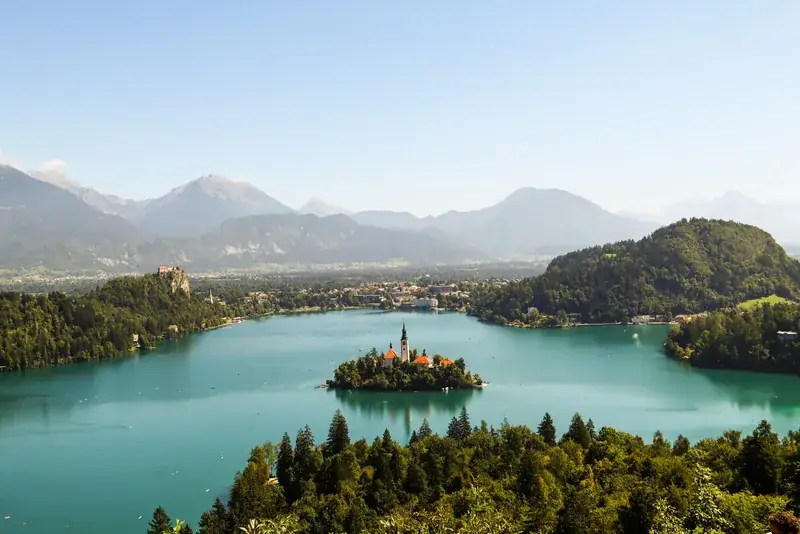
Lake Bled is the picture Slovenia puts on its postcards: a small glacial lake in the Julian Alps, a tear-shaped island with a church on it, and a medieval castle on a cliff above the water. The lake itself is modest, about 2.1 km long and 1.3 km wide, so the whole shore is a gentle hour-and-a-half stroll. That compactness is the point. Everything here, from the wishing bell on Bled Island to the walkways of Vintgar Gorge, is close enough that you can let a self-guided audio guide set the pace and listen to each place tell its own story as you reach it.
The town of Bled, home to roughly 10,000 people, grew from a farming village into a spa resort in the mid-19th century, when the Swiss hydropath Arnold Rikli started sending his patients into the cold lake water and up the surrounding hills. The resort habit stuck: lakeside villas, grand hotels and the famous cream cake all followed, and today the lake is as much about slow afternoons on the promenade as it is about the views.

Across the water to the island church
Bled Island can only be reached by boat, and the traditional way is a pletna, a flat-bottomed wooden boat rowed standing up by a local pletnar, a trade passed down through a handful of Bled families for centuries. Most set off from the little harbour at Mlino on the south shore. Once you land, 99 stone steps climb to the Church of the Assumption of the Blessed Virgin Mary, a 17th-century pilgrimage church with a Baroque altar and faded frescoes. Local legend says the first bell was lost in a storm on the lake and the Pope sent a replacement; ring today's wishing bell three times and your wish is supposed to come true. The island's audio guide covers the church, the bell and the pilgrimage still held every 15 August.
Bled Castle on its cliff
Bled Castle sits on a sheer rock more than 100 metres above the north shore and is usually described as the oldest castle in Slovenia, with a first written mention in 1004. The reward for the walk up (take the forest trail from the lakeside rather than the road) is a terrace view that frames the island, the lake and the Karavanke ridge behind it. Inside are a small museum of the lake's history, a working print shop with replicas of Slovenia's earliest printed texts, and a wine cellar where you can bottle your own. Back at the foot of the cliff, the castle bathing area is the classic spot for a summer swim with the fortress overhead.
Walkways through Vintgar Gorge
Four kilometres north of town, Soteska Vintgar is a 1.6 km ravine cut by the Radovna River through Triassic limestone. A wooden walkway pinned to the rock face follows the water past rapids, pools of impossible turquoise, and finally the 16-metre Waterfall Šum at the far end. Entry is timed in high season, so book a slot and go early; the quieter return is the forest path over the hill past the chapel of St Catherine, which drops you back toward Bled with the castle as your landmark.
Soteska Vintgar
River gorge with wooden galleries clinging to cliffs above emerald rapids, ending at a waterfall.
Waterfall Šum
River waterfall closing a narrow limestone gorge, reached by wooden walkways along the Radovna.
Church of St. Catherine
Gothic hilltop pilgrimage church from around 1400, with sweeping views over lake, Alps and plateau.
The viewpoints: Ojstrica, Mala Osojnica and Straža
The famous aerial view of the island is earned on foot. From the western end of the lake, a steep 20-minute scramble reaches Ojstrica Viewpoint, and a longer, rougher climb continues to Mala Osojnica, a rock ledge where hikers have lined the trail with heart-shaped stones. Sunrise is the moment the photographers come for, but sunset from Osojnica is just as good if you carry a torch for the way down. On the opposite shore, the wooded hill of Straža Bled has a chairlift to a 360-degree summit, Rikli's old fitness trail through the trees, and a toboggan run back to the lake.
Ojstrica Viewpoint
Rocky hilltop lookout framing the island church, cliff-top castle and Julian Alps in one classic view.
Mala Osojnica
Forested hilltop lookout over the lake, its island church and clifftop castle, reached by a steep trail.
Straža Bled
Forested lakeside hill with a chairlift, ski slope, summer toboggan run and sweeping lake views.
Cream cake, Rikli and the resort shore
No visit is complete without a kremšnita, the Bled cream cake: a block of vanilla custard and whipped cream between sheets of puff pastry, served at the lake since the 1950s. The original is at Kavarna Park on the eastern promenade, where the terrace looks straight across to the island. The shore around it is the old spa quarter that Rikli created: Grand Hotel Toplice with its thermal pool fed by a warm spring, and Vila Bled, the lakeside mansion that served as Tito's summer residence and still hosts guests today. The audio guides for these buildings tell the story of how a cold-water cure turned a village into a European resort.
Kavarna Park
Lakeside café terrace where the layered cream cake of custard and puff pastry was first served.
Grand Hotel Toplice
Lakefront grand hotel built over natural springs, a diplomats' retreat since the interwar years.
Vila Bled
Royal summer residence turned Tito's lakeside villa, later a luxury hotel and state protocol venue.
Beyond the lake: Bohinj and Radovljica
Half an hour's drive west, Lake Bohinj is Bled's wilder sibling: larger, deeper and almost unbuilt, ringed by Triglav National Park. The Vogel Cable Car lifts you from its shore to alpine meadows with views of Triglav itself, and a short walk at the valley's end reaches Savica Waterfall, the source of the Sava Bohinjka. In the other direction, the medieval market town of Radovljica keeps a preserved old square, the Beekeeping Museum with its painted hive panels, and the Lectar gingerbread museum, where gilded hearts are still made by hand in the cellar.
Lake Bohinj
Glacial alpine lake beneath the Julian Alps, ringed by forest, meadows and mountain trails.
Valley station - Vogel Cable Car
Aerial tramway lifting two eighty-person cabins nearly a kilometre up from the lakeshore to the ski slopes.
Savica Waterfall
Karst-spring waterfall splitting into an A-shaped double cascade above an emerald alpine pool.
Čebelarski muzej Radovljica
Baroque-mansion museum of beekeeping, famed for its painted folk-art beehive front panels.
Muzej Lectar - Gingerbread museum
Working gingerbread workshop and museum in a 500-year-old house, famed for red honey-dough hearts.
Getting around
Bled is small enough to do without a car. Buses from Ljubljana take about 90 minutes; by train, change at Jesenice for Bled Jezero station on the lake's west shore. Around the lake, walk, hire a bike or a rowing boat, and use the pletna for the island. Vintgar Gorge is a flat 4 km bike ride or a summer shuttle bus away, and Bohinj and Radovljica are on the regular local bus routes.