
Gothenburg is Sweden's second city and its biggest port, laid out in 1621 on a marsh at the mouth of the Göta älv. King Gustavus Adolphus chartered it as a fortified trading colony and handed the drawing board to Dutch engineers, who drained the ground and cut canals through it the way they had in Amsterdam. Four centuries on, the moat and the old harbour canal still frame the centre, the East India Company's warehouses have become museums and hotels, and the city that built Volvo and Sweden's biggest shipyards has settled into something more relaxed: trams rattling past cafés, seafood counters by the water, and a car-free archipelago at the end of the line.
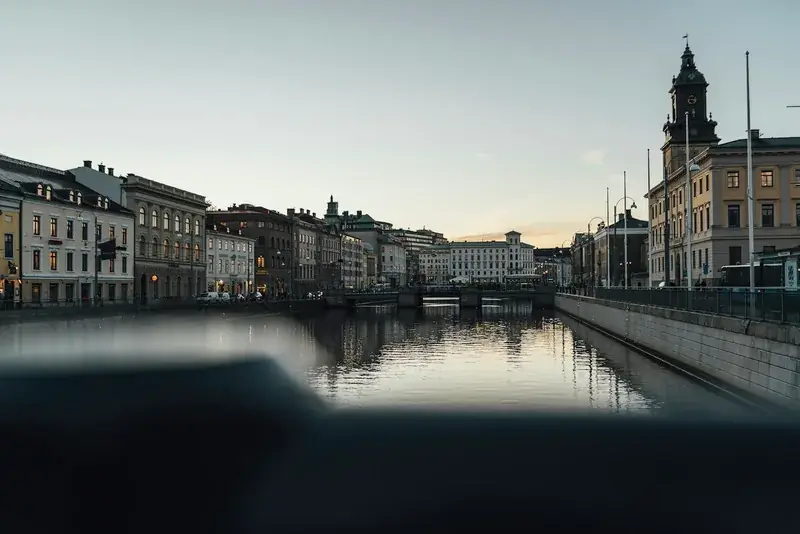
It is a city that rewards exploring at your own pace, with self-guided audio guides filling in the stories behind the facades. Start where the city did: along Stora Hamnkanalen, the great harbour canal, where Gustaf Adolf's square holds the founder's statue and the old exchange and town hall, and where Kronhuset, the 1640s brick armoury that briefly hosted the Swedish parliament, is the oldest secular building still standing. Each has an audio guide that tells its story while you look.

Stora Hamnkanalen
Seventeenth-century harbour canal with stone quays, lined by the old East India Company headquarters.
Gustaf Adolf's square
Historic civic square ringed by city halls and the bourse, guarded by a bronze founder-king.
Kronhuset
Red-brick seventeenth-century arsenal whose pillarless hall once hosted Sweden's parliament.
Haga, Skansen Kronan and the cinnamon buns
Haga is Gothenburg's oldest suburb, a grid of cobbled lanes and landshövdingehus — the city's own hybrid of a stone ground floor with two wooden storeys on top. Slated for demolition in the 1970s, it was saved and restored, and today Haga Nygata is one long run of cafés, antique shops and artisan stores, famous for cinnamon buns the size of dinner plates. Above it, on a bare granite knoll, sits Skansen Kronan, a late-17th-century fortress built to hold off the Danes that never fired a shot in anger; its terrace has the best view over the roofs toward the river.
Haga
Historic workers' district of wooden and stone houses, cobbled streets, cafés and small shops.
Haga Nygata
Pedestrian café street of old wooden houses, famed for plate-sized cinnamon buns and fika.
Skansen Kronan
Baroque hilltop redoubt with an octagonal tower crowned in gilded copper, never once attacked.
Feskekörka and the harbour of the East Indiamen
On the moat at the foot of Haga stands Feskekörka, the "fish church" — an 1874 market hall whose Gothic windows and gabled nave earned it the nickname. It reopened in 2024 after a four-year restoration and is once again where the city buys its shrimp, oysters and smoked mackerel. Follow the water to the river and the harbour that made Gothenburg rich. The Swedish East India Company was founded here in 1731, and a full-size reconstruction of one of its ships, the Ostindiefararen Götheborg, has sailed to China and back. Beside the opera house, Maritiman moors a destroyer, a submarine and a lightship you can climb through — a floating museum of the port's working life.
Feskekörka
Church-like fish market hall of yellow brick with a steep, pillar-free roof beside a canal.
Ostindiefararen Götheborg
Full-scale wooden replica of an eighteenth-century East India Company ship, moored at the quay.
Maritiman
Floating museum of retired warships, a submarine and harbour vessels moored along a river quay.
Up Avenyn to Götaplatsen
Kungsportsavenyen, the Avenue, is the kilometre-long boulevard laid out in the 1860s to connect the old town with the hill behind it. It has the city's densest run of bars and restaurants, and it climbs to Götaplatsen, the ceremonial square opened for the 1923 jubilee exhibition. Carl Milles's bronze Poseidon towers over the fountain in the middle, flanked by the concert hall, the city theatre and the Gothenburg Museum of Art, whose Nordic collection — Zorn, Larsson, Munch — is among the best in Scandinavia.
Kungsportsavenyen
Broad nineteenth-century boulevard of terraces, bars and restaurants leading up to a grand cultural square.
Götaplatsen
Cultural square crowned by a seven-metre bronze sea god, flanked by museum, theatre and concert hall.
Poseidon
Seven-metre bronze sea god by Carl Milles, rising from a fountain at the head of the grand avenue.
Gothenburg Museum of Art
Neoclassical yellow-brick art museum famed for late nineteenth-century Nordic painting.
Liseberg and Universeum
Sweden's most visited attraction is an amusement park in the middle of the city. Liseberg opened in 1923 for the same jubilee as Götaplatsen and now draws over three million visitors a year to its gardens, its wooden coaster Balder and the steel loops of Helix and Valkyria; in winter it turns into a Christmas market under millions of lights. Next door, Universeum is Scandinavia's largest science centre, with an indoor rainforest, a shark aquarium and a full-dome theatre.
Slottsskogen, the Botanical Garden and the Garden Society
Gothenburg is unusually green for a port city. Slottsskogen, 137 hectares of woodland and lawn opened in 1874, has free-roaming elk and a penguin pool in its open zoo, and the Natural History Museum on its hill. Across the road, the Gothenburg Botanical Garden holds around 16,000 species across 175 hectares, from a rock garden to a Japanese glade and wild woodland in Vitsippsdalen. Back by the central station, Trädgårdsföreningen — the Garden Society — is one of Europe's best-preserved 19th-century parks, with a cast-iron palm house and a rose garden.
Slottsskogen
Landscaped park of lawns, dug ponds and woodland, with a zoo, seals and old regional cottages.
Gothenburg Botanical Garden
Vast garden and arboretum with rock garden, orchid glasshouses and a tree extinct in the wild.
Trädgårdsföreningen (The Garden Society)
Nineteenth-century city park with a Victorian cast-iron palm house, rose garden and flower borders.
Out to the car-free archipelago
Take tram 11 to the end of the line at Saltholmen and a city transport ticket carries you onto a ferry into the southern archipelago, where no cars are allowed. Styrsö is the largest island, with a fishing village and a church above the harbour; Vrångö, the southernmost, has a nature reserve and smooth granite for swimming; Brännö is the one islanders dance on in summer at the jetty. An hour from the centre, it is a different Sweden entirely.
Saltholmen
Rocky seaside peninsula with a century-old cold bathhouse, sauna and archipelago ferry terminal.
Styrsö
Car-free archipelago island of fishing villages, sea-captain houses and an old bathing resort shore.
Vrångö
Car-free archipelago island of pilots and fishermen, with a nature reserve, beaches and rocky trails.
Brännö
Car-free archipelago island famed for its summer dances on a seaside pier facing the open sea.
Getting around
The centre is compact and flat enough to walk, but the blue-and-white trams are the city's real circulation system and reach everything from Slottsskogen to the ferry terminal. Paddan canal boats run the moat and harbour in summer, ducking under bridges low enough that passengers are told to lean back. A single Västtrafik ticket covers trams, buses and the archipelago ferries, so the islands cost no more than a ride across town.