
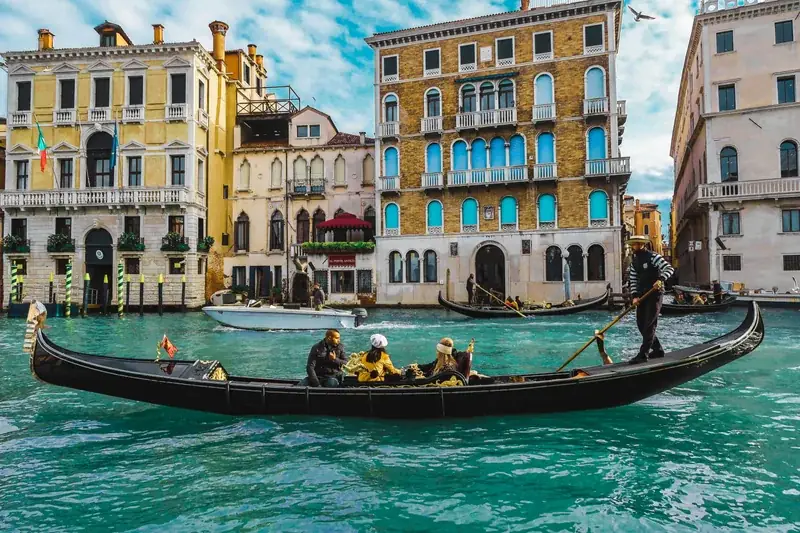

La Serenissima, the city built on water
Venice is a city that by all rights shouldn't exist — a maze of marble palaces and golden domes raised on more than a hundred islands in a shallow lagoon, stitched together by canals and some four hundred bridges. For almost a thousand years, from 810 to Napoleon's arrival in 1797, this was the capital of the Republic of Venice — La Serenissima, the "Most Serene" — a maritime empire that grew rich on trade with the East and spent that wealth on art, mosaics, and architecture found nowhere else on Earth. Since 1987 the whole city and its lagoon have been a UNESCO World Heritage Site.
There are no cars here, which makes Venice perhaps the world's perfect city for self-guided exploring: wander the six historic sestieri at your own pace with an audio guide in your ears, and every campo, church, and canal-side palazzo starts telling its story.
The heart: Piazza San Marco
Every visit gravitates to Piazza San Marco, the political and ceremonial heart of the Republic for over a thousand years. Here the Byzantine domes and golden mosaics of Saint Mark's Basilica rise beside the pink-and-white Gothic facade of the Doge's Palace, seat of Venice's rulers, from which the enclosed Bridge of Sighs crosses to the old prisons — each landmark with an audio guide that unpacks its dramas, from doges' elections to prisoners' last glimpses of the lagoon. Climb the Campanile for a view over red rooftops all the way out to sea, then come back after sunset, when the crowds thin and the floodlit square turns quietly magical.
Piazza San Marco
Grand medieval square framed by arcades, a soaring bell tower, and a Byzantine basilica.
Saint Mark's Basilica
Gold-mosaicked Byzantine basilica built to enshrine an evangelist's relics smuggled from Alexandria.
Doge's Palace
Gothic palace of lacy stone arcades, once seat of the Doge, linked by a bridge to its former prisons.
Bridge of Sighs
Enclosed limestone bridge linking a palace's interrogation rooms to a prison across a narrow canal.
St Mark's Campanile
Nearly thousand-year-old bell tower, rebuilt brick for brick after collapsing in nineteen oh two, with sweeping lagoon views.
Beyond the square
Cross the Rialto Bridge — the Grand Canal's oldest span, with its centuries-old market alongside — and Venice keeps unfolding: the gilded opera house of La Fenice, risen from its ashes more than once; the great domed silhouette of Santa Maria della Salute guarding the canal's mouth; Titian masterpieces in the Frari; modern art at the Peggy Guggenheim Collection; and oddities like a bookshop that keeps its stock in gondolas and bathtubs against the acqua alta floods, or a hidden palazzo with a spiral staircase worthy of a fairy tale.
"Built on a hundred islands with wealth from trade and plunder from the East, its exotic-looking palaces are laced together by sun-speckled canals." — Rick Steves
Come for a day and you'll see the icons; stay for an evening and you'll understand why romantics have surrendered to Venice's elegant decay for centuries. Press play, get lost, and let the city narrate itself.
Ponte di Rialto
Single-arch stone bridge over the Grand Canal, its ramps lined with shops built by a design many predicted would collapse.
Teatro La Fenice
Opera house rebuilt from ashes three times, named the phoenix for its knack of rising again.
Basilica Santa Maria della Salute
Domed baroque basilica built as a votive offering after a devastating seventeenth-century plague.
Basilica S.Maria Gloriosa dei Frari
Vast Gothic brick basilica sheltering Titian's altarpiece and a sculptor's pyramid tomb for his own heart.
Peggy Guggenheim Collection
Art museum in an unfinished Grand Canal palazzo, home to a collector who rescued art from the Nazis.
Libreria Acqua Alta
Cramped secondhand bookshop stacking thousands of volumes in a gondola, boats, and old bathtubs.