

The city where the Renaissance began
Florence is less a city with museums than a city that is a museum — a compact medieval core on the Arno where Brunelleschi, Michelangelo, and Leonardo once walked the same narrow streets you will. Almost everything worth seeing sits within a twenty-minute stroll, which makes Florence ideal for exploring at your own pace with a self-guided audio tour: stand in front of a facade or a fresco, press play, and hear the story unfold while you look.
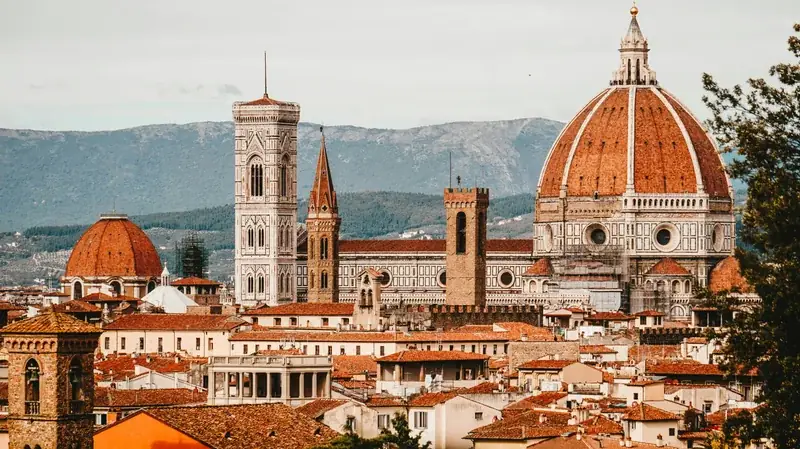
The skyline is anchored by the Cathedral of Santa Maria del Fiore and Brunelleschi's dome — the first great dome raised since ancient Rome, still climbable via 463 winding steps. Beside it rise Giotto's Bell Tower and the Baptistery of St. John, whose gilded bronze doors Michelangelo reportedly dubbed the "Gates of Paradise." Each has a story of ambition, rivalry, and engineering nerve that an audio guide can tell you on the spot.
Cathedral of Santa Maria del Fiore
Gothic cathedral topped by the world's largest masonry dome, a feat of Renaissance engineering.
Brunelleschi's dome
Double-shell brick dome engineered without wooden scaffolding, crowning a Renaissance cathedral above the city.
Giotto's Bell Tower
Gothic marble bell tower with geometric patterns, sculpted reliefs and city views from the top.
Baptistery of St. John
Octagonal baptistery famed for gilded bronze doors and a glittering Byzantine mosaic ceiling.
Art, power, and the Medici
For three centuries the Medici family bankrolled the artists who changed Western art, and their legacy is everywhere. The Uffizi Galleries hold the world's most comprehensive collection of Italian Renaissance painting — Botticelli's Birth of Venus, Leonardo, Caravaggio, Titian — while Michelangelo's 5.17-meter David, carved when he was in his twenties, draws pilgrims to the Galleria dell'Accademia. In Piazza della Signoria, an open-air sculpture gallery spreads beneath the crenellated tower of Palazzo Vecchio, the fortress-palace that has housed Florence's government since 1299.
Uffizi Galleries
Former offices turned art museum, holding one of the world's premier Renaissance collections.
Galleria dell’Accademia di Firenze
Domed gallery hall built to display a monumental marble hero, still bearing the scars of a riot.
Piazza della Signoria
Medieval square of Renaissance sculpture, stage for a preacher-turned-ruler's public execution.
Palazzo Vecchio
Fortified medieval palace and Medici seat, with soaring tower, grand halls and secret passages.
Across the Arno
Cross the Ponte Vecchio — Florence's oldest bridge, lined with goldsmiths' shops since the Middle Ages — and you reach the Oltrarno, where artisan workshops still practice leatherwork and bookbinding, and the vast Palazzo Pitti opens onto the Boboli Gardens. Climb at sunset to Piazzale Michelangelo for the classic panorama of dome, towers, and river.
Come for the art, stay for the life around it: bistecca alla fiorentina, ribollita, a gelato eaten on a warm piazza at dusk.
Give Florence at least two or three days. With an audio guide in your ears, every street corner — from Santa Croce's tombs of Michelangelo and Galileo to the stalls of Mercato Centrale — becomes a chapter in the story of how the modern world was imagined here.
Ponte Vecchio
Medieval stone bridge lined with goldsmith shops and a private elevated Medici corridor above.
Palazzo Pitti
Renaissance banker's palace turned grand ducal residence, with vast galleries and gardens behind it.
Boboli Gardens
Sprawling sixteenth-century formal garden of terraces, statues and fountains behind a Medici palace.
Piazzale Michelangelo
Hilltop terrace with sweeping panoramic views, ringed by bronze copies of Michelangelo's sculptures including David.