
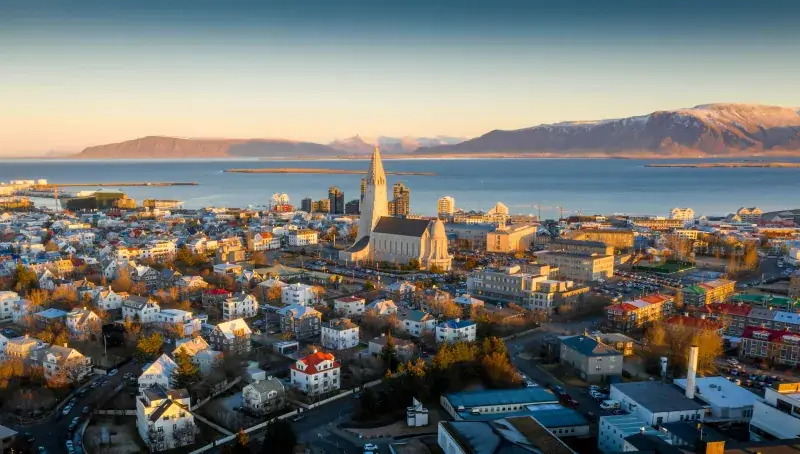

Reykjavik is the world's northernmost capital of a sovereign nation — a city of roughly 140,000 people on Faxaflói Bay, settled around 874 AD by the Viking chieftain Ingólfur Arnarson and still small enough to cross on foot in an afternoon. That compactness is exactly what makes it ideal for exploring with self-guided audio tours: press play, wander the colorful corrugated-iron streets at your own pace, and let each landmark tell its own story as you reach it.
A capital powered by the earth
Few cities wear their geology so openly. Reykjavik runs almost entirely on geothermal and hydroelectric energy, steam rises from public pools like Sky Lagoon on the shoreline, and even the architecture borrows from the landscape: Hallgrimskirkja, the 74.5-meter church that crowns the city, was designed in 1939 by Guðjón Samúelsson to echo Iceland's basalt columns and took more than four decades to complete. Its tower lift delivers a 360° panorama over rainbow-painted rooftops — and its audio guide unpacks why this concrete mountain divided the city before it came to define it.
From the harbour to the pond
Down on the waterfront, the glittering glass facade of Harpa Concert Hall — home to Iceland's symphony and opera — mirrors the sea in geometric panels inspired by the same basalt forms. A short stroll along Sæbraut brings you to the Sun Voyager, Jón Gunnar Árnason's polished-steel "dream boat" unveiled in 1990 for the city's 200th anniversary; it looks like a Viking ship but was conceived as an ode to sun, light, and hope, gazing across the bay toward Mount Esja. From the Old Harbour, whale-watching boats head out past the fish restaurants of the Grandi quarter, while inland the Tjörnin pond gathers City Hall, Parliament, and swans in one serene frame.
Harpa Concert Hall and Conference Centre
Glass-clad concert hall on the waterfront, its honeycomb facade shifting color with the northern light.
Sun Voyager
Stainless-steel dreamboat on granite, its raised prow aimed at the shoreline rather than the sunset its sculptor intended.
Tjörnin
Shallow city-center lagoon where ducks and swans crowd a geothermally warm corner all winter while the rest freezes for skaters.
Why visit
- Layers of story everywhere — from a 10th-century Viking longhouse excavated beneath the streets to 1,100 years of history at the National Museum of Iceland, each stop's audio guide turns a short walk into a saga.
- Nature at the doorstep — the Perlan dome on Öskjuhlíð hill holds a real ice tunnel and northern-lights planetarium; the Golden Circle and the Blue Lagoon are easy day trips.
- Big-city culture, small-town scale — more restaurants per capita than most European capitals, a legendary music scene, and a hot dog stand (Bæjarins Beztu Pylsur) with a cult following.
Come for a stopover, and Reykjavik will hand you a story on every corner — you just need headphones to hear it.
National Museum of Iceland
Antiquarian collection of medieval carvings, Viking-age silver, and saga-era artifacts.
Perlan
Glass dome atop six former hot water tanks, with a planetarium, a man-made ice tunnel, and a rotating rooftop restaurant.
Blue Lagoon
Milky-blue geothermal lagoon in a black lava field, fed by power-plant runoff rich in silica and minerals.
Bæjarins Beztu Pylsur
Streetside hot dog kiosk serving a lamb-beef-pork snack since nineteen thirty-seven, eaten standing up.