

Jakarta is Indonesia's capital and its largest city, home to about eleven million people inside the city limits and some forty million across the metro — a scale that earned it the nickname the Big Durian. It is loud, humid and endlessly traffic-bound, but underneath the flyovers lies one of the richest layered histories in Southeast Asia: a Hindu-era spice port called Sunda Kelapa, the walled Dutch company town of Batavia, and the capital where Indonesian independence was proclaimed in 1945. Our self-guided audio guides are built for exactly this kind of city, where the story is not always visible from the pavement.
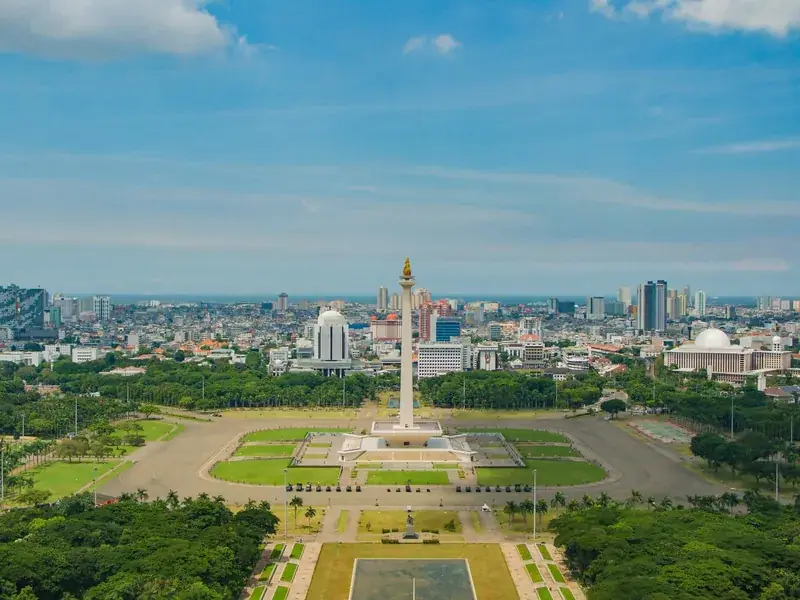
Start at the centre. The National Monument, or Monas, rises 132 metres from the middle of Merdeka Square, topped by a bronze flame once gilded with 35 kilograms of gold leaf (raised to 50 for the fiftieth anniversary of independence). President Sukarno drove the first pile himself on 17 August 1961, and the audio guide follows the long road from that gesture to the opening in 1975, then takes you down to the hall of 51 dioramas beneath it. Play it on the way up, and the view across the square makes sense.

Merdeka Square and the national axis
Merdeka Square was planned as the symbolic heart of the republic, and its edges still read like a statement of what the young nation wanted to be. On the north-east corner stands the Istiqlal Mosque, the national mosque, opened in 1978 and designed by Friedrich Silaban, a Christian architect who won the competition; its 45-metre dome nods to the year 1945, and its visitor gate faces straight across the street to the neo-Gothic Cathedral of Our Lady of the Assumption — the two are now even linked by an underground Tunnel of Friendship. On the west side, the National Museum of Indonesia holds the country's great archaeological and ethnographic collection in a colonial-era building locals still call the Elephant Building. Each has its own audio guide, so you can walk the square's perimeter and let the buildings explain themselves one by one.
Istiqlal Mosque
National mosque of marble and steel under a vast dome, built over seventeen years on a former fort.
Cathedral of Our Lady of the Assumption
Neo-Gothic church with twin iron spires, a Marian portal and a museum of archbishops' relics.
National Museum of Indonesia
Neoclassical museum of archaeology and ethnography, fronted by a bronze elephant from a Siamese king.
Kota Tua, the Old Batavia
A short ride north, the city changes century. Jakarta Old Town (Kota Tua) is what remains of the Dutch East India Company's Batavia, founded in 1619 after the VOC destroyed the earlier town of Jayakarta. Its centre is Taman Fatahillah, the old town square, named after the Demak commander who captured the port in 1526. The former city hall on its south side is now the Jakarta History Museum, and the audio guide uses it as the hinge of the whole district — the governors who ruled from its upper floor, the dungeons underneath, the epidemics that eventually emptied the old city. Around the square sit the Wayang Museum, with its shadow puppets on the site of Jan Pieterszoon Coen's tomb, the marble halls of the Museum Bank Indonesia in the former De Javasche Bank, and Café Batavia, a restored 1830s building where the colonial ambience comes with the coffee. The district was declared heritage in 1972, left to decay for decades, and finally revitalised between 2005 and 2022, which is why it looks so freshly scrubbed today.
Jakarta Old Town
Historic Dutch colonial quarter of canals, merchant houses and a town-hall square from the VOC era.
Taman Fatahillah
Colonial city hall square where Dutch Batavia once held public executions, now a lively plaza.
Jakarta History Museum
Former Dutch colonial town hall, courtroom and jail with dungeons beneath its portico.
Wayang Museum
Puppet museum holding thousands of wayang on the site of a colonial church and its burial ground.
Museum Bank Indonesia
Neo-Renaissance former central bank housing galleries of currency, monetary history and gold bullion.
Café Batavia
Nineteenth-century colonial house turned 1930s-style restaurant and bar overlooking a historic square.
Sunda Kelapa and the Kali Besar canal
Keep walking north along the Kali Besar canal and you reach the place where Jakarta began. Sunda Kelapa Harbour was the port of the Sunda Kingdom by the fourteenth century, and today it is still a working harbour where wooden phinisi schooners load cargo for the outer islands much as they have for centuries. The VOC's seventeenth-century spice warehouses next door now house the Museum Bahari (Maritime Museum), and on the canal itself stands Toko Merah, the red-brick eighteenth-century mansion of Governor-General van Imhoff. These three stops string together into one audio walk: the harbour, the warehouses that fed it, and the house of the man who grew rich from them.
Sunda Kelapa Harbour
Old harbour of painted wooden pinisi schooners, still loaded and unloaded by hand.
Museum Bahari (Maritime Museum)
Colonial spice warehouses and an old harbour lookout tower, now a museum of seafaring history.
Toko Merah
Red-fronted canal-side mansion from around 1730, once a naval academy, hotel and Chinese merchant's shop.
Glodok, the oldest Chinatown
West of the old square, the VOC designated a Chinese quarter in 1741, and it has never moved. Chinatown Kawasan Pancoran Glodok is a dense tangle of medicine shops, noodle stalls and electronics arcades, and the audio guide walks you through the alleys to Petak Sembilan Market and on to the incense-dark courtyards of Dharma Bakti Temple, among the oldest Chinese temples in the city. It is the best place in Jakarta to understand how Chinese, Betawi and Dutch histories fused into the city's own culture — and to eat.
Chinatown Kawasan Pancoran Glodok
Historic Chinatown corner of shophouses, temples and a tea house pouring free tea from eight pots.
Petak Sembilan Market
Chinatown wet market of tarp-roofed lanes selling softshell turtles, live eels, herbs and festival goods.
Dharma Bakti Temple
Oldest Chinese temple in the old Chinatown, founded for the goddess of mercy and rebuilt after fire.
Menteng and the modern city
South of Merdeka Square the capital turns twentieth-century. Menteng was laid out in the 1910s as a garden-city suburb for the colonial middle class, and its tree-lined streets of Art Deco villas are still the city's most elegant walking ground. The road south leads to the Selamat Datang Monument at the Hotel Indonesia roundabout, the waving welcome statue Sukarno commissioned for the 1962 Asian Games, now ringed by the glass towers of the business district. Further west, Museum MACAN shows modern and contemporary Indonesian art alongside international names — a reminder that Jakarta is also one of Asia's liveliest contemporary art scenes.
Menteng
Leafy colonial-era garden suburb of tiled-roof villas, boulevards, parks and a heritage-protected plan.
Selamat Datang Monument
Bronze couple waving flowers atop a fountain roundabout, built to greet the 1962 Asian Games.
Museum MACAN
Private museum of modern and contemporary Indonesian and international art from a collector's holdings.
Beyond the centre: Ancol and Taman Mini
Jakartans themselves spend weekends at the water's edge or in the parks. Ancol Taman Impian on the north coast is a sprawling waterfront of beaches, an art market, an aquarium and the Dufan amusement park. Out east, Taman Mini Indonesia Indah was conceived as a cultural showcase of the whole archipelago, with full-scale traditional houses from every province around a lake shaped like the map of Indonesia — the easiest way to glimpse Papua, Toraja and Bali in one afternoon. In the south, Ragunan Zoo offers shade and orangutans in a vast green park.
Ancol Taman Impian
Seaside amusement park and resort with rides, beaches and an art market of open painters' studios.
Taman Mini Indonesia Indah
Cultural theme park of provincial pavilions ringing a lake with a miniature island archipelago.
Ragunan Zoo
Sprawling forested zoo with a primate center where gorillas roam beneath a raised bridge.
Getting around
Jakarta's traffic is legendary, so plan by district rather than by distance. The MRT runs north–south from Bundaran HI through Menteng and the business district; TransJakarta busways cover far more of the city, including Kota Tua, and ride-hailing apps are cheap for everything else. Each of the districts above can be explored on foot once you arrive, which is how the audio guides are meant to be used — download them, put the phone away, and listen.