
Düsseldorf is the Rhineland's city of contrasts: a medieval Old Town packed with brewery taverns, a boulevard of designer boutiques a few streets away, a harbour rebuilt by star architects, and the largest Japanese community in Germany. It received its town charter on 14 August 1288, after the Battle of Worringen, and spent its grandest years as the seat of Elector Johann Wilhelm II, whose art collection later left for Munich but whose taste still shapes the city's museums and palaces.
It is a compact, flat city that rewards exploring at your own pace. The highlights below each have a self-guided audio guide that tells the story behind what you are looking at, so you can move between the Rhine, the Altstadt and the galleries in any order and still hear how it all fits together.
Start in the Altstadt, the longest bar in the world
The Altstadt is nicknamed the "longest bar in the world" because roughly 300 bars and restaurants are squeezed into less than a quarter of a square mile. The drink is Altbier, a copper-coloured, top-fermented beer served in a small 250 ml Becher glass; the waiter marks a pencil stroke on your beer mat for every round. Four taverns in the Old Town still brew it on site. Uerige, with its stained-glass windows and cavernous rooms, is one of the city's oldest, and Füchschen is the largest Altbier brewery in town. Between pints, the twisted spire of the Basilika St. Lambertus marks the oldest corner of the city, and the audio guides for the brewery houses and the basilica explain how a riverside market town became the capital of North Rhine-Westphalia.
Altstadt
Historic riverside quarter of cobbled lanes, Baroque churches and a lone surviving castle tower.
Uerige
Historic house brewery serving bitter, top-fermented Altbier in wood-panelled rooms since 1862.
Brewery Füchschen
Family-run Altbier house brewery rebuilt after wartime bombs, once a haunt of artists and actors.
Basilika St. Lambertus
Gothic brick basilica with a twisted spire, ducal crypt and a lavish Renaissance marble tomb.
The Rhine, the tower and the Gehry harbour
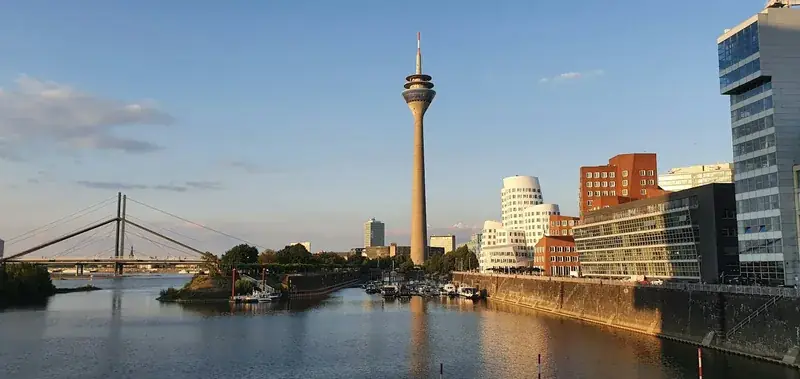
A broad, tree-lined promenade runs along the river below the Old Town, and locals head here at sunset. Follow it south and the Rhine Tower takes over the skyline: 240 metres tall, with an observation deck at 164.5 metres and a restaurant one level above it offering 360-degree views. Just beyond lies the Medienhafen, the former harbour that has become a business district of media, fashion and finance firms. Its centrepiece is Frank Gehry's Neuer Zollhof, three riverside towers that seem to lean and ripple in different skins. The audio guides here trace the harbour's conversion from working docks to showcase architecture.
Rheinuferpromenade Düsseldorf
Tree-lined riverside walk along the Rhine, laid over a stacked road tunnel beneath the old town.
Rhine Tower
Slender concrete telecom tower with a revolving restaurant and a giant light clock on its shaft.
Medienhafen Düsseldorf
Former river port turned office and dining quarter, anchored by a listed flour mill and grain silos.
Neuer Zollhof
Three leaning, curving towers in white render, mirror-like steel and red brick beside the harbour.
Königsallee and the Hofgarten
The Königsallee, or simply the "Kö", is a double-sided avenue with a canal running down the middle and a strip of parkland on either bank, lined with cafés and designer boutiques. It is Düsseldorf's luxury shopping street, but also one of its most elegant walks. At its northern end the boulevard opens into the Hofgarten, the city's central park, which ties the shopping district back to the Old Town and the museum quarter.
K20, K21 and the Kunstpalast
Düsseldorf's art credentials run deep. The Kunstsammlung Nordrhein-Westfalen is split across two houses: K20, behind a polished black stone façade, holds twentieth-century work by Kandinsky, Matisse, Picasso and Klee alongside post-1945 American art, while K21 occupies a nineteenth-century building and shows international artists working after 1980. The Museum Kunstpalast spans the Middle Ages to the present, with German Expressionists, works by Rubens and one of Europe's finest glass collections. The Kunstakademie Düsseldorf trained Joseph Beuys, Gerhard Richter, Sigmar Polke and Andreas Gursky, and its audio guide explains why this city, not Berlin, became the school of post-war German art.
Kunstsammlung Nordrhein-Westfalen
State art museum of twentieth-century masterpieces behind a curved façade of polished black granite.
Kunstsammlung
Contemporary art museum in a former parliament building, crowned by a glass and steel dome.
Museum Kunstpalast
Art museum in a 1920s exhibition palace, spanning antiquity to modern art plus a major glass collection.
Kunstakademie Düsseldorf
State art school where Joseph Beuys taught, cradle of a world-famous school of photography.
Little Tokyo and the Japanese Garden
Around 11,000 Japanese people live in the wider Düsseldorf area, the largest such community in Germany, with over 6,000 Japanese nationals in the city proper. Little Tokyo clusters along Immermannstraße, where ramen bars, bookshops and grocery stores sit a short walk from the main station. The connection is visible in the parks too: the Japanese Garden in Nord Park opened in 1975 as a gift to the city, and it is one of the quietest places in Düsseldorf to sit with an audio guide.
Little Tokyo Düsseldorf
Japanese quarter of ramen bars, sushi, grocers and bookshops, with bilingual street signs.
Japanese Garden
Pond garden of koi, clipped cloud pines, stone bridge and island, gifted by a Japanese community.
Nord Park
Geometric nineteen-thirties park with long water basins, horse-tamer sculptures and a Japanese garden.
Schloss Benrath and Kaiserswerth
Two trips to the edges of the city reach back furthest in time. Schloss Benrath, in the south, is a pink Baroque pleasure palace built between 1755 and 1770 for Elector Charles Theodore by his architect Nicolas de Pigage, with a hunting park and two museums in its wings. In the north, Kaiserpfalz Kaiserswerth is the ruined imperial palace that Emperor Frederick Barbarossa fortified to watch traffic on the Rhine; the village around it, with its own riverside taverns, only became part of Düsseldorf in 1929.
Getting around
The centre is walkable: Altstadt, Königsallee, Hofgarten and the museum quarter are all within fifteen minutes of each other on foot. The Rhine Tower and Medienhafen are a half-hour riverside stroll from the Old Town, and both Benrath and Kaiserswerth are reached by the city's U-Bahn and S-Bahn lines.