
The Medieval City the Sea Left Behind
Bruges is what happens when a boom town falls asleep for four centuries. In the 1400s this was one of the great trading capitals of northern Europe — a Hanseatic hub where Italian bankers, Spanish wool merchants and Flemish weavers made fortunes along its canals. Then, around 1500, the Zwin channel that linked the city to the sea silted up, commerce drifted to Antwerp, and Bruges was left almost perfectly intact: a UNESCO World Heritage city of step-gabled houses, cobbled lanes and swan-patrolled waterways. It is a city built for slow discovery — and with a self-guided audio tour in your ears, every tower and quayside tells you its story the moment you reach it, at your own pace.
"For centuries the canals of Bruges have linked the city to the sea, a guarantee of wealth and prosperity." — Visit Bruges
A skyline built by merchants
Start on the Markt, where the 13th-century Belfry of Bruges rises 366 steps above the rooftops, its 47-bell carillon still ringing across town — the audio guide unpacks how one tower doubled as watchtower, treasury and civic archive. A minute's walk away lies the Burg, the city's seat of power for a thousand years, home to the Gothic City Hall and the Basilica of the Holy Blood, which guards a relic of Christ's blood brought back from the Second Crusade by Count Thierry of Alsace. Further south, the Church of Our Lady lifts its 115.6-metre brick spire — the second-tallest brick tower in the world — above a treasure few expect: Michelangelo's Madonna and Child, believed to be the only sculpture of his to leave Italy during his lifetime.
Market Square
Cobbled medieval square where Hanseatic merchants once traded, ringed by stepped gables and a leaning bell tower.
Belfry of Bruges
Medieval bell tower and treasury leaning over a market square after centuries of settling.
De Burg
Grand medieval square once the seat of Flanders' counts, ringed by Gothic and Renaissance civic landmarks.
Bruges City Hall
Gothic council chamber where early twentieth-century murals repaint a trading empire that vanished four centuries earlier.
Basilica of the Holy Blood
Twin Romanesque and Gothic chapel guarding a relic venerated as Christ's own blood.
Church of Our Lady
Gothic church with the world's second-highest brick tower and a marble Madonna by Michelangelo.
Canals, swans and quiet corners
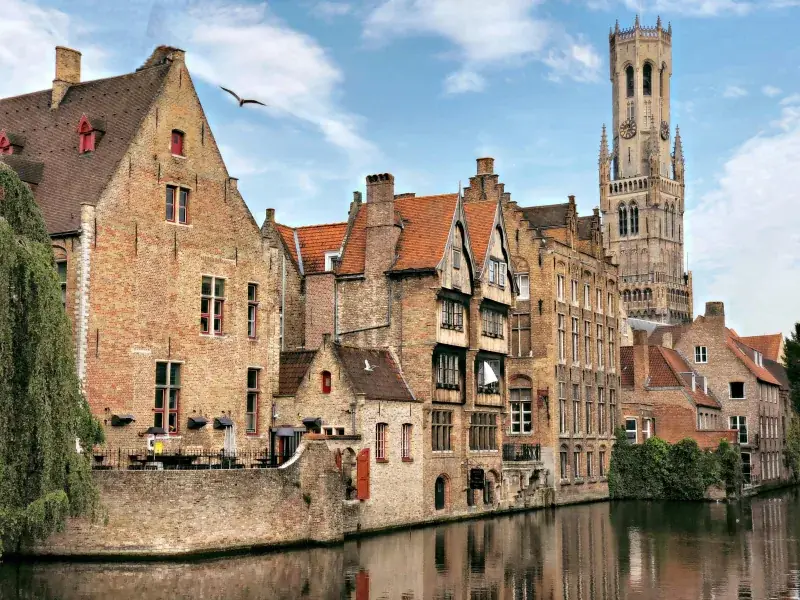
The canals are Bruges' bloodstream — the reason it is called the "Venice of the North" — and no viewpoint captures them better than the Rosary Quay (Rozenhoedkaai), the city's most photographed corner. Follow the water south past the Gruuthuse palace to the Lake of Love (Minnewater) and the walled hush of the 13th-century Beguinage "Ten Wijngaerde", part of the Flemish Beguinages World Heritage site, where whitewashed houses circle a poplar-shaded green. Each stop's history plays in your headphones as you arrive — no group, no schedule.
Rosary Quay
Canal-corner quay where medieval salt barges once docked, now the city's most photographed reflection of gabled rooftops.
Lake of Love
Willow-lined park lake where a fixed number of swans has floated since a fifteenth-century execution.
Beguinage "Ten Wijngaerde"
Walled village of single women who financed their own lives through lace work and nursing care.
Flemish masters, beer and chocolate
Bruges was a cradle of Renaissance art north of the Alps: the Groeninge Museum hangs Jan van Eyck and the Flemish Primitives just steps from the canals they painted. Between landmarks, the city runs on pleasure — chocolate shops on nearly every lane, and the historic De Halve Maan brewery still brewing inside the old town. Compact, flat and made for wandering, Bruges rewards a day and enchants over two. Press play and let the medieval city talk.