
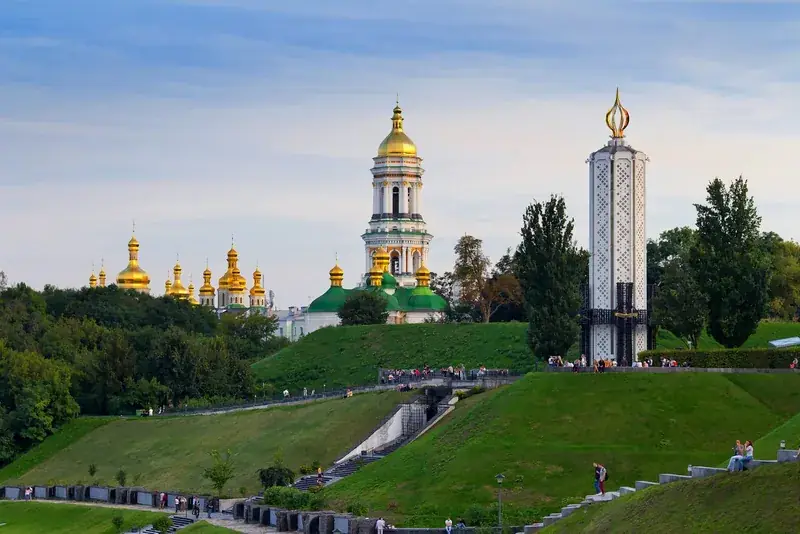

Kyiv is the capital of Ukraine and the cradle of Kyivan Rus, a city of golden domes stacked along the steep right bank of the Dnipro. Eleventh-century cathedrals stand a few streets from Soviet monumental boulevards and a young café-and-gallery scene, and the city's story runs from medieval princes through the Revolution of Dignity on the Maidan to the present day. It is a city with a lot to say, and the self-guided audio guides here let each landmark tell its own chapter as you reach it.
The centre is compact enough to explore on foot, with the funicular and one of the deepest metros in the world to spare your legs on the hills. Spring, when the chestnut trees along Khreshchatyk bloom, and the long golden evenings of early autumn are the kindest seasons for walking between the sights.
Sophia Square and the Golden Gate
Start in the old upper town, where St. Sophia's Cathedral has stood since the 11th century. Built under Grand Prince Yaroslav the Wise, who is buried inside, it keeps its original mosaics and frescoes beneath thirteen cupolas, and the 76-metre bell tower gives one of the best views in the centre: the Maidan to one side, Podil to the other and the blue walls and gold domes of St. Michael's Golden-Domed Monastery straight ahead across the square. The two cathedrals face each other, so the audio guides for both flow naturally into one walk. A short stroll along Volodymyrska Street brings you to the Golden Gate, the ceremonial entrance to Yaroslav's fortified city, rebuilt in 1982 over the medieval remains and now home to a small museum and a bronze statue of the prince himself.
St. Sophia's Cathedral
Eleventh-century cathedral of gold mosaics and frescoes, its walls scratched with medieval graffiti.
St. Michael's Golden-Domed Monastery
Rebuilt blue-and-gold monastery beside an early eighteenth-century refectory church that outlived it.
Золоті ворота
Rebuilt medieval fortress gateway sheltering eleventh-century brick ruins and a small museum.
Down Andriivskyi Descent to Podil
From the upper town the cobbled Andriivskyi Descent winds steeply down to the river, past artisan stalls, galleries and cafés. It earns its nickname as Kyiv's Montmartre, and it begins beneath the turquoise domes of St. Andrew's Church, the baroque landmark Bartolomeo Rastrelli designed in the 18th century. On the way down you pass the neo-Gothic tower of the Castle of Richard Lionheart and the house where Mikhail Bulgakov grew up, now the Bulgakov Museum. At the bottom lies Podil, the historic merchant quarter around Kontraktova Square, once the city's trading heart and today its most relaxed district of bars, creative spaces and riverside walks.
Andriivs'kyi descent
Steep cobbled lane of art stalls and historic houses winding from a baroque church to the old port.
St. Andrew's Church
Hilltop Baroque church by Rastrelli with green-and-gold domes, famed for having no bells.
Castle of Richard Lionheart
Neo-Gothic apartment house of towers, spires and battlements on a steep historic hillside street.
BULGAKOVA MUSEUM
Writer's family home, where real heirlooms mingle with white-painted objects from his novel.
Podil
Historic riverside merchant quarter of baroque churches, cobbled streets and an old fountain square.
Kontraktova Square
Historic riverside market square where a great winter trade fair once sealed grain and estate deals.
Pechersk: the Lavra and the Motherland Monument
South along the river bluffs is Kyiv-Pechersk Lavra, the monastery Saint Anthony founded as a cave hermitage in 1051. The gold-domed churches were built above ground over the centuries; beneath them the caves hold the relics of the monks who lived and were buried there, and the whole complex is a UNESCO World Heritage site that rewards a few hours. The audio guide walks you from the Upper Lavra down to the caves and explains what you are looking at. Beyond the monastery walls the Ukrainian Motherland Monument raises her sword and shield over the Dnipro: a 62-metre titanium figure, over a hundred metres with its base, whose shield holds a viewing terrace. She stands at the National Museum of the History of Ukraine in the Second World War, the memorial complex at her feet.
Kyiv-Pechersk Lavra
Cave monastery of gilded domes, underground passages and monks' relics above the Dnipro.
Ukrainian Motherland Monument
Colossal stainless-steel woman with sword and trident shield, towering over a Second World War museum.
National Museum of the History of Ukraine in the Second World War
War museum beneath a towering stainless-steel woman holding a sword and a trident-emblazoned shield.
Khreshchatyk and the Maidan
Khreshchatyk is the city's main street, rebuilt after 1945 in grand Soviet style and closed to cars at weekends, when it fills with performers and strollers under the chestnuts. It opens onto Independence Square, the Maidan, where the protests of the winter of 2013-14 became the Revolution of Dignity; the audio guide tells that story on the spot where it happened. Two curious buildings sit nearby: the Gorodetsky House, better known as the House with Chimeras for the concrete elephants, mermaids and frogs crawling over its façade, and the Bessarabian Market, a 1912 covered hall at the top of Khreshchatyk where you can taste the city's food.
Khreschatyk Street
Broad main boulevard of post-war Stalinist facades, closed to cars on weekends for shows.
Independence Square
Vast central square and protest heart of two revolutions, crowned by a column topped with a guardian figure.
Gorodetsky House
Art Nouveau mansion swarming with cement rhinos, elephants and frogs, built by a big-game hunter.
Bessarabian market
Glass-roofed Art Nouveau market hall from 1912, stacked with salo, pickles, meat and local produce.
The Dnipro, the hills and the parks
Kyiv's right bank is a chain of green hills, and the best way between the upper town and Podil is the century-old Kyiv Funicular. At the top, Volodymyr Hill is laid out around the monument to Prince Volodymyr, who brought Christianity to Rus, with wide views over the river. Follow the bluffs south across the Glass Bridge, the pedestrian span with see-through panels, to the government quarter and the baroque Mariyinsky Palace, the ceremonial residence Rastrelli designed for Empress Elizabeth. Below you, Trukhaniv Island stretches out in the river with beaches and cycle paths, reached by a pedestrian bridge from the bank.
Kiev Funicular
Cable railway from 1905 linking the hilltop old town to the riverside district below.
Володимирська Гірка
Terraced hillside park above the river, crowned by a nineteenth-century bronze prince on an iron pedestal.
Glass Bridge
Steel footbridge with glass floor panels over a busy descent, framing views of the Dnipro and Podil.
Mariyinsky Palace
Baroque palace above the Dnipro, rebuilt after fire and now used for state ceremonies.
Trukhaniv Island
Wooded river island of sandy beaches and trails, reached by a footbridge across the river.
Getting around
The metro is cheap, fast and a sight in itself: Arsenalna, the station for the Lavra, is among the deepest in the world at 105.5 metres, and the long escalator ride is part of the experience. Most of the central landmarks are within walking distance of each other, so the simplest plan is to pick a hill, start the audio guide and let the city unfold street by street.