
Bratislava is the small capital that spent two and a half centuries as a very big one. When the Ottomans took the old Hungarian coronation town, the crown moved here: from 1563 to 1830 the kings and queens of Hungary were crowned in St. Martin's Cathedral, and for most of that time this city on the Danube (then called Pressburg, Pozsony or Prešporok, depending on who you asked) was the kingdom's capital. Today it is the only capital in the world that borders two other countries, Austria to the west and Hungary to the south, and Vienna is barely an hour away by boat.
That history is packed into a compact, walkable Old Town of Baroque palaces, cobbled lanes and street cafés, with a castle on the hill above and a flying saucer on the bridge below. It is a city you can cover in a day or two, which is exactly what makes self-guided audio guides work so well here: every landmark is a few minutes from the next, and each one has a story (a treaty signed, a king crowned, a bridge built to look like a spaceship) that the audio guide tells you as you stand in front of it.

The coronation city
Start where the kings did. St. Martin's Cathedral, the Gothic church at the edge of the Old Town, hosted the coronations of eleven kings and queens and eight consorts, Maria Theresa among them in 1741, and still wears a gilded replica of the Crown of St. Stephen on top of its tower. Brass crowns set into the pavement trace the procession route the new monarchs followed through the streets. A few steps away, the Neoclassical Primacial Palace was built in the 1770s for the Archbishop of Esztergom; in December 1805 Napoleon and Emperor Franz signed the Peace of Pressburg in its Hall of Mirrors. The Old Town's medieval walls once had four gates, and Michael's Gate, fourteenth-century at its base and Baroque since a 1759 remodel, is the only one left standing, with a viewpoint on its upper floor and the city's prettiest street running beneath it.
St. Martin's Cathedral
Gothic coronation church of Hungarian kings, its tall spire topped by a gilded replica crown.
Primacial Palace
Neoclassical archbishop's palace with a Hall of Mirrors and rare English tapestries.
Michael's Gate
Last surviving medieval town gate, crowned by a baroque tower and a statue of the Archangel Michael.
Hlavné námestie and the Old Town Hall
The heart of the Old Town is Hlavné námestie, the main square, ringed by café terraces and home to the Christmas and Easter markets. On one side stands the Old Town Hall, knitted together from merchants' houses in the thirteenth century around a Renaissance courtyard from 1581; climb its tower for a view over the rooftops. In the middle of the square, Maximilian's fountain is the oldest in the city, raised under the first king to be crowned here. The audio guides for the square untangle who built what, and why the Napoleonic soldier is leaning on a bench nearby.
Hlavné námestie
Historic market square ringed by palaces, with a Renaissance knight fountain and the old town hall.
Old Town Hall
Medieval town hall with a Baroque tower, a lodged Napoleonic cannonball and the city museum inside.
Maximilian's fountain
Renaissance stone fountain crowned by an armoured knight, ringed by cheeky putti on the main square.
Čumil and the street statues
Bratislava has a habit of putting bronze characters at street level. The most famous is Čumil, the sewer worker peering out of a manhole at the corner of Laurinská and Panská, whose purpose nobody has ever explained. Along the main square you will meet Schöne Náci, the top-hatted dandy who greeted ladies on these streets for decades, and the Napoleonic soldier resting his elbows on a bench. They are small, easy to miss, and each one comes with a story worth hearing.
Čumil Statue
Bronze figure of a grinning man peeking out of a manhole on a busy pedestrian corner.
Schöne Náci
Life-size aluminium statue of a top-hatted street dandy raising his hat to passers-by.
Estátua do Soldado de Napoleão
Bronze Napoleonic soldier in bicorne hat leaning on a square bench, a favourite photo companion.
Bratislava Castle and the view from the hill
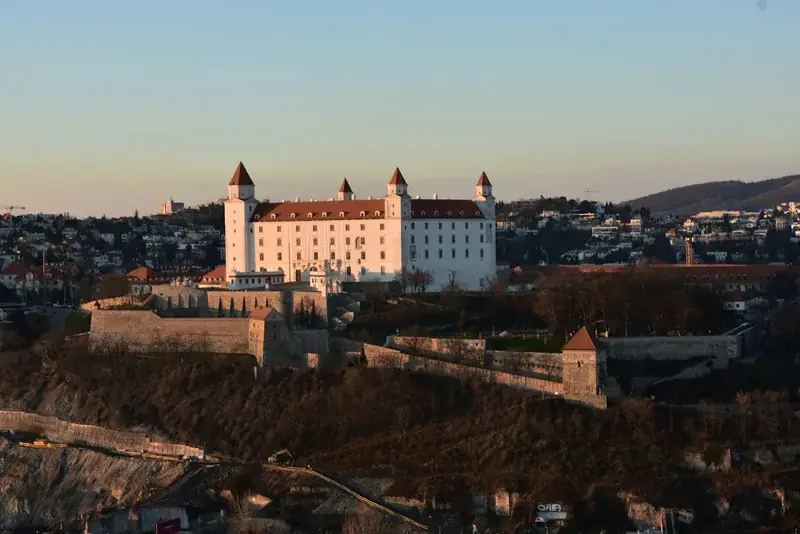
Bratislava Castle is the boxy, four-towered silhouette on the hill above the river. The site was fortified thousands of years ago; the castle you see is a 1950s reconstruction of Emperor Sigismund's fifteenth-century fortress, which burned down in 1811 and stood in ruins for more than a century. In the 1500s it held the Hungarian crown jewels, and it now houses the Slovak National Museum's history collections. On a clear day the ramparts look out over three countries. Further up the hill, the white pylon of Slavín, unveiled in 1960 above the graves of 6,845 Soviet soldiers who died liberating the city in 1945, gives the other classic skyline view.
The Blue Church and Hviezdoslav's promenade
East of the Old Town, the Blue Church (officially the Church of St. Elizabeth) looks like it was made of icing: pale blue walls, white trim and a glazed blue-tile roof, designed by Ödön Lechner in the 1910s in the Hungarian Secessionist style. Back towards the river, Hviezdoslavovo námestie is the tree-lined promenade running from the bridge to the Neo-Renaissance Slovak National Theatre of the 1890s, with the outsized statue of the poet Hviezdoslav halfway along. It is the evening stroll the whole city takes.
The Blue Church - Church of St. Elizabeth
Art Nouveau church clad in pale blue majolica, with a glazed ceramic roof and slender round tower.
Hviezdoslavovo námestie
Tree-lined promenade square with fountains, a bronze poet's monument and the historic opera house.
Slovak National Theatre (Historical Building)
Neo-Renaissance opera and ballet house by Fellner and Helmer, opened in 1886 on a historic square.
Across the Danube: the UFO and beyond
The SNP Bridge opened in 1972 and locals have called it the UFO Bridge ever since, for the saucer perched on its single pylon. The UFO Observation Deck inside it, roughly 95 metres up, delivers the best view in Bratislava, partly, as the joke goes, because the bridge itself is not in it. Across the water in Petržalka, Sad Janka Kráľa was laid out in 1774–1776 and claims to be the oldest public park in Central Europe; its Gothic gazebo is the top of a dismantled Franciscan church tower. Ten kilometres upstream, the ruins of Devín Castle sit on a cliff where the Morava meets the Danube, on a site occupied since the fifth century BC and blown up by Napoleon's troops in 1809.
UFO Observation Deck
Saucer-shaped deck and restaurant atop a cable-stayed bridge pylon, high above river and old town.
Sad Janka Kráľa
Riverside landscape park from the 1770s with rare exotic trees, old plane trees and a Gothic gazebo.
Múzeum mesta Bratislavy – Hrad Devín
Clifftop castle ruins above the Danube and Morava confluence, a cradle of Slovak national memory.
Getting around
The Old Town is pedestrianised and everything in it is within a ten-minute walk; the castle is a fifteen-minute climb from the main square. Trams and buses reach Slavín, Petržalka and Kamzík, bus 29 runs out to Devín, and a hydrofoil from the embankment takes you to Vienna in about ninety minutes.