
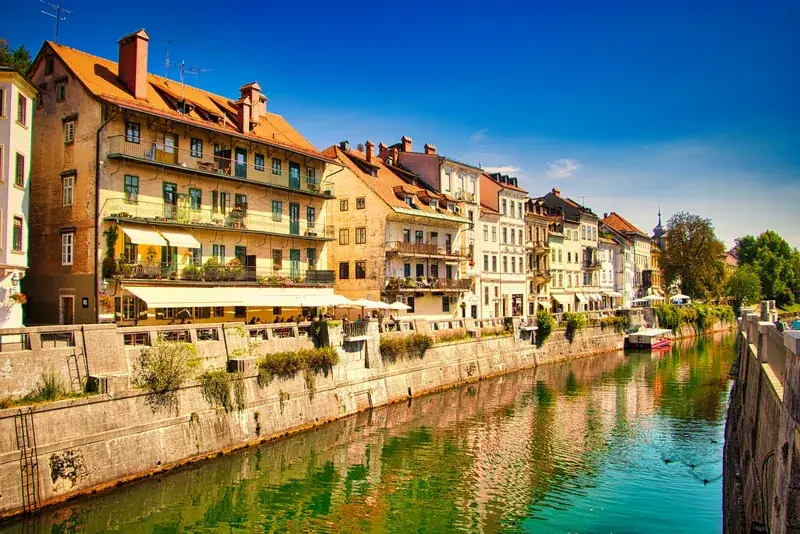
Ljubljana is the small, green capital of Slovenia — a city of about 300,000 people folded around a bend of the Ljubljanica river, with a castle on the wooded hill above and the Alps on the horizon. Romans built a camp here around 50 BC that grew into the colony of Emona; a Renaissance town rose after the 1511 earthquake, and when another quake levelled a tenth of the city in 1895, the rebuilding left behind whole streets of Vienna Secession facades. Then, between the wars, one architect — Jože Plečnik — reshaped the bridges, the market, the riverbanks and the library into the city you see today, work that UNESCO listed in 2021.
It is a compact place, but the stories are dense, and that is what makes Ljubljana ideal for exploring with self-guided audio guides: you can cross the river a dozen times in an afternoon, and nearly every crossing, square and facade has a tale worth hearing on the spot. The emblem everywhere is the dragon — on the castle tower, on the city crest and, most famously, on its bridge.

Start at Prešeren Square and the Triple Bridge
Every visit begins on Prešeren Square, the open-air living room of the city, watched over not by a king or general but by a poet: France Prešeren, author of the national anthem, gazes across at the window of the woman he loved. The pink Baroque Franciscan Church of the Annunciation fills one side of the square, and on the other the Triple Bridge fans out across the river — a stone span of 1842 to which Plečnik added two flanking footbridges in the early 1930s, turning a road crossing into a stage. Stand in the middle with an audio guide and you'll understand how the whole old town is arranged around this one spot.
Prešernov trg
Riverside main square around a bronze poet and muse, framed by Art Nouveau facades and a Franciscan church.
Triple Bridge
Trio of stone-balustraded river bridges fanning out like a funnel, with stairs down to the water.
Franciscan Church of the Annunciation
Pink Baroque church with a Robba high altar and illusionistic ceiling frescoes from the 1930s.
Plečnik's riverbank: the market, the Cobblers' Bridge and the library
Follow the Ljubljanica and you are following Plečnik. Downstream from the Triple Bridge, his riverside colonnade of 1940–44 houses the Central Market, where the halls and the open squares behind them sell honey, cheeses, sausages and bread Monday to Saturday. Upstream, the broad, pillared Cobblers' Bridge replaced the wooden span where the city's shoemakers once worked. A few streets back from the river stands his masterpiece, the National and University Library, its facade a patchwork of brick and raw stone and its reading room reached through a deliberately dark staircase that opens into light. Each of these has its own audio guide, and together they explain why a single architect is so often called the maker of modern Ljubljana.
Central Market
Curving riverside colonnade of market halls with a fish market at the waterline and open-air stalls.
Cobblers' Bridge
Balustraded stone footbridge by Plečnik, lined with columns and lamps over a medieval river crossing.
National and University Library
Brick-and-stone library with a black marble colonnaded stair rising to a sunlit reading room.
Up to the castle, down through the Old Town
From Krekov Square a funicular climbs to Ljubljana Castle in about a minute; the walk up from Stari trg takes ten. The castle grounds are free, the viewing tower gives the best panorama of the red roofs and the mountains beyond, and the Chapel of St George and the Virtual Time Machine fill in the fortress's thousand-year story. Come back down through the Old Town spine of Mestni trg, Stari trg and Gornji trg — a 700-metre run of cobbles, Baroque facades and courtyards. On Mestni trg the Town Hall opens its courtyard on weekdays, and in front of it the Robba Fountain, a Baroque copy of Francesco Robba's 1751 original (now in the National Gallery), represents the three rivers of Carniola. Just behind the market, the Cathedral of St Nicholas, rebuilt in Baroque style in 1701–06, hides frescoed vaults behind its famous bronze doors.
Ljubljana Castle Funicular
Cable-hauled glass-walled cabin gliding up a hillside from the market square to a medieval fortress.
Town Hall
Baroque civic hall with a Venetian-style gable, clock tower, loggia and arcaded fountain courtyard.
Robbov vodnjak
Baroque obelisk fountain with three marble river gods pouring water from jugs beside the town hall.
Roman Catholic Cathedral of St. Nicholas
Baroque cathedral with a green dome, painted ceilings and bronze doors cast with bishops and history.
Stari trg
Cobbled old market street of Baroque townhouses, small shops and cafés beneath the castle hill.
Gornji trg
Sloping medieval old-town street of narrow houses, climbing to a Baroque church built after a fire.
Dragons, butchers and the far bank
At the end of the market colonnade the Dragon Bridge sweeps across the river — built in 1900–01 as the city's first reinforced-concrete structure, and guarded at each corner by a verdigris copper dragon that has become the symbol of Ljubljana. Between the market and the Dragon Bridge the newer Butchers' Bridge carries modern bronze sculptures and a railing of padlocks; the audio guide for each tells how the river crossings here went from medieval necessity to civic showpiece.
Tivoli Park and the museum quarter
Fifteen minutes' walk west of Prešeren Square, Tivoli Park is the city's great green lung — tree-lined promenades, flower gardens and a pond, with the woods of Rožnik hill rising behind. The Jakopič Promenade through the park doubles as an outdoor photography gallery. On its edge sit the two big art collections: the National Gallery of Slovenia, home to the original Robba Fountain and the country's best medieval-to-impressionist painting, and the Museum of Modern Art for the twentieth century.
Tivoli Park
Sprawling wooded city park with tree-lined promenades, a hillside mansion and an old alpine-style inn.
Jakopič Promenade
Broad sandy park avenue lined with lamps and benches, doubling as an open-air photo gallery.
National Gallery of Slovenia
National art museum spanning medieval to early modern works, including Slovene Impressionist landscapes.
Museum of Modern Art Ljubljana
National museum of modern art in a symmetrical wartime-delayed building with skylit halls.
Metelkova and the city after dark
Ten minutes from the railway station, the former Austro-Hungarian barracks of Metelkova were occupied by around 200 volunteers in 1993 to stop their demolition. The result is AKC Metelkova mesto, an autonomous cultural zone of murals, mosaics, sculptures, clubs and galleries that is quiet and strange by day and loud by night. Next door, in the renovated half of the same barracks, the Museum of Contemporary Art Metelkova (+MSUM) shows the art of the Yugoslav and post-Yugoslav decades.
Getting around
The centre is car-free and flat, so most of what you want is within a twenty-minute walk of the Triple Bridge; the castle funicular and the city buses cover the rest, and both are included in the Ljubljana Card along with the main museums. Spring to autumn, the riverside cafés spill onto the embankments, and the open-air food market Open Kitchen takes over Pogačarjev trg on Fridays — the best time to let an audio guide set the pace while you eat your way through the city.