
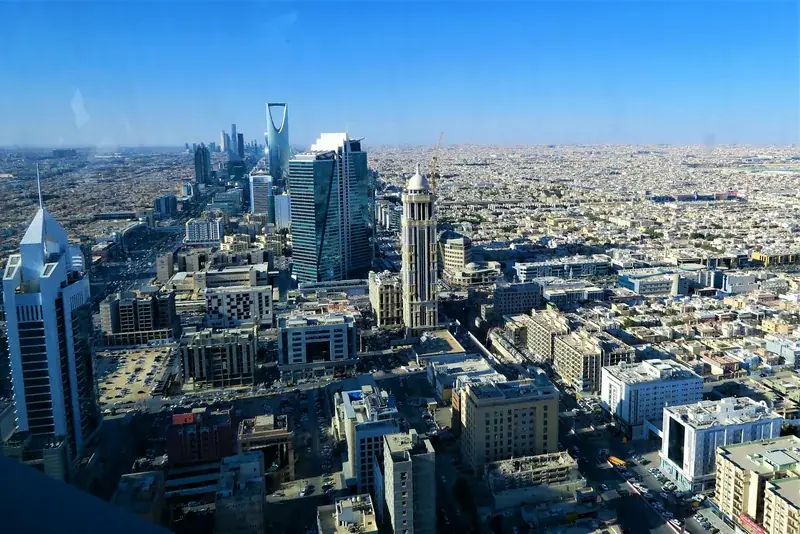
Riyadh means "gardens" — a name inherited from the oasis villages that once dotted this stretch of the Najd plateau, some 600 metres above sea level in the middle of the Arabian Peninsula. The walled town those gardens grew into was still small enough to circle on foot in 1950, when the walls came down; today the Saudi capital is home to around seven million people and sprawls across a grid of highways, glass towers and new entertainment districts. It is a city that rewards curiosity, because the stories that explain it — a daring night raid in 1902, a mud-brick capital razed in 1818, a king's palace with a Rolls-Royce in the garage — are not written on the facades. Our self-guided audio guides tell them, landmark by landmark, so you can move between old Deira, Diriyah and the Olaya skyline at your own pace and still hear what each place meant.

Start at Masmak Fortress and the old town
Everything in modern Saudi Arabia traces back to one small clay fort. Masmak Fortress, begun in 1865 and finished in 1895, is a compact stronghold of mud brick on a stone footing, with four conical watchtowers about 18 metres tall and a palmwood gate pierced by a tiny hatch called al-Khokha. In January 1902 the young Abdulaziz ibn Saud, back from exile in Kuwait, stormed it with a handful of men and retook Riyadh from the Rashidi governor — the opening act of the unification that produced the Kingdom three decades later. The fort served as an arms store, then a prison, and since 1995 has been a museum of that founding story; the audio guide walks you through the gate, the majlis and the well while it unfolds. Step outside into Alsafat Square, the open plaza beside the Qasr al-Hukm that has been the city's civic heart for a century, and across to the Imam Turki Bin Abdullah Grand Mosque, a modern Najdi-style landmark whose courtyards shade the square. A few streets away, Souk Al Zal is one of Riyadh's oldest markets — carpets, antiques, oud, incense and the odd brass coffee pot — and a reminder that this was a trading town long before it was a capital.
Masmak Fortress
Mud-brick fortress with corner watchtowers, stormed in the raid that began the Saudi kingdom.
Alsafat Square
Historic plaza by the Grand Mosque, once a camel and horse market, watched over by a clock tower.
Imam Turki Bin Abdullah Grand Mosque
Vast stone mosque with twin minarets, linked by covered bridges to the old seat of government.
Souk Al Zal
Century-old rug and cloak market of narrow alleys selling bishts, swords, oud and Najdi antiques.
Diriyah: where the Saudi story began
Twenty minutes north-west, on a bend of the Wadi Hanifah, lies the place the House of Saud calls home. Diriyah was founded in 1446–47 by Mani' Al-Muraydi, an ancestor of the royal family, and from 1727 to 1818 it was the capital of the First Saudi State. Its hilltop citadel, the At-Turaif World Heritage Site, was inscribed by UNESCO in 2010 and is among the finest surviving examples of Najdi mud-brick architecture: thick tapering walls, triangular vents, palm-trunk ceilings and the four-storey Salwa Palace where the first imams lived and governed. In 1818 an Ottoman-Egyptian army under Ibrahim Pasha besieged the town, levelled its houses and cut down its palms; what you walk through today has been painstakingly restored, and the audio guide fills the lanes back in with the court, the scholars and the siege. Across the wadi, Al Bujairi Heritage Park marks the old religious quarter around the mosque of Muhammad ibn Abd al-Wahhab, and Bujairi Terrace turns it into the best evening in the city — Najdi-style courtyards of restaurants and cafés with At-Turaif floodlit on the ridge opposite.
At-Turaif World Heritage Site
Restored mud-brick citadel on a ridge, first capital of the Saudi state and seat of its early imams.
Al Bujairi Heritage Park
Restored mud-brick quarter of terraces and cafes facing the UNESCO-listed ruins across a desert valley.
Bujairi Terrace
Open-air dining terrace of restaurants overlooking a restored desert valley and mud-brick ruins.
The National Museum and Murabba Palace
The King Abdulaziz Historical Centre, laid out around a park a short ride north of Masmak, is where to make sense of the whole sweep. The National Museum, opened in 1999, moves from the geology of Arabia through pre-Islamic kingdoms, the Prophet's mission and the Hajj to the story of the Saudi states — allow several hours, and let the guide pick out the pieces worth lingering over. Next door is Murabba Historical Palace, the square-plan mud-brick residence King Abdulaziz built when he moved his court out of Masmak in 1938 and used as home and office until his death in 1953. It is a rare, intimate look at how a king ran a young country: the majlis where petitions were heard, the modest private rooms, and the collection of state cars including his first Rolls-Royce.
Kingdom Centre, Al Faisaliah and the new skyline
Riyadh's wealth is written in Olaya. Al Faisaliah Tower, the 44-storey needle topped by a golden glass sphere, was the capital's first true skyscraper when it opened in 2000; the Kingdom Centre Sky Bridge, a glass walkway slung across the top of the 99-storey, roughly 300-metre Kingdom Centre, is the view to save for sunset, when the desert haze turns the whole city gold and the lights come on along King Fahd Road. The audio guides explain why each tower looks the way it does — the bottle-opener silhouette, the sphere — and who built them. Further north, the King Abdullah Financial District is a city-within-a-city of angular towers, skywalks and plazas that is only now filling up with life; it is the clearest picture of the Riyadh of the 2030 plan.
Al Faisaliah Tower
Tapering steel-and-glass skyscraper crowned by a golden glass sphere with a restaurant and city views.
Kingdom Centre Sky Bridge
Glass-walled skybridge spanning a skyscraper's arched crown, with panoramic views over the capital.
King Abdullah Financial District
Glass-tower business quarter linked by climate-controlled skywalks and a sculptural metro station.
Boulevard Riyadh City after dark
When the heat drops, Riyadh comes out. Boulevard Riyadh City is the country's largest entertainment complex — nine zones of restaurants, concert stages, a dancing fountain and a Times Square-style plaza that fills with families late into the night during Riyadh Season. Its sibling Boulevard World stretches the idea into themed quarters evoking cities around the globe. Neither is ancient, but together they show how fast the capital's public life has changed in a handful of years.
Wadi Hanifah and the Edge of the World
The desert is never far. Wadi Hanifah, the valley that made settlement here possible, has been rehabilitated into a 120-kilometre ribbon of parks, palm groves and walking paths running right through the western suburbs — a cool green counterpoint to the towers. Downstream, Wadi Namar Waterfall spills over a dam into a lake lined with picnic lawns. For the big landscape, drive about 100 kilometres north-west to the Edge of the World, where the Tuwaiq escarpment ends in sheer cliffs dropping over a thousand metres to a plain that runs, unbroken, to the horizon; most visitors time it for sunset and stay for the stars.
Wadi Hanifah
Desert valley of restored wetlands, lakes and trails, busy with weekend picnics and barbecues.
Wadi Namar Waterfall
Dam-fed lake and artificial waterfall in a palm-lined desert valley with corniche walkways.
Edge of the World
Sheer limestone cliffs dropping about 300 metres to an ancient seabed, with fossils underfoot.
Getting around and when to go
Distances are long and pavements scarce, so plan Riyadh as a series of clusters: old Deira, Diriyah, the Historical Centre, Olaya and the Boulevard. The new Riyadh Metro links several of them, and ride-hailing is cheap and reliable for the rest. Visit between November and March: August highs average above 43 °C, while winter days are warm and evenings pleasantly cool. Dress modestly — knees and elbows covered — and remember that much of the city only really wakes up after dark.