
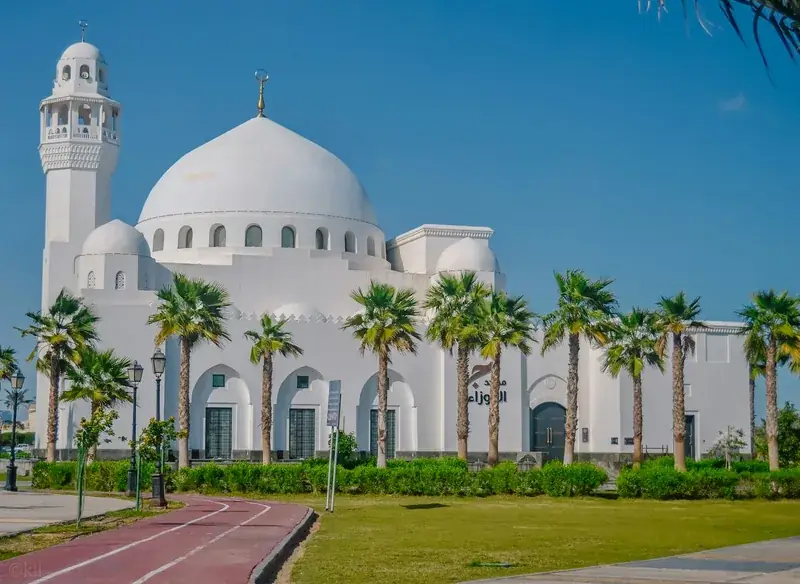
Dammam is the capital of Saudi Arabia's Eastern Province and the anchor of a three-city metro that runs along the Arabian Gulf: Dammam itself, the lively waterfront town of Al Khobar, and Dhahran, the company town where Saudi oil was first struck in 1938. It is not a city of ancient medinas or mountain scenery. Its story is newer and stranger: a fishing and pearling coast that, within a single lifetime, became the engine room of a kingdom. The landscape shows it everywhere, from refinery flares on the horizon to the sleek stone forms of a world-class cultural centre built on the spot where the first well came in.
The best way to read that story is to follow it place by place with a self-guided audio guide in your ear. Each landmark here, from a capped oil well to a Portuguese fort on an island, has its own narrated guide, so you can start at the corniche at sunset, drive out to Dhahran the next morning, and let the city explain itself as you go. The Dammam Corniche is the natural opening chapter: a long promenade of lawns, playgrounds and cafes where the city comes out in the evening to walk beside the Gulf.

Dhahran, where the oil began
Everything in the Eastern Province leads back to a single borehole. Oil Well 7, drilled on the Dammam Dome after six disappointing attempts, struck commercial oil on 3 March 1938 at a depth of about 1,440 metres. It pumped for 45 years and more than 32 million barrels before it was shut in 1982, and in 1999 it was formally named the Prosperity Well. It still stands, now a landmark beside the Aramco complex, and its audio guide tells the story of the geologists who nearly gave up.
Next to it rises Ithra, the King Abdulaziz Center for World Culture. Opened in December 2016 and designed by the Norwegian firm Snøhetta, its cluster of pebble-like stone volumes covers 80,000 square metres and holds a library, museum, cinema, theatre, the Great Hall and the Knowledge Tower. Give it half a day. The Energy Exhibit, Aramco's interactive science museum, sits in the same grounds and explains what actually happens between the well and the petrol pump.
Oil Well 7
Historic wellhead of the kingdom's first commercial oil strike, flowing from 1938 until 1982.
King Abdulaziz Center for World Culture - Ithra
Pebble-shaped cultural centre wrapped in curved steel tubes, with a rammed-earth plaza.
Energy Exhibit
Interactive oil science center on the field where the kingdom's first commercial oil was struck.
The corniches of Dammam and Khobar
The metro area is defined by its waterfronts, and each has a different mood. Dammam's corniche is local and unhurried. The Khobar Corniche, a short drive south, is busier and more polished, lined with restaurants and shopping complexes and watched over by the Khobar Water Tower, the landmark that has defined the skyline since the 1980s. Keep going north and the Al Khobar Northern Corniche opens into a quieter stretch of beaches and picnic lawns that is at its best in the cooler months, when families set up for the whole evening.
Khobar Corniche
Sixteen-kilometre seafront of parks and promenades facing the Gulf, toward nearby Bahrain.
Khobar Water Tower
Ninety-metre water tower on a small island, crowned by a restaurant and a viewing terrace over the Gulf.
Al Khobar Northern Corniche
Seafront promenade with Gulf views, walking paths, play areas and a landmark water tower nearby.
Tarout Island and five thousand years
About thirty minutes north of Dammam, three causeways cross from Qatif to Tarout Island, one of the oldest continuously inhabited places on the Gulf. Settlement here goes back more than 5,000 years, and the island was a centre of the Dilmun civilisation that traded between Mesopotamia and the Indus. On the hill in the middle of the old town stands Tarout Castle, a fort raised by the Portuguese between 1515 and 1521 on older Uyunid foundations, themselves built over ancient ruins. The narrow lanes around it and the shallow waters of Tarout Bay, still worked by fishermen, are the counterweight to Dhahran's modernity: this is what the coast was before oil.
Half Moon Bay and the Gulf shore
South of Khobar the coast curves into Half Moon Bay, a crescent of calm, shallow water that is the Eastern Province's favourite beach. Long stretches of knee-deep shallows suit children, while the deeper water draws kite surfers, divers and sailors. Stay for the sunset. Closer to the city, Azizia beach serves the same purpose on a smaller scale, and Marjan Island, the man-made outlier off the Dammam Corniche, is a popular place to walk out over the water.
Half Moon Bay
Crescent-shaped shallow Gulf bay with soft sand beaches, salt flats, low dunes and calm water.
Azizia
Quiet Gulf beach with shallow, salty water and sunset views across to Bahrain and its causeway.
Marjan Island
Circular man-made island on a Gulf breakwater, crowned by a thirty-metre spiral lookout tower.
Across the water on the King Fahd Causeway
From Khobar, the King Fahd Causeway runs 25 kilometres of bridges and embankments across the Gulf of Bahrain to Al Jasra in Bahrain. Opened in November 1986 at a cost of around 800 million dollars, it is both an engineering landmark and a weekend ritual for thousands of families. Midway, Passport Island carries the border station, two mosques and a pair of 65-metre tower restaurants with views back over both shores.
Parks, heritage and family days
For the days in between, King Fahd Park, also called Life Park, is one of the largest parks in the kingdom, with lakes, fountains, barbecue stations, a skate park and amusement rides. Heritage Village on the Dammam waterfront is a five-storey reconstruction of traditional architecture stuffed with vintage cars, manuscripts, jewellery and weaponry, with a restaurant and a costume studio. In Khobar, Scitech, the Prince Sultan Science and Technology Center, pairs seven exhibition halls with an IMAX dome and an astronomical observatory.
King Fahd Park
Sprawling green park of lawns, artificial lakes and woodland, watered by recycled runoff.
Heritage Village
Adobe-style palace complex with a traditional restaurant, market and private museum of Saudi antiques.
Scitech - Prince Sultan Science and Technology Center
Seaside science centre with interactive halls, a giant-screen dome and an astronomical observatory.
Getting around
Dammam, Khobar and Dhahran run into each other, but distances are large and summer heat is serious, so plan on taxis or a hired car and save walking for the corniches after dark. King Fahd International Airport lies well north of the city, and the Riyadh train arrives at Dammam station. Winter, from November to March, is the season to be outdoors.