
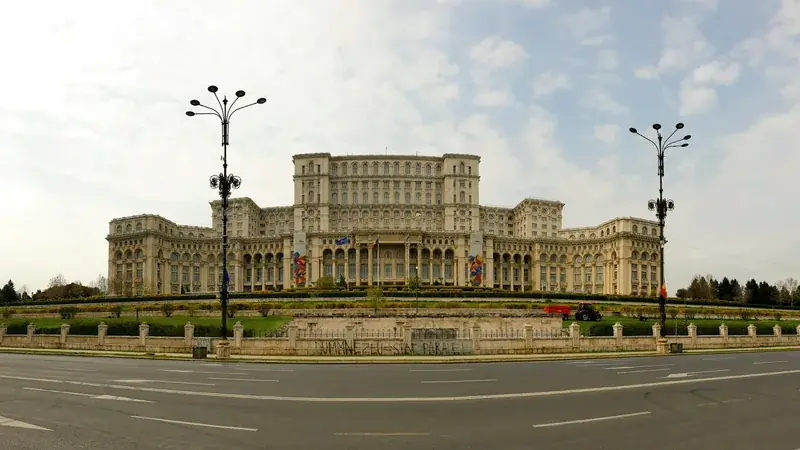

Bucharest is a city of abrupt contrasts, and that is exactly what makes it worth exploring. First recorded in 1459 as the citadel of Vlad the Impaler, it became Romania's capital in 1862 and spent the following decades rebuilding itself in the image of Paris — grand boulevards, French-trained architects, Beaux-Arts palaces and a reputation as the "Paris of the East". Then came the twentieth century: war, communism, and Nicolae Ceaușescu's decision to raze an entire historic quarter and raise the largest civilian administrative building on Earth in its place. The result is a capital where an eighteenth-century monastery church, a belle-époque concert hall and a concrete megastructure can all be seen in a single morning.
It is also a city whose stories are not written on its facades. Why does a stone triumphal arch stand on a road named after a Russian general? Which balcony did a dictator never get to speak from? Why do Bucharest's best cafés hide inside glass-roofed passages? These are the questions a self-guided audio tour answers as you go — each landmark below has its own guide, so you can wander at your own pace and let the city explain itself.
Start at the Palace of Parliament
Every visit begins, sooner or later, with the Palace of Parliament. Ordered by Ceaușescu in 1984 and still unfinished when he was executed in 1989, it is 84 metres high, sinks 92 metres underground, contains about 1,100 rooms and weighs an estimated four million tonnes — the heaviest building in the world. Today it houses both chambers of Parliament, the Constitutional Court and, in a wing of its own, the National Museum of Contemporary Art, whose rooftop terrace is one of the best vantage points over the boulevard Ceaușescu built to admire it from. That boulevard runs down to Piața Unirii, the vast square and fountain parade that marks the seam between the old city and the socialist one. The audio guide here tells the story of the neighbourhood that vanished so the palace could rise.
Palace of Parliament
Colossal communist-era palace raised on a razed hillside, with over a thousand rooms.
MNAC – Muzeul Național de Artă Contemporană al României
Contemporary art museum in a palace wing, with glass elevators rising to a rooftop café terrace.
Piața Unirii
Central square built over a buried river, with a park, fountains and major metro interchange below.
The Old Town and the Old Court
North of Unirii the streets suddenly narrow, twist and fill with people: this is Old Town, the Lipscani district, named for the merchants who once brought goods from Leipzig. At its heart lie the excavated ruins of the Old Court, the princely residence where Vlad III held court and where a bust of him still watches the tourists. A few steps away, the tiny Stavropoleos Monastery church of 1724 is the most beautiful building in the quarter — carved stone columns, painted arcades and a silent courtyard that feels a world away from the bars outside. Lipscani's other institutions are more boisterous: Caru' cu bere, the Art Nouveau beer hall that has been pouring its own brew since 1879, and Cărturești Carusel, the white-balconied bookshop that has become one of the most photographed interiors in Romania. Listen to the Old Court guide first; it makes sense of the whole district.
Old Town
Pedestrian merchant quarter of cobbled lanes, old inns, churches and lively bars and terraces.
"The Old Court" Voivodal Palace
Ruined medieval palace of Wallachian princes, rediscovered by archaeologists beneath old streets.
The Church of the "Stavropoleos" Monastery
Ornate eighteenth-century Brâncovenesc church with carved stone portico and a quiet monastery courtyard.
Caru' cu bere
Neo-Gothic beer hall from the late nineteenth century with ornate Art Nouveau interiors and Romanian fare.
Cărturești Carusel
Restored former bank turned bookshop, with curving white balconies stacked around marble columns.
Calea Victoriei and Revolution Square
Calea Victoriei is Bucharest's Champs-Élysées — the long avenue along which the city's nineteenth-century elite built their palaces, hotels and passages. Walking north, it opens onto Revolution Square, framed by the former Royal Palace (now the National Museum of Art), the Athenaeum and the balcony of the old Communist Party headquarters, from which Ceaușescu gave his last speech on 21 December 1989 before a crowd that turned against him. The Romanian Athenaeum, opened in 1888 after a 28-year public campaign under the slogan "Give a leu for the Athenaeum!", is the city's jewel: a neoclassical rotunda whose concert hall is ringed by a fresco telling the whole of Romanian history, and home of the George Enescu Philharmonic. The audio guides on this stretch cover both the glamour and the gunfire.
Calea Victoriei
Historic avenue of palaces, theatres and old cafés, first paved with timber in the seventeenth century.
Revolution Square
Historic square where a dictator's final speech turned to jeers, with a memorial to revolution victims.
National Museum of Art
Former royal palace holding Romanian and European art, from icons to El Greco and Old Masters.
The Romanian Athenaeum
Domed neoclassical concert hall raised on old circus foundations and funded by one-leu public donations.
Green Bucharest: Cișmigiu to King Mihai I Park
Bucharest is greener than its reputation suggests. Cișmigiu Garden, laid out in the 1840s, is the city's oldest park and its favourite — a lake for rowing in summer and skating in winter, chess players under the plane trees. Further north, the enormous King Mihai I Park wraps around Lake Herăstrău, and on its edge stands the open-air National Village Museum, founded in 1936 by the sociologist Dimitrie Gusti, where more than 300 peasant houses, wooden churches and windmills were dismantled across Romania and rebuilt here, village by village. The park's southern gate is the Arcul de Triumf, the 1935 stone arch that commemorates Romania's soldiers of the First World War.
Cișmigiu Garden
Romantic lakeside garden with rowboats in summer, an ice rink in winter and centuries-old plane trees.
King Mihai I Park
Vast lakeside park on a drained marsh, with a shoreline promenade, islands, gardens and boat rides.
"Dimitrie Gusti" National Village Museum
Open-air museum of rebuilt peasant houses, windmills, presses and churches from across the country.
Arcul de Triumf
Granite and marble triumphal arch with sculpted reliefs, rebuilt in the 1930s to replace a plaster original.
Behind the Iron Curtain
For the communist decades themselves, head to the leafy Primăverii district and the Ceaușescu House, the surprisingly suburban villa where the dictator and his wife Elena lived with their gold-tapped bathrooms, winter garden and private cinema — a guided look at how the regime lived while the city queued for bread. Nearby, the House of the Free Press on Kiseleff road is the Stalinist tower that once printed every newspaper the state allowed. The audio guides here connect the two faces of the era: the propaganda and the private luxury.
Getting around
Central Bucharest is compact enough to walk from Piața Unirii through the Old Town and up Calea Victoriei to Revolution Square in under an hour; the metro (M1–M5) links Unirii, Universitate, Piața Victoriei and Aviatorilor for King Mihai I Park. Late spring, early summer and September are the kindest months; July and August can be hot. Bucharest is also the gateway for day trips to Peleș Castle at Sinaia and the Transylvanian towns of Brașov and Bran, each a few hours away by train.