
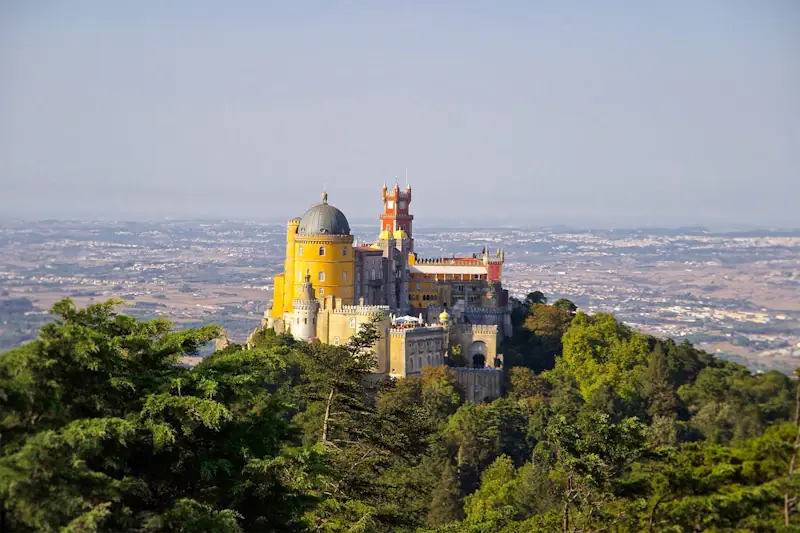

Sintra is the hill town where Portugal's kings went to escape the Lisbon summer, and where a Romantic-era king built himself a palace that looks like it was painted by a child with the brightest box of crayons. A granite ridge about ten kilometres long rises just west of the capital and runs out to the Atlantic, trapping sea mist in its folds; the result is a microclimate of ferns, camellias and giant sequoias wrapped around palaces, convents and a Moorish fortress. Lord Byron called it a "glorious Eden", and UNESCO lists the whole hillside as the Cultural Landscape of Sintra.
It is a place best explored at your own pace with a self-guided audio guide in your ear, because almost every building here has a story that the view alone doesn't tell: a monastery flattened by an earthquake and reborn as a fantasy palace, a millionaire's garden coded with Templar symbolism, a lighthouse on the edge of Europe. Most visitors come from Lisbon for the day on the suburban train, which takes around 40 minutes, and arrive in the cobbled Sintra Historic Centre, a knot of lanes, pastry shops and viewpoints beneath the ridge.

Start at Pena Palace
The National Palace of Pena crowns the highest ridge, a riot of ochre, crimson and tiled turrets stacked over the ruins of a 16th-century Hieronymite monastery. King Ferdinand II, the "artist king", acquired the site in 1838 and had the German engineer Baron von Eschwege turn it into a summer residence between 1842 and 1854, mixing Neo-Gothic, Neo-Manueline, Neo-Islamic and Neo-Renaissance styles with cheerful abandon. The audio guide walks you through the drawbridge, the cloister and the terraces, where on a clear day you can see the Atlantic.
Give yourself time for Pena Park too, over 200 hectares of forest that Ferdinand planted with trees from across the world, including sequoias and ginkgoes. Hidden in the trees is the Chalet of the Countess of Edla, the alpine-style retreat Ferdinand built for the opera singer he married after the queen's death, trimmed with cork and bark.
National Palace of Pena
Romantic hilltop palace in red and yellow, built over a ruined monastery with sweeping views.
Pena Park
Romantic hillside forest of exotic trees, fern valleys, lakes and hidden follies around a palace.
Chalet of the Countess of Edla
Alpine-style royal cottage trimmed in cork, with faux-timber walls and romantic gardens.
The Moorish Castle and the royal town
Facing Pena across a saddle of rock is The Moorish Castle, whose ramparts snake along the ridge like a miniature Great Wall. The Moors held Sintra, which they called Xintara, until Afonso Henriques took it in 1147; walk the walls and the audio guide fills in what the garrison would have seen from here.
Down in the town, the National Palace of Sintra is the one you cannot miss, thanks to the two enormous white conical chimneys over its kitchens. The royal family summered here for centuries, and its painted rooms, from the Swan Room to the Magpie Room, tell the story of the Portuguese court better than any museum.
Quinta da Regaleira and the Initiation Well
A ten-minute walk from the centre, Quinta da Regaleira is the estate of António Carvalho Monteiro, "Monteiro the Millionaire", who bought it in 1892 and hired the Italian architect Luigi Manini to build a Gothic-fronted palace bristling with pinnacles and gargoyles, completed around 1910. The gardens are the real draw: grottoes, a chapel floored with the Order of Christ cross and pentagrams, and tunnels that link a waterfall lake to the famous Initiation Well, an inverted tower 27 metres deep whose spiral staircase descends in nine flights. Whether the symbolism is Templar, Masonic or Dante's nine circles, the audio guide lays out the theories while you spiral down into the dark.
Monserrate, Capuchos and the quiet side of the hills
West of town the crowds thin out. The Park and Palace of Monserrate is an Anglo-Moorish confection built for the English merchant Gerard Devisme in the 1790s and reimagined by Sir Francis Cook in the 19th century, with a lace-like Music Room and gardens of exotic plants fed by the mountain damp. Further into the forest, the Capuchos Convent is its opposite: a 16th-century Franciscan retreat where the cells are lined with cork and the doorways are built for monks who had renounced everything. On the far rim of the ridge, the Sanctuary of Peninha sits on a bare crag with views down to the coast.
Park and Palace of Monserrate
Romantic hilltop palace of Gothic, Indian and Moorish styles set in exotic botanical gardens.
Capuchos Convent
Austere sixteenth-century friary tucked among granite boulders, its tiny cells lined with cork.
Sanctuary of Peninha
Hilltop baroque chapel and unfinished Romantic mansion with sweeping Atlantic coastline views.
Cabo da Roca and the Atlantic coast
The ridge ends at Cape Roca, the westernmost point of mainland Europe, where cliffs more than 100 metres high drop into the Atlantic beneath a lighthouse that has been lit since 1772. Northward the coast softens into beaches: Praia das Maçãs, reached by the heritage tram from Sintra, and Azenhas do Mar, a whitewashed village stacked down a cliff above a natural sea pool.
Cape Roca
Windswept granite headland with sheer sea cliffs and an old lighthouse at Europe's western edge.
Praia das Maçãs
Wide Atlantic sandy beach at a river mouth, reached by a vintage electric tram through farmland.
Azenhas do Mar
Clifftop village of whitewashed houses above a tide-filled ocean pool and sand-rooted wine vineyards.
Queijadas, Colares wine and getting around
Sintra has its own pastries, and Casa Piriquita in the historic centre is the classic address for queijadas, small cinnamon-scented cheese tarts, and the pillow-shaped travesseiros. The village of Colares on the road to the coast gives its name to one of Portugal's oldest demarcated wine regions, where vines grow in sand dunes. The Eléctrico de Sintra tram links the town to Praia das Maçãs along an 11.5-kilometre scenic line; in town the 434 bus loops from the station to the Moorish Castle and Pena, though many visitors simply walk up through the woods with their audio guide playing.
Casa Piriquita
Historic family pastry shop famed for almond-cream travesseiros and cheese queijadas since the 1860s.
Colares
Wine village of ungrafted sand-planted vines, on the vintage tram line from the hills to the sea.
Eléctrico de Sintra - Praia das Maçãs (estação terminal)
Beachside end of a century-old metre-gauge tram line, with vintage cars running inland through vineyards.