
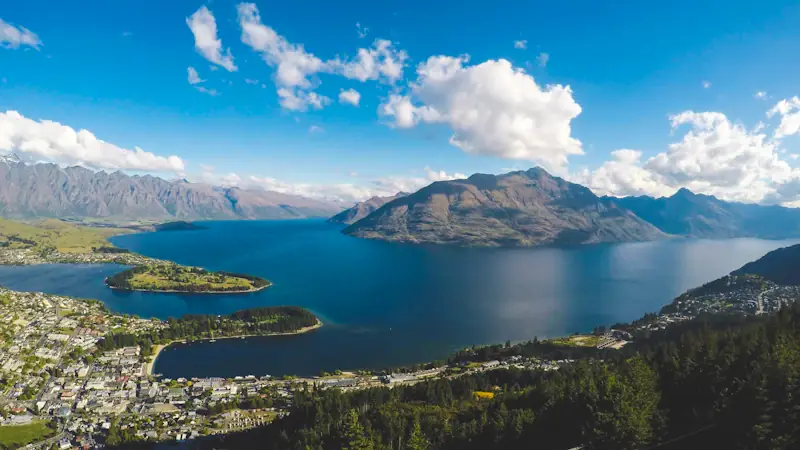

Queenstown sits on a shallow bay of Lake Wakatipu — the Māori name, Tāhuna, means exactly that — with the jagged wall of The Remarkables rising to the south-east and Ben Lomond at its back. A town of under 30,000 people, it is New Zealand's adventure capital, the place where commercial bungy jumping was invented, where a coal-fired steamship still crosses the lake every day, and where the Central Otago wine country, a gold-rush village and the road to Milford Sound all begin within an hour's drive.
It is also a town with a surprising amount of story under the scenery. Kāi Tahu tradition says the S-shaped glacial lake was dug by the ancestor Rākaihautū; the lakeside Queenstown Gardens stand on the site of Te Kirikiri Pā; and the whole settlement only exists because William Rees started a sheep run here in 1860 and gold turned up in the Arrow River two years later. The self-guided audio guides on this page let you hear those stories where they happened — on the wharf, at the top of the gondola, on the old bungy bridge — and leave you free to look.

Lake Wakatipu
Long glacial lake ringed by alpine peaks, crossed by a century-old coal-fired steamship.
The Remarkables
Serrated schist mountain range above a glacial lake, with a high alpine ski area and summer trails.
Queenstown Gardens
Lakeside peninsula park of old exotic trees, rose beds and a glacial boulder honouring Scott's polar party.
Start at the lakefront: Steamer Wharf and the TSS Earnslaw
Everything in Queenstown radiates from the waterfront. Steamer Wharf is where the TSS Earnslaw has tied up since her maiden voyage in October 1912 — the "Lady of the Lake", still hand-fired with coal and the last commercial passenger steamship of her kind in the southern hemisphere. The 45-minute crossing to Walter Peak High Country Farm is the classic way to see the lake, and the audio guide to the ship fills in the engine-room story while you watch the stokers work. Back on shore, the Gardens are a ten-minute stroll around the bay.
RealNZ | TSS Earnslaw Queenstown Cruise
Coal-fired vintage twin-screw steamship cruising an alpine lake, with a working engine room on view.
Steamer Wharf
Lakefront wharf and dining precinct where a coal-fired nineteen-twelve steamship still berths.
RealNZ | Walter Peak High Country Farm
Lakeside high country sheep farm with a red-roofed homestead, heritage gardens and farm-to-table dining.
Up Bob's Peak on the Skyline Gondola
The Skyline Gondola climbs the flank of Ben Lomond straight out of the town centre to a deck above Bob's Peak, with the whole lake, the Remarkables and Coronet Peak laid out in one view. Most visitors ride the Skyline Luge at the top; the fitter ones keep walking, because the summit station is also the trailhead for the Ben Lomond Track, a full-day climb to one of the best panoramas in the South Island. The Tiki Trail zigzags up through the pines if you would rather earn the view on foot.
Skyline Gondola
Steep hillside gondola with ten-seat cabins climbing to a summit lookout over the lake and peaks.
Skyline Luge
Gravity-powered cart track winding down a mountainside, with lake views and a chairlift back up.
Ben Lomond Track
Steep alpine summit trail through forest and tussock to panoramic lake and mountain views.
Where bungy was born: the Kawarau and the Shotover
Queenstown's reputation for adrenaline started on a historic suspension bridge over the Kawarau River. The AJ Hackett Kawarau Bungy Centre has run the world's first commercial bungy here since 1988 — a 43-metre plunge, with the option of a dip in the river. The Shotover Jet does for water what the bridge does for air, spinning jet boats within arm's reach of the canyon walls of the Shotover River, while the Nevis Bungy, Swing & Catapult takes the whole idea up a notch over a far deeper gorge. The audio guides here are as much about the gold-rush rivers as the rides.
AJ Hackett Kawarau Bungy Centre
Historic 1880 gold-rush suspension bridge and the world's first commercial bungy jump site.
Shotover Jet Queenstown
Riverside jet boat base launching high-speed thrill rides through narrow river canyons since 1965.
Nevis Bungy, Swing & Catapult
Check-in base for canyon bungy, giant swing and catapult rides, with shuttles out to a remote valley.
Gold-rush Arrowtown
Twenty minutes east, Arrowtown is the Otago gold rush preserved in miniature. Jack Tewa found gold in the Arrow River in August 1862, and within months 800 miners were camped here; at its peak the district counted more than 7,000 people. The Historic Arrowtown Chinese Settlement on Bush Creek keeps the restored huts and Ah Lum's store of the Chinese miners who arrived in the 1870s to rework the abandoned claims — a quietly moving place, and one the audio guide handles with care. The Lakes District Museum & Gallery on the main street tells the wider story, and in April the avenue of old trees turns the whole town gold again.
Arrowtown
Historic gold-rush village of stone shops and miners' cottages beneath an avenue of old trees.
Historic Arrowtown Chinese Settlement
Restored huts of gold-rush Chinese miners beside a creek, with an original stone merchant store.
Lakes District Museum & Gallery
Gold-rush-era bank turned museum of Māori, miners and settler life, with over thirty thousand objects.
Wine in Gibbston and the Crown Range
The Kawarau Gorge road out of Queenstown runs through Gibbston, the "valley of the vines" and the gateway to Central Otago, the world's southernmost — and New Zealand's fastest-growing — wine region. Gibbston Valley Winery & Restaurant has a cellar cut into the schist hillside, Chard Farm sits at the end of a famously narrow cliff road, and Amisfield Restaurant & Cellar Door near Lake Hayes is the region's destination lunch. Pinot noir is the story, and the audio guides explain why this cold, dry, high-altitude valley makes it so well.
Gibbston Valley Winery & Restaurant
Pioneering Central Otago vineyard with a cellar door, restaurant and a barrel cave cut into schist.
Chard Farm
Clifftop vineyard and cellar door above the Kawarau gorge, reached by a dramatic narrow track.
Amisfield Restaurant & Cellar Door
Schist-and-copper winery hall with lake and mountain views, tastings and acclaimed wild-food dining.
Day trips: Glenorchy, Wānaka and Milford Sound
The road along the lake's western shore to Glenorchy is forty-five minutes of the best lake scenery in the country, ending at a red wharf shed and the Dart River valley that stood in for Isengard and Lothlórien. Over the Crown Range, Lake Wānaka is Queenstown's quieter sibling, with its much-photographed lone willow in the water. And Milford Sound / Piopiotahi in Fiordland National Park is the big one — a long day by coach or a short flight, with Mitre Peak rising 1,692 metres straight out of the sea. Load the audio guides before you leave; the fiord has no mobile signal.
Glenorchy
Lakeside hamlet at the head of a glacial lake, ringed by high peaks and old sheep stations.
Lake Wānaka
Alpine lake ringed by mountains, with a lone willow growing from its shallows.
Milford Sound / Piopiotahi
Glacier-carved fiord of sheer cliffs, plunging waterfalls and Mitre Peak rising from dark water.
Getting around and when to go
The town centre is compact and walkable, and the gondola, wharf and Gardens are all within fifteen minutes of each other on foot. A car — or a tour coach — is needed for the gorge, the vineyards, Arrowtown and anything further. Queenstown works in every season: summer runs to about 30 °C and long evenings on the lake; autumn brings Arrowtown's colours; from late June the four ski fields — Coronet Peak, The Remarkables, Cardrona and Treble Cone — turn it into New Zealand's winter resort, with night skiing under floodlights at Coronet Peak.