
Oslo sits where the forest meets the fjord. Norway's capital is a compact city of about 700,000 people wrapped around the head of the Oslofjord, with the Nordmarka woods beginning where the last metro stops. It is a place where you can walk a marble opera roof in the morning, stand under a ski jump by lunch and swim off a wooden sauna raft before dinner. For most of its life it was called Christiania, a modest timber-and-brick capital in the shadow of Copenhagen and Stockholm; the oil decades turned it into one of Europe's most confident small cities, and the last twenty years have rebuilt its entire waterfront.
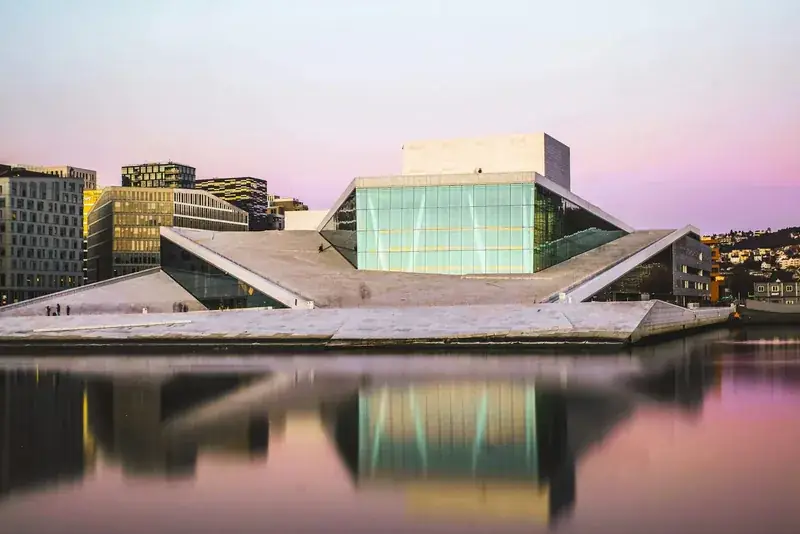
It is also a city that rewards curiosity. The sculptures, fortress walls and polar ships all have stories that are easy to miss without a guide, so the self-guided audio guides here are built to be played on the spot: stand in front of a landmark, press play, and hear what it meant and who made it. Begin at the Oslo Opera House, whose sloping white roof rises straight out of the harbour and invites you to climb it.

Bjørvika: the Opera roof, MUNCH and the Barcode
The Opera House opened in 2008 and started the transformation of Bjørvika from railway yards into Oslo's new front door. Its roof slopes down to the water so that anyone can walk up it for free; from the top the whole inner fjord opens out. Next door stands MUNCH, the tall, leaning museum that holds the world's largest collection of Edvard Munch's work, including painted and printed versions of The Scream. Across the square, Deichman Bjørvika is the city's main public library, a cantilevered glass building that doubles as a free viewing platform, and behind it the narrow high-rises of the Barcode Project form the skyline you see on every postcard. The audio guides for these buildings explain how a boggy harbour became the showpiece of modern Oslo.
Munch
Waterfront art museum holding a vast bequest of Munch paintings, prints and drawings, with a rooftop bar.
Deichman Bjørvika
Six-floor public library with rooftop views, cafés and a sealed room of manuscripts unread until 2114.
Barcode Project
Row of slender high-rises of varied heights with open gaps between them, facing the fjord waterfront.
Karl Johans gate: from the Palace to Akershus
Oslo's main street runs in a straight line from the central station up to The Royal Palace, which sits on a low hill at the top with its park open to everyone and guided tours of the state rooms in summer. Karl Johans gate itself is lined with cafés, the Storting (parliament) building, the National Theater and the university, and it is the natural spine for a first walk through the centre; the audio guide follows it landmark by landmark. A few blocks towards the harbour, Akershus Fortress has guarded the city since the 13th century. Its ramparts are free to wander and offer the best view of the fjord from the old town, while inside the walls Norway's Resistance Museum tells the story of the German occupation.
The Royal Palace
Neoclassical royal residence atop a hill, with a columned balcony overlooking the main avenue.
Karl Johans gate
Grand pedestrian boulevard running from the central station past parliament to the royal palace.
Akershus Fortress
Medieval royal castle and star-shaped fortress on a harbour headland, rebuilt in Renaissance style.
The harbour front: City Hall, the Nobel Peace Center and Aker Brygge
The brick towers of Oslo City Hall dominate the harbour, and every December its great hall hosts the Nobel Peace Prize ceremony. Facing it across the square, the Nobel Peace Center occupies a former railway station and displays the 18-carat gold medal, designed by Gustav Vigeland in 1901, alongside exhibitions on each year's laureate. West along the water, the National Museum is the largest art museum in the Nordic region, home to another Scream and to Norway's romantic landscape painters. From there the Harbour Promenade continues past the restaurants of Aker Brygge to Tjuvholmen, where the Astrup Fearnley Museum of Modern Art and a small sculpture park sit at the tip of the pier.
Oslo City Hall
Red-brick functionalist twin towers by the fjord, with a courtyard of painted Norse-myth wood reliefs.
Nobel Peace Center
Nobel Peace Prize museum in a converted 1872 railway station, with laureate exhibits by the harbour.
National Museum
Norway's largest art museum, home to Munch's The Scream plus design, architecture and old masters.
Aker Brygge
Former shipyard turned waterfront of restaurants, shops and ferries, with preserved workshop halls.
Vigeland Park and the Frogner sculptures
In the elegant Frogner district, The Vigeland Park is the largest sculpture park in the world made by a single artist. Gustav Vigeland spent decades on its more than 200 bronze, granite and wrought-iron figures, from the famous Angry Boy on the bridge to the 17-metre Monolith of entwined bodies at the park's heart. The audio guide walks you from the gate to the Monolith and decodes the cycle of life that the sculptures depict. The Vigeland Museum, in the artist's former studio at the park's southern edge, shows the plaster originals, and the Oslo City Museum (Oslo Bymuseum) inside the park tells the story of the city itself.
The Vigeland Park
Sculpture park of over two hundred bronze and granite figures, crowned by a towering carved monolith.
The Vigeland Museum
Sculptor's former studio and home, holding his plaster models, drawings and a preserved apartment.
Oslo City Museum (Oslo Bymuseum)
Eighteenth-century manor house holding the city's history museum, photo archive and art collection.
Bygdøy: Fram, Kon-Tiki and the Vikings
A short ferry or bus ride from City Hall, the leafy Bygdøy peninsula gathers Norway's great expedition stories under one roof after another. The Fram Museum is built around the wooden polar ship that carried Nansen and Amundsen towards both poles, and you can walk its decks. Across the car park, the Kon-Tiki Museum holds the balsa raft that Thor Heyerdahl sailed across the Pacific in 1947. The Norwegian Museum of Cultural History is an open-air village of 150 relocated buildings, including a medieval stave church. The Viking ships are currently off display while the Museum of the Viking Age is rebuilt; it is due to reopen in late 2027.
The Fram Museum
Polar exploration museum built around a wooden expedition ship that visitors can board.
Kon-Tiki Museum
Museum housing the original balsa raft sailed across the Pacific in 1947, plus expedition archives.
The Norwegian Museum of Cultural History
Open-air museum of more than 150 relocated farmhouses, town houses and a medieval stave church.
Holmenkollen and the forest
Take metro line 1 uphill and the city gives way to pine forest. Holmenkollbakken, the ski jump that has hosted competitions since 1892, rears over the slope like a steel wave; the lift to its top gives the widest view in Oslo. Beneath it, the Holmenkollen Ski Museum, founded in 1923, is the oldest of its kind and traces 4,000 years of skiing. The line ends at Frognerseteren, where a timber lodge serves apple cake and marked trails lead into Nordmarka. The audio guide here explains why skiing is close to a religion in this city.
Holmenkollbakken
Steel ski jump towering over the city, with a panoramic deck, ski museum and a century of history.
Holmenkollen Ski Museum
World's oldest ski museum, tracing four thousand years of skiing up to polar expedition gear.
Frognerseteren
Dragon-style timber lodge on a forest hilltop, famed for apple cake, city views and a toboggan run.
Grünerløkka, the Akerselva and the fjord islands
East of the centre, Grünerløkka is the former working-class district that became Oslo's creative quarter: vintage shops, coffee bars, Birkelunden's weekend flea market. The Akerselva river runs along its western edge, and the old mill buildings beside it now hold Mathallen Oslo, the city's food hall. Riverside paths make this a good area to explore slowly with an audio guide, as the mills and workers' housing each carry a chapter of the industrial city.
When the weather is kind, do as Oslo does and take a Ruter ferry from the City Hall pier out to the islands. Hovedøya, ten minutes away, has the ruins of a 12th-century Cistercian monastery, beaches and quiet woods. The same Ruter ticket covers the metro, trams, buses and island boats, so a day pass is all you need to move between fjord, forest and city centre.
Grünerløkka
Former working-class district of rental blocks, leafy squares, cafés and riverside factory buildings.
Mathallen Oslo
Converted industrial hall packed with food stalls, delis, cafés and bars beside a riverside quarter.
Hovedøya
Wooded fjord island holding the ruins of a twelfth-century Cistercian monastery burned in 1532.