
Bergen is Norway's second city and its gateway to the fjords: a harbour town of some 295,000 people wedged between the sea and seven mountains, where wooden houses climb the slopes and the rain (around 2,500 mm a year, on roughly 200 days) is part of the character rather than a complaint. Tradition dates its founding to King Olav Kyrre in 1070, but a trading settlement was already here decades earlier, and trade is what shaped it: for four centuries the Hanseatic League ran one of its four great overseas offices from the wharf at Bryggen.
It is a compact city that rewards slow exploring. Almost everything that matters sits within a short walk of the harbour, and every landmark on this page has its own audio guide, so you can stand in front of a 300-year-old warehouse or a composer's lakeside hut and hear its story told in place, at your own pace, before moving on to the next.
Start at Bryggen, the Hanseatic wharf
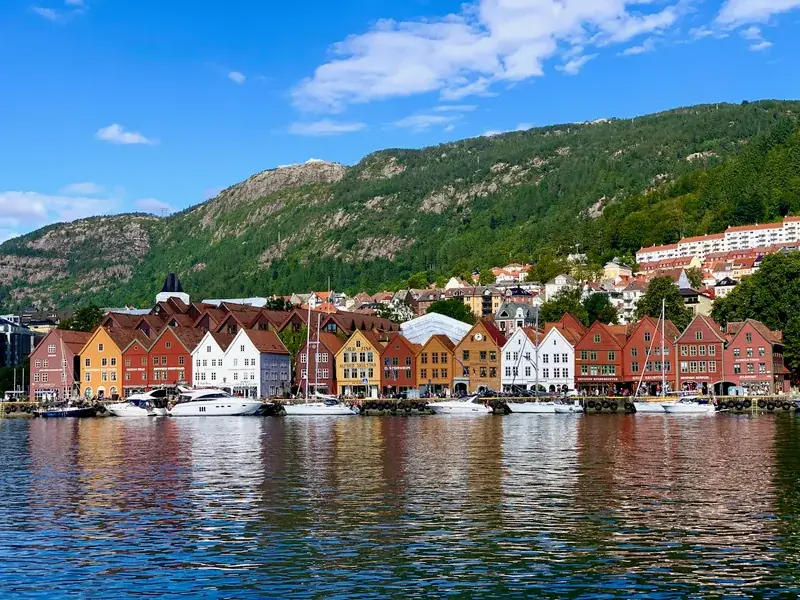
The row of leaning, colour-washed gables along the east side of the harbour is Bryggen, a UNESCO World Heritage Site since 1979 and the reason most people come. The Hanseatic kontor was set up here around 1350 and did not close until 1754; behind the facades, the narrow timber passages and stacked warehouses once held stockfish and grain. Fire has swept the wharf again and again (1702 was the great one, and 1955 the last), yet the layout is medieval and the stone cellars go back to the 15th century. Listen to the Bryggen guide as you walk the alleys, then go deeper at the Hanseatic Museum and Schøtstuene, where the German merchants lived, ate and held their assemblies, and at Bryggens Museum, built on the ground the 1955 fire cleared and full of what the excavations found beneath it, including the famous runic inscriptions.
Bryggen
Row of gabled timber warehouses from the Hanseatic stockfish trade, now shops, cafes and museums.
The Hanseatic Museum & Schøtstuene assembly rooms
Hanseatic merchants' assembly rooms where fires were allowed for communal winter meals and meetings.
Bryggens Museum
Archaeological museum built over medieval wharf ruins, home to hundreds of everyday rune sticks.
Bergenhus Fortress and St Mary's Church
At the end of the wharf the city turns royal. Bergenhus Fortress has guarded the harbour mouth since the 1240s, when Bergen was Norway's capital; inside its walls stand Håkon's Hall, the great stone banqueting hall of King Håkon Håkonsson, and the Rosenkrantz Tower, a Renaissance keep wrapped around a medieval core. A few steps back toward Bryggen is St Mary's Church, the oldest building in the city, a 12th-century Romanesque church that later served as the Hanseatic merchants' own parish. The audio guides here pick up the thread the wharf started: how a fishing-and-trading town became a seat of kings, and then a German enclave on Norwegian soil.
Bergenhus Fortress
Harbourside royal fortress with a thirteenth-century stone banqueting hall and a Renaissance tower.
Håkonshallen - Bymuseet i Bergen
Thirteenth-century royal stone banquet hall, still used for royal dinners and festival concerts.
Rosenkrantz Tower
Medieval royal keep wrapped in a Renaissance governor's tower, with dungeons and rooftop harbour views.
St Mary's Church | Bergen
Twin-towered Romanesque soapstone church, begun in the twelfth century, the city's oldest building.
Up Fløyen and Ulriken
No visit is complete without going up. The Fløibanen funicular leaves from three minutes' walk behind the Fish Market and climbs to Fløyen, about 320 metres up, in six minutes; at the top are the classic postcard view over the harbour and the fjord, a cafe, a troll forest for children, and marked trails that let you walk back down to the city in an easy hour. Ulriken is the highest of the seven mountains, more rugged and reached by cable car, with a wider panorama out to the islands and the open sea. Either summit is a fine place to hear the city's story told from above.
Fløibanen
Century-old funicular climbing steeply from the old town to a mountaintop viewpoint over the harbour.
Fløyen
Forested mountaintop viewpoint reached by funicular, with sweeping views over harbour and fjords.
Ulriken
Highest mountain above the harbour, reached by cable car, with sweeping views of sea and islands.
The Fish Market and the city centre
The Fish Market on the inner harbour has been trading for centuries and is one of the most visited markets in Norway: today its stalls serve fish soup, grilled salmon and king crab alongside fruit and flowers, and yes, the prices match the setting. Behind it opens Torgallmenningen, the broad main square that gives Bergen its civic heart, and a short walk on lies the KODE art museums around the little lake Lille Lungegårdsvannet. Rasmus Meyer, KODE's collection of Norwegian art, holds one of the best groups of Edvard Munch paintings outside Oslo.
Fishmarket in Bergen
Harbourside seafood market with a glass-and-timber hall, selling fresh catch since medieval times.
Torgallmenningen
Pedestrian main square born as a firebreak, framed by a bronze sailors' monument and a meeting stone.
Rasmus Meyer, Kode
Art museum of Norwegian golden-age painting, major Munch works and historic painted interiors.
Grieg at Troldhaugen
Bergen's most famous son is the composer Edvard Grieg, and his villa at Troldhaugen, a short ride south of the centre, is the city's most affecting museum. Edvard and Nina Grieg finished the house in 1885 to a design by his cousin, the architect Schak Bull; the tiny hut where he composed still looks out over Nordås Lake, the couple's ashes rest in a tomb in the rock nearby, and the Troldsalen hall hosts recitals through summer and autumn. On the way, Fantoft Stave Church is a faithful rebuilding of a medieval wooden church destroyed by arson in 1992, dark and tarred among the pines.
Out to the fjords
Bergen is where fjord journeys begin. The narrow Nærøyfjord, a UNESCO World Heritage Site, is the dramatic one, with sheer walls dropping into water barely 250 metres wide in places; the classic day trip pairs a boat on the fjord with the Flåmsbana railway, which climbs from the fjord village of Flåm to Myrdal on the Bergen Line past waterfalls and hairpin cliffs. South of the city, the broader Hardangerfjord is orchard country, at its loveliest in blossom time in May.
Nærøyfjord
Narrow, steep-walled fjord between towering mountains, on a classic scenic ferry route.
Flåmsbana
Steep mountain railway climbing from fjord to high plateau through twenty mostly hand-dug tunnels.
Hardangerfjord
Long, deep fjord lined with steep fruit orchards that blossom white each spring below a glacier.
Getting around and the weather
The centre is walkable, and the light-rail Bybanen runs from the city to Troldhaugen, Fantoft and the airport. Bergen is the terminus of the Bergen Line from Oslo and Norway's busiest port, with the coastal ships and more than 300 cruise calls a year. Pack a waterproof rather than an umbrella, expect the sky to change twice in an afternoon, and remember that the rain is exactly why the gables are painted so brightly.