
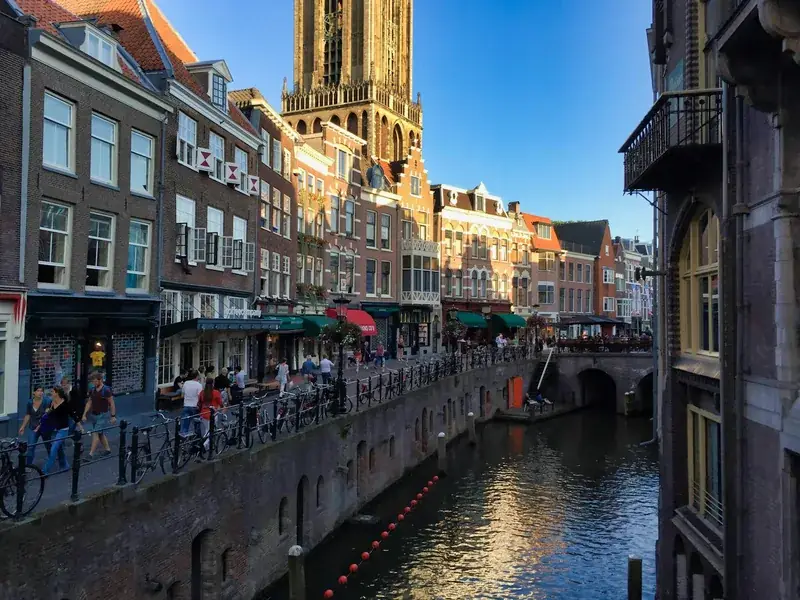

Utrecht is the Netherlands' fourth-largest city and, in many ways, its oldest heart: a medieval bishops' town wrapped around a single Gothic tower, with canals that sit a storey below street level and a centre that is almost entirely car-free. It is compact enough to cover in a weekend, and dense enough with stories that a weekend never feels like enough. Our self-guided audio guides let you take those stories at your own pace: stand under the Dom Tower, press play, and hear why the tallest church tower in the country stands apart from its own church.
The city's big student population keeps it lively well after the museums close, with jazz bars, cafés and galleries tucked along the Oudegracht, the old canal that runs the length of the centre. Walk it once by day and once after dark; the audio guide fills in what the brick does not say.

Domplein, the Dom Tower and what lies beneath
Start at Domplein. The Dom Tower rose between 1321 and 1382 to 112 metres, and was never quite finished because the money ran out. On the night of 1 August 1674 a tornado tore down the cathedral's nave; the tower survived untouched, and the gap was never rebuilt. That is why the tower and the Domkerk face each other across an open square today, with coloured paving marking where the nave once stood. Climbing the 465 steps is the classic Utrecht view; the quieter pleasure is the Pandhof van de Dom, the cloister garden beside the church. Beneath the square, DOMunder takes you down into the archaeological layers of the Roman fort and medieval cathedral, with each site's audio guide telling the chapter it belongs to.
Domplein
Open cathedral square paved over a vanished nave, between a lone Gothic tower and its severed church.
Domkerk
Gothic cathedral choir and transept, cut off from its tower when a storm felled the nave.
Pandhof van de Dom
Medieval cloister garden of herbs and a bronze fountain, ringed by gables carved with a saint's life.
DOMunder
Underground archaeological site with Roman fort remains and foundations of a storm-felled Gothic nave.
The Oudegracht and its wharf cellars
Utrecht's canals are unlike Amsterdam's. Along the Oudegracht the water runs one level below the street, and storage cellars dug into the canal walls in the thirteenth century open onto wharves at the waterline. Stairs lead from the shop-lined street down to café terraces, restaurants and studios set into those vaults. Follow the canal south towards Twijnstraat, a street of independent shops and food, or branch east to the tree-shaded Nieuwegracht, the calmer, more residential canal where the wharf cellars hide behind private doors.
Museums of the Museumkwartier
The southern end of the old town is Utrecht's museum quarter. The Centraal Museum holds the city's art collection and also manages the Rietveld Schröder House; across the way, the Nijntje Museum is devoted to Miffy, the rabbit drawn by Utrecht native Dick Bruna. Museum Speelklok is the one that makes visitors grin: a collection of self-playing musical instruments, from music boxes to street organs, demonstrated live. Museum Catharijneconvent, in a former convent, tells the story of Christianity in the Netherlands through its art.
Centraal Museum
Art and history museum with a medieval cargo boat preserved beneath its old monastery building.
Nijntje Museum
Playful children's museum of themed rooms built around a world-famous white rabbit and her friends.
Museum Speelklok
Self-playing music boxes, clocks and street organs demonstrated live inside a medieval church.
Museum Catharijneconvent
Religious art museum in a former convent, spanning medieval relics to modern Christian art.
Rietveld Schröder House, a De Stijl original
A twenty-minute walk east of the centre stands a small white house that changed architecture. Gerrit Rietveld built the Rietveld Schröder House in 1922-24 for Truus Schröder-Schräder, a widowed pharmacist who wanted a home without fixed interior walls and who shaped the design alongside him. The result is the only true piece of De Stijl architecture, a UNESCO World Heritage Site since 2000. Schröder lived there until her death in 1985; it opened as a museum house afterwards, and tickets must be booked with a time slot.
A day trip to De Haar Castle
West of the city in the village of Haarzuilens, De Haar Castle is the largest castle in the Netherlands, though most of what you see is Victorian fantasy. Baron Etienne van Zuylen inherited the ruin in 1890, married Hélène de Rothschild, and with her family's money had Pierre Cuypers rebuild it from 1892 in full neo-Gothic splendour, moving the whole village to make room for a park with Versailles-style formal gardens. The audio guide walks you through the family emblems hidden in the interiors.
Getting around
Utrecht Centraal is the busiest railway station in the Netherlands, and almost everything in this guide is within a half-hour walk of it; the centre is best done on foot or by bike, like the locals. Train lovers should add The Railway Museum, housed in the city's grand nineteenth-century Maliebaan station. For De Haar, take a train or bus west to Vleuten and finish the trip by bus or bicycle.