
Rotterdam is the Dutch city that had to start again. On 14 May 1940 a German air raid flattened the historic centre, killing 711 people and leaving around 85,000 homeless. Where other European cities patched up their old towns, Rotterdam treated the cleared ground as an empty canvas and invited architects to build whatever came next. The result is the only Dutch city with a real skyline: tilted cube houses, a market hall shaped like a horseshoe, a mirrored bowl full of art, and a bridge that looks like a swan. Walk here with a self-guided audio guide and the buildings stop being a strange collection of shapes and become a single story about loss and reinvention.
The story is told most plainly on Plein 1940, outside the Maritime Museum, where Ossip Zadkine's The Destroyed City has stood since 1953: a figure with its hands thrown up and a hole where its heart should be. A short walk away, the medieval St. Lawrence Church (Laurenskerk) is the only pre-war building left standing in the centre, and the audio guide for each of them explains what the surrounding emptiness once held.

Start at the Markthal and the Cube Houses
The best introduction to the new Rotterdam is a single square. The Markthal, designed by MVRDV and opened in 2014, is a horseshoe of apartments arched over a covered food market, its ceiling covered by what is billed as the world's largest digital artwork. Across the street, Piet Blom's Cube Houses tilt on their stems; one of them, the Kijk-Kubus, is open as a show home so you can see how anyone lives in a cube. Then look down the Oudehaven, one of the oldest harbours in the Netherlands, to the Witte Huis of 1898, often called Europe's first skyscraper at 45 metres, which survived the bombing and still stands among its much taller neighbours. Each has its own audio guide, so you can hear how the city went from a 45-metre marvel to 150-metre towers in a century.
Markthal (Market Hall)
Horseshoe-arched food hall of market stalls beneath apartments and a vast painted vault of produce.
Kijk-Kubus Museum-house
Furnished show home inside a tilted cube house, revealing life among leaning walls and custom furniture.
Witte Huis
Ten-storey Art Nouveau office tower of white glazed tiles, among Europe's earliest high-rises.
Cross the Erasmusbrug to Kop van Zuid
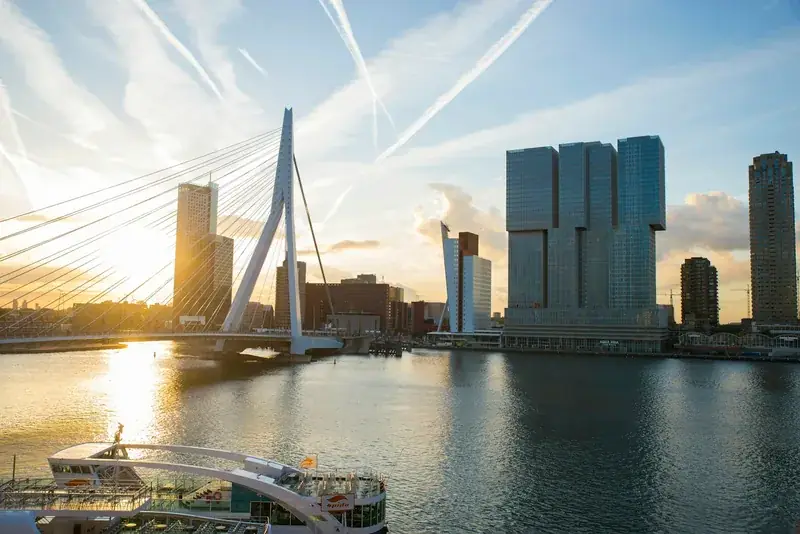
The Erasmusbrug, by Ben van Berkel and Caroline Bos and finished in 1996, is the city's emblem: a single leaning pylon and a sweep of cables that earned it the nickname "the Swan". It was built to pull the old docklands of Kop van Zuid into the city, and it worked. At the tip of the Wilhelminapier stands Hotel New York, the 1901 headquarters of the Holland America Line, from which generations of emigrants sailed for the United States; today you can drink coffee where they bought their tickets. Behind it rises De Rotterdam, OMA's three stacked and shifted towers, 150 metres high and sixteen years in the making. The audio guides here follow the emigrants down to the quay and then up the towers that replaced the shipping offices.
Erasmusbrug
Pale-blue cable-stayed bridge with a soaring asymmetric pylon and a giant bascule span for ships.
Hotel New York
Twin-towered Art Nouveau former shipping-line headquarters, now a hotel at the tip of a historic pier.
De Rotterdam
Three linked mixed-use towers on a harbour pier, cooled with river water and staggered against the wind.
Katendrecht and the SS Rotterdam
A footbridge from the pier leads to Katendrecht, a former sailors' quarter and the city's old Chinatown, now a neighbourhood of breweries and food halls in converted warehouses. Moored on its southern shore is the SS Rotterdam, the Holland America Line's former flagship ocean liner, which has served as a hotel since 2010. Its story and the district's rough past are both told on the audio guide, which is a good companion while you wait for a table.
Museumpark and Witte de Withstraat
Rotterdam's museum quarter clusters around a single park. The Art Depot Museum Boijmans Van Beuningen, another MVRDV building opened in 2020, is a bowl clad in mirrored glass that holds the museum's entire collection in open storage: you walk through the racks rather than past a selection. Next door, the Kunsthal Rotterdam is Rem Koolhaas's 1992 exhibition hall, a ramped box that changes its shows several times a year. The audio guides tell you why both buildings look the way they do before you go in. Afterwards, Witte de Withstraat is the street for a drink, lined with galleries, bars and the city's art institutes.
Art Depot Museum Boijmans Van Beuningen
Mirrored bowl-shaped art storehouse with open collection vaults and a birch-forest rooftop restaurant.
Kunsthal Rotterdam
Glass-and-concrete exhibition hall designed by Rem Koolhaas, opened in nineteen ninety-two.
Witte de Withstraat
Lively art and nightlife street lined with galleries, late-night bars and busy café terraces.
Delfshaven and the Van Nelle Factory
To see what the rest of Rotterdam used to look like, take the tram west to Historisch Delfshaven, a canal-side harbour that was once an independent town and escaped the bombing. Its gabled houses, windmill and distillery are the old-Dutch picture the centre lost; the Pilgrim Fathers Church here is where the Pilgrims held their last service before sailing for America in 1620. Further out, the Van Nelle Factory, by Brinkman and Van der Vlugt, is a glass-walled coffee, tea and tobacco plant from the 1920s that UNESCO listed as World Heritage in 2014, a reminder that Rotterdam was building modern before the war made it necessary. Both have audio guides that cover the ground the tram cannot.
Historisch Delfshaven
Old harbour quarter of gabled warehouses, a historic church and a malt windmill beside the water.
Pilgrim Fathers Church
Fifteenth-century harbourside church where English Pilgrims prayed before sailing for America.
Van Nelle Factory - Unesco World Heritage site
Glass-walled modernist factory once processing coffee, tea and tobacco, now a design hub.
The Euromast and getting around
For the overview, the Euromast has been the city's viewing tower since 1960; the open platform sits at 112 metres and a rotating glass lift carries you up to 185. From there the river, the bridge and the whole patchwork of post-war Rotterdam lay themselves out. Most visitors arrive at Rotterdam Centraal, the 2014 station with the angled steel roof, which is itself worth a minute of your audio guide before you set off. The centre is compact enough to walk, and trams, the metro and the water taxi reach everything else; play the guides as you ride.