
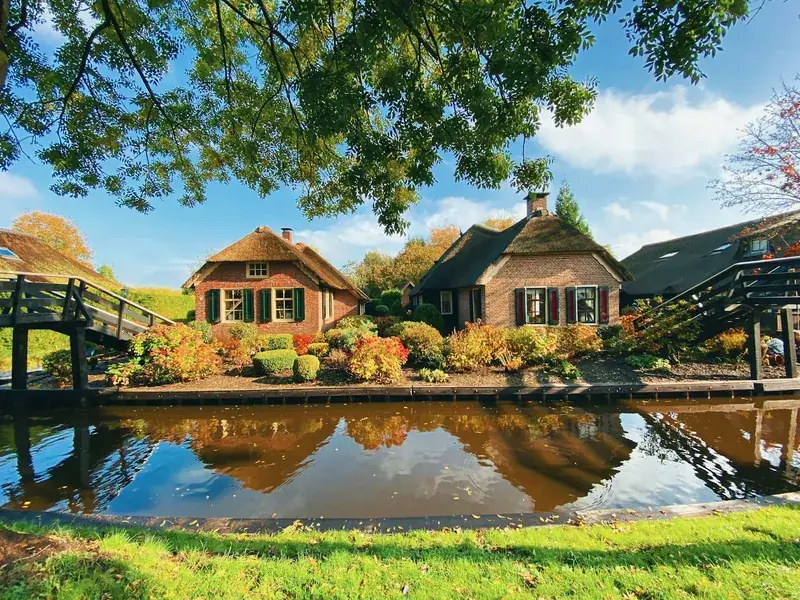

Giethoorn is a village in the Dutch province of Overijssel where the oldest streets are water. Its canals began as peat pits: medieval settlers dug the marsh for fuel, rain filled the cuts, and what was left was a village of thatched farmhouses on small islands, stitched together by some 176 wooden footbridges. For centuries everything moved by punt, and the old core still has no through road, which is why guidebooks reach for "Venice of the North" and why Bert Haanstra's 1958 comedy Fanfare made the place a national favourite.
It is a small village, around 2,800 people, and it rewards slow travel. Drift along the Dorpsgracht, the village canal that runs the length of Giethoorn, in an electric "whisper boat" with an audio guide playing, and the houses, bridges and reed beds come with their stories attached: who cut the peat, who built the bridges, why the farmhouses turn their backs to the water. The same guides work on foot or by bike along the paths that shadow the canal.

Walk the Binnenpad
The easiest way into Giethoorn is the Binnenpad, the footpath and cycle path that follows the Dorpsgracht north to south into the car-free heart of the village. Cross any of the hump-backed bridges and you are on someone's island, so keep to the path and your voice down; people live here. Beside the canal stands the Doopsgezinde Kerk, the Mennonite church. A Mennonite congregation was founded in Giethoorn in 1551, and the present building dates from 1871, a reminder that this was a village of plain, hard-working dissenters long before it was a postcard.
Peat, farms and fossils: the museums
Two small museums on the Binnenpad explain what you are looking at. Museum Giethoorn 't Olde Maat Uus is a restored old farmhouse that shows how a family here lived a century ago, with rooms on fishing, farming and peat-cutting, and it offers audio tours in several languages. A few minutes along the path, Museum De Oude Aarde is a mineral and fossil collection largely assembled by René Boissevain, where children can crack open a geode for a small fee. Nearby, the Gloria Maris shell gallery holds two rare Conus gloriamaris shells, once among the most coveted shells in the world.
Museum Giethoorn 't Olde Maat Uus
Authentic thatched farmhouse museum with a boathouse, fisherman's cottage and peat-cutting stories.
Museum De Oude Aarde
Gemstone, mineral and fossil museum with a giant elephant bird egg and a jewellery shop.
Gloria Maris Giethoorn
Shell gallery of rare seashells, coral and pearl jewellery, and a pair of glory-of-the-sea cones.
Out onto the lakes
The Dorpsgracht opens to the south-east onto the Bovenwijde, a broad shallow lake that, like the canals, is a flooded peat cutting. Guided cruises from the village, including those running from Smit's Paviljoen on the canal, head out here for about an hour; you can also hire a kayak or a whisper boat and go at your own pace. Further west lies the larger Beulakerwijde, which the 41.5 km Giethoorn-De Wieden cycling route loops around. The lake covers the drowned village of Beulake, a story the visitor centre across the water tells in film.
Bovenwijde
Broad lake born from peat digging and storms, with a boat-only swimming island in its middle.
Smit's Paviljoen
Lakeside café pavilion jutting into open water, with a panorama terrace and boat rental harbour.
Beulakerwijde
Broad shallow lake born from peat digging and storm floods, hiding a drowned village beneath it.
Into Weerribben-Wieden
Giethoorn sits on the edge of Nationaal Park Weerribben-Wieden, more than 6,000 hectares of lakes, reed beds and swamp forest in two halves, the Weerribben to the north and the Wieden to the south, both shaped by peat-cutting. Otters have returned, bitterns boom in the reeds, and from April to October ranger-skippers run silent electric boat trips. Visitor center De Wieden at Sint Jansklooster has a one-kilometre floating walkway, a 45-metre water tower with a view over the park and a summer waterbus to Giethoorn and Blokzijl, while the Outside Center Weerribben at Ossenzijl is the gateway to the northern half.
Nationaal Park Weerribben-Wieden
Vast reed-fringed wetland of lakes, ditches and peat strips carved by centuries of turf cutting.
Visitor center De Wieden
Farmhouse nature centre with a floating-land boardwalk, whisper-boat trips and otter marshes.
Outside Center Weerribben
Reedland nature centre on a peat-cut marsh, start point for boat and canoe trips among otter habitat.
Beyond the village: Dwarsgracht and Jonen
When the Binnenpad fills with day-trippers, the quieter water villages repeat the same pattern without the crowds. Dwarsgracht, across the lakes to the west, is a single canal lined with thatched farms and footbridges, and tiny Jonen beyond it is smaller still. To the south, Belt-Schutsloot strings its houses along the water between the Beulakerwijde and Belterwijde lakes. Reaching them by boat or bike is half the point.
Dwarsgracht
Water hamlet of thatched farmhouses, footbridges and boat sheds strung along a quiet canal.
Jonen
Single-row water hamlet of reed-thatched farms under dense trees, reached by ferry, bike or boat.
Belt-Schutsloot
Reed-fringed canal village of wooden footbridges and thatched farms, once reachable only by boat.
Getting there and when to come
From Amsterdam it is about an hour and a half by car, or just over two hours by train to Steenwijk and bus 70 to Giethoorn. Spring and early summer are greenest and calmest; July and August bring the crowds, so arrive early or stay a night and have the canals to yourself once the last tour boat ties up.