
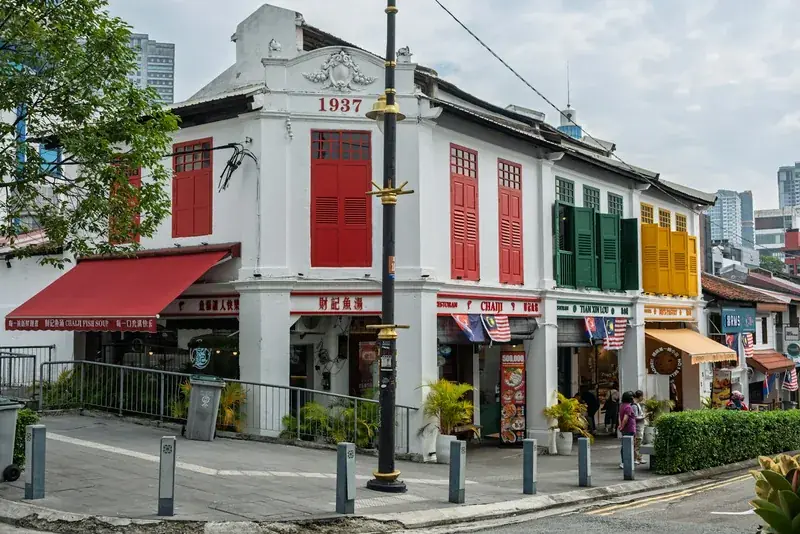

Johor Bahru is the city at the southern tip of mainland Asia, a kilometre of causeway away from Singapore and the capital of the Johor sultanate that once ruled the island across the water. Most visitors arrive over that causeway, and many of them see nothing but a mall and a border queue. That is a shame, because "JB" is a city with a real story: a nineteenth-century sultan who built a modern state with the help of a Chinese contractor, a Teochew pepper-and-gambier town whose shophouses still stand, and a waterfront that has reinvented itself around theme parks and marinas.
It is also a city that rewards being told its stories. The landmarks are spread out and rarely labelled, so the self-guided audio guides in this collection do the explaining as you go: stand in front of the Sultan Abu Bakar State Mosque, with its four minarets above the Straits of Johor, and hear why a mosque begun in 1892 looks so much like a British colonial hall, and who Wong Ah Fook, the builder, was to the royal family.

Royal Johor on the hill above the Straits
Sultan Abu Bakar, remembered as the father of modern Johor, moved his father's capital here and gave the town its name, "New Johor", in 1862. His Istana Besar, the Grand Palace of 1866, sits in gardens above the water with a blue roof and a great dome, and houses the Royal Abu Bakar Museum of heirlooms; it was also the hall where UMNO, Malaysia's dominant political party, was founded in 1946. A short walk along the ridge is the Sultan Ibrahim Building, the 1940 state secretariat whose tower dominated the skyline for decades, and the Mahmoodiah Royal Mausoleum, where the sultans are buried. Together they make a compact circuit of royal Johor, and each one has an audio guide that fills in the reign it belongs to.
Istana Besar
Anglo-Malay royal palace with a blue roof above the strait, housing a museum of royal heirlooms.
Sultan Ibrahim Building
Hilltop colonial-Malay government tower of stone and steel, once Malaya's tallest building.
Mahmoodiah Royal Mausoleum
Hilltop royal burial ground of Johor's sultans, blending Victorian, Moorish and Malay styles.
Tan Hiok Nee and the old Chinese quarter
Downhill from the palace is the oldest part of town, settled by Teochew migrants who grew the pepper and gambier that made the sultan's fortune. The Laluan Kebudayaan Tan Hiok Nee heritage trail runs through streets named for the Chinese leader who worked with Abu Bakar, past antique shops, century-old bakeries and coffee shops in shophouses that still look like 1900. Start at the Johor Bahru Chinese Heritage Museum, which explains how five dialect groups came to share one town, then walk to the Johor Ancient Temple on Jalan Trus. Founded in the 1870s on land granted by the sultan, it is a red-and-white Taoist temple squeezed between towers, home to five deities who tour the city every year in the Chingay parade, a four-day festival in the first lunar month that draws hundreds of thousands.
Laluan Kebudayaan Tan Hiok Nee
Heritage street of pre-war shophouses, cafes, murals and a century-old wood-fired bakery.
Johor Bahru Chinese Heritage Museum
Four-storey shophouse museum tracing Chinese pioneers, pepper-and-gambier planters and clan life.
Johor Ancient Temple
Nineteenth-century Chinese temple where five dialect groups share one roof and five patron deities.
A temple of glass and a church of 1883
Johor Bahru's faiths sit close together. The Arulmigu Sri Rajakaliamman Glass Temple is a Hindu shrine covered inside and out in hundreds of thousands of glass pieces, often described as the first glass temple in the world, and at its most intense during Thaipusam. A few streets away the Church of the Immaculate Conception, built in 1883 with a single colonial steeple, holds a Harvest Festival each January rooted in the Tamil festival of Pongal, a reminder of how mixed this congregation has always been.
Night markets and the waterfront
JB eats late and outdoors. After dark the Pasar Karat flea market fills the streets behind the heritage quarter with second-hand clothes, vinyl and street food; it only gets going after eight. For the water, head west to Danga Park on the bay, the city's evening promenade, or further out to Puteri Harbour Marina Park, where the yachts and waterside restaurants of the Iskandar development look across the strait to Singapore. Order laksa Johor somewhere along the way: legend has it the sultan swapped the rice noodles for spaghetti after a trip to Italy.
Pasar Karat • Bazar JB
Sprawling night flea market of second-hand goods, antiques, street food and buskers beside a reborn river.
Danga Park
Waterfront recreational park on reclaimed estuary land, lined with seafood restaurants and strait views.
Puteri Harbour Marina Park
Waterfront marina park with yacht berths and a promenade facing the narrow strait toward Singapore.
Legoland and the family day out
Johor Bahru is Southeast Asia's family-trip city. LEGOLAND Malaysia, opened in 2012 as Asia's first, has some forty rides plus a water park and an aquarium next door. Closer to the old town, the Johor Zoo dates from 1928 and was once the sultan's private menagerie, one of the oldest zoos in Malaysia.
Beyond the city: mangroves and waterfalls
The state around JB is worth a day. Taman Negara Johor Tanjung Piai is the southernmost point of mainland Asia, a boardwalk through mangroves where the Straits of Malacca and Johor meet. Nearby, Taman Negara Johor Pulau Kukup protects an uninhabited mangrove island reached by boat from the stilt village of Kukup, and to the north-east the Air Terjun Kota Tinggi waterfalls are the classic weekend swim.
Taman Negara Johor Tanjung Piai
Mangrove forest and mudflats on boardwalks at the southernmost tip of mainland Asia.
Taman Negara Johor Pulau Kukup
Uninhabited mangrove island and Ramsar wetland with boardwalks, mudflats and breeding storks.
Air Terjun Kota Tinggi
Mountain waterfall with dammed wading pools and water slides, closed in recent years after floods.
Crossing from Singapore
The Johor-Singapore Causeway, completed in 1923, blown up by the retreating British in January 1942 and repaired by the Japanese within a month, is now the busiest land border in the world. Walk-through immigration at JB Sentral drops you a few minutes from the heritage quarter, which is the best place to start listening.