
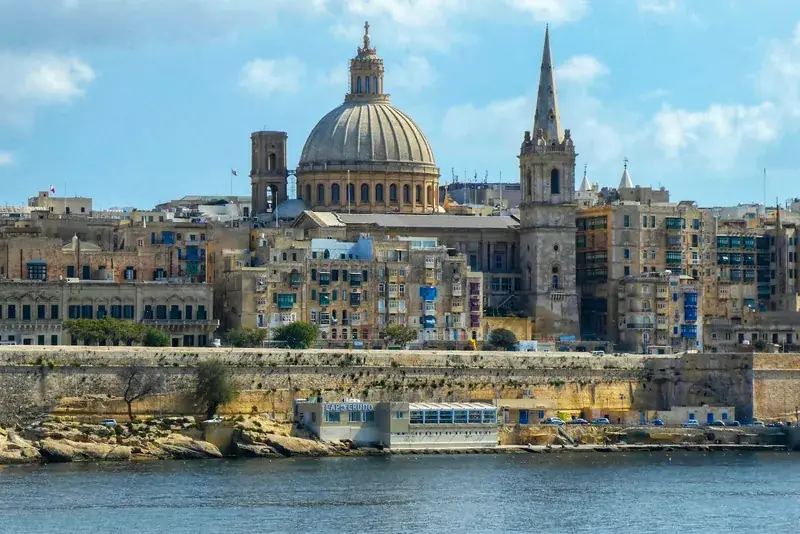
Valletta is the smallest capital in the European Union, a fortress city of roughly 0.6 square kilometres and about five thousand residents, crammed onto a rocky peninsula between two deep harbours. It was born out of a war. In 1565 the Knights of St John held Malta against an Ottoman siege, and the following spring Grand Master Jean de Valette laid the first stone of a new city to make sure it could never happen again. His engineer, Francesco Laparelli, drew it as a strict grid behind bastioned walls; Valette himself died in 1568 and never saw it finished. Four and a half centuries on, UNESCO counts some 320 monuments inside its walls, one of the densest concentrations of history anywhere.
That density is what makes Valletta such a good city to explore with self-guided audio guides. Nothing is far, the grid never lets you get lost, and nearly every doorway on Republic Street or Merchants Street has a story: a knight's auberge, a wartime bunker, a theatre that took ten months to build. Each of the landmarks below has its own audio guide, so you can walk the honey-coloured streets at your own pace and listen when something catches your eye. When Benjamin Disraeli came through in 1830 he called it a city of palaces built for gentlemen, and the phrase has stuck as the city's motto.

Start at St John's Co-Cathedral
The plain limestone front of St John's Co-Cathedral gives nothing away. Inside, the Knights spent two centuries gilding every surface: Mattia Preti painted the barrel vault, and the floor is a carpet of some four hundred inlaid marble tombstones, each one a knight's final boast. In the oratory hangs Caravaggio's Beheading of St John the Baptist, the largest canvas he ever painted and the only one he signed, with his Saint Jerome Writing nearby. A few blocks up Republic Street, the Grand Master's Palace was the Order's seat and is now the office of Malta's President; its state rooms and the Armoury, stacked with the knights' own armour and weapons, cover four hundred years of Maltese history. Round the corner, Casa Rocca Piccola is a sixteenth-century palazzo still lived in by the de Piro family, who open their rooms, and their wartime shelter dug beneath them, to visitors.
St. John's Co-Cathedral
Baroque conventual church of gilded carved stone walls under a vast painted vault of the Baptist's life.
Grand Master's Palace
Baroque seat of the Knights of St John, hung with a complete set of Gobelins tapestries of Brazil.
Casa Rocca Piccola
Sixteenth-century noble palace still lived in by its family, filled with heirlooms, costumes and lace.
The Barrakka Gardens above the Grand Harbour
Valletta's best view is from its highest point. The Upper Barrakka gardens open onto a terrace above the Grand Harbour, with the fortified Three Cities across the water, and from the ledge below the Saluting Battery still fires a gun at noon and again at four in the afternoon, as it once did for visiting warships. Beneath your feet, around 150 feet down in the rock, are The Lascaris War Rooms: a tunnelled headquarters dug between 1940 and early 1943, from which the defence of the island was run and where Eisenhower and Montgomery directed the invasion of Sicily in 1943. NATO kept using it until 1977. Further along the ramparts, the quieter Lower Barrakka gardens look out to the harbour mouth and the Siege Bell War Memorial, which rings for the island's dead of the Second World War.
Upper Barrakka
Arcaded bastion-top garden with sweeping Grand Harbour views and a panoramic lift to the waterfront.
Saluting Battery
Working gun platform below a garden terrace, firing restored cannon across the harbour every day.
The Lascaris War Rooms
Secret wartime tunnel headquarters with restored operations rooms, plotting maps and radar galleries.
Lower Barrakka
Quiet bastion garden around a Greek-style temple monument, overlooking the harbour entrance.
Siege Bell War Memorial
Bronze belfry and shrouded soldier on a harbour bastion, honouring the dead of the Second World War siege.
Fort St Elmo and the city at war
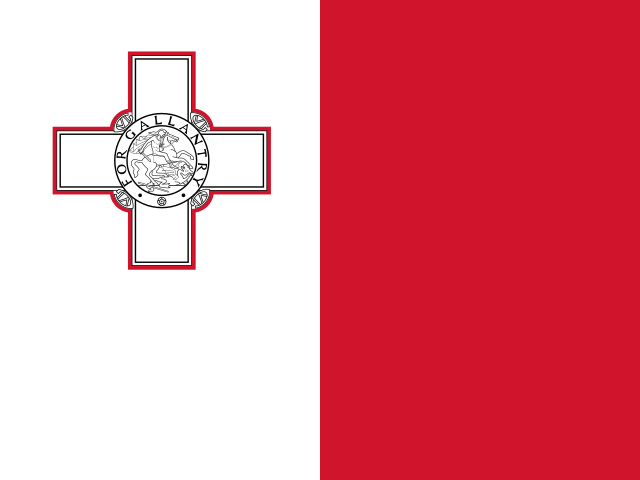
At the very tip of the peninsula, Fort St Elmo and the National War Museum mark the spot where the 1565 siege opened; the fort fell after weeks of bombardment, and its defenders bought the time that saved the rest of the island. The museum inside runs from the Knights to the British period, with the George Cross awarded to Malta in 1942 and the jeep Roosevelt rode through the ruined streets. Just behind it stands the Order's great hospital, the Sacra Infermeria of 1574, once among the largest in Europe, whose long wards you can walk in Reliving the Sacra Infermeria and in the history show that shares the building.
Castille, the auberges and the museums
Each national tongue of the Order built itself an auberge, and they are still the city's grandest houses. The Auberge de Castille, on the ridge at the top of the city, is the most imposing and now holds the Prime Minister's office. The Auberge d'Italie on Merchants Street reopened in 2018 as MUŻA - The National Community Art Museum, Malta's national art collection, while the Auberge de Provence houses the National Museum of Archaeology | Valletta, where the island's prehistory, from the first Neolithic farmers to the Phoenicians, is laid out before you head out to the temples themselves.
Auberge de Castille
Spanish Baroque knights' palace crowned by a bronze Grand Master bust, now the prime minister's office.
MUŻA - The National Community Art Museum
National art museum in a Knights' auberge, with Mattia Preti canvases, Maltese landscapes and sculpture.
National Museum of Archaeology | Valletta
Prehistoric museum of temple altars, animal reliefs and corpulent stone figures in a Knights' auberge.
City Gate and the new Valletta
You enter the city across a bridge over the dry ditch, past the Tritons’ Fountain by Maltese sculptor Vincent Apap, restored for Valletta's year as European Capital of Culture in 2018. Renzo Piano's stone City Gate of 2014 and the honeycomb Parliament Building beyond it, in use since 2015, are the city's one bold modern gesture. Beside them lie the bombed-out ruins of the Royal Opera House, left as they were after the Second World War and turned into the open-air theatre of Pjazza Teatru Rjal. Older performance survives too: Teatru Manoel, commissioned by Grand Master Manoel de Vilhena in 1731 and built in ten months, is one of Europe's oldest working theatres.
Tritons’ Fountain
Mid-century fountain of three cast Tritons hoisting a vast basin above Roman travertine pools.
Parliament Building
Modern legislature clad in honeycomb-cut limestone, designed by Renzo Piano beside the city gate.
Pjazza Teatru Rjal
Open-air theatre set in the restored ruins of a bombed Victorian opera house, framed in light steel.
Teatru Manoel
Baroque jewel-box theatre of gilded wooden boxes, a painted sky ceiling and famously crisp acoustics.
Across the water to the Three Cities
Valletta is only half of the harbour story. A short ferry ride away, Fort St Angelo rises from the end of Birgu's peninsula; this was the Knights' headquarters during the 1565 siege, before Valletta existed. The Birgu Waterfront below it, lined with old galley stores, is the calmer, more local side of the Grand Harbour. Back under Valletta's walls, The Valletta Waterfront has turned a row of eighteenth-century warehouses with brightly painted doors into restaurants along the cruise quay. With a day to spare, the same audio guides take you to the silent city of Mdina, the underground Hypogeum and the temples of Ħaġar Qim, and over to Gozo.
Fort St Angelo
Waterfront citadel, once the Knights' headquarters, that held out through a sixteenth-century siege.
Birgu Waterfront
Restored harbourside promenade of yachts, galley-era palaces and a castle-fronted Victorian naval bakery.
The Valletta Waterfront
Row of colourful-doored Baroque harbour warehouses, now a cruise quay of restaurants and bars.
Getting around
The city is walkable but steep: the grid runs up and over the ridge, and several side streets are staircases. The Barrakka Lift saves the climb between the harbour quay and the Upper Barrakka. Ferries are the pleasant way in: the Sliema Ferries Terminal boat lands just outside the walls on the Marsamxett side, and the Three Cities ferry arrives at the Customs House, about five minutes from the lift. Buses from the whole island terminate at the Tritons' Fountain outside City Gate.