
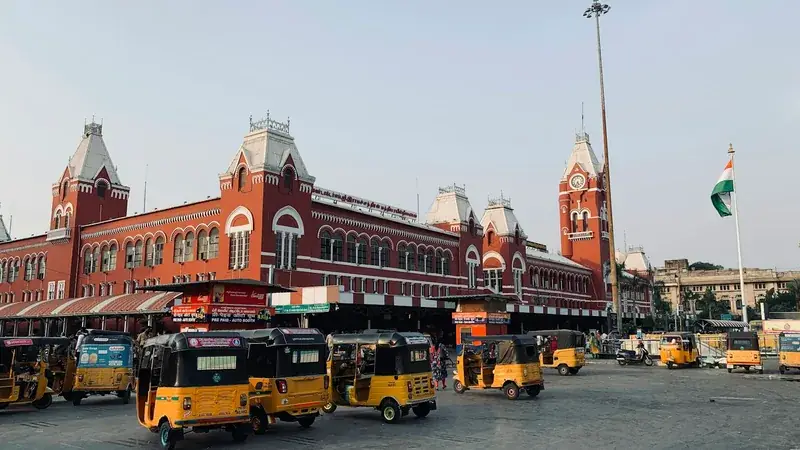
Chennai, the city the British called Madras, is the capital of Tamil Nadu and the gateway to South India. It is hot, loud and sprawling, with a population edging towards ten million, and it does not perform for visitors the way Jaipur or Goa does. That is exactly its appeal. Beneath the traffic is one of the oldest continuously settled places on the Coromandel Coast: a port mentioned by Ptolemy in the second century, a Pallava-era town, the East India Company's first foothold in India and, today, the home of Carnatic music, Bharatanatyam dance and the filter coffee that fuels both.
It is also a city that rewards listening more than looking. The great landmarks are spread along a few kilometres of coastline, and most of their stories are invisible from the pavement: who lies beneath a cathedral altar, why a fort has a church older than any other Anglican one in Asia, what a 40-metre temple tower is actually for. Each of the places below has its own audio guide, so you can walk from the beach into the lanes with the story playing in your ear and let Chennai explain itself.
Marina Beach and the sea front
Start where everyone in Chennai starts: on Marina Beach, a broad ribbon of sand that runs for roughly five kilometres from the harbour down to San Thome. It is one of the longest urban beaches in the world, and it is at its best at dusk, when families, kite sellers and sundal vendors take over and the lighthouse at the southern end catches the last light. Do not swim; the currents are notorious. Along the inland side runs a parade of Indo-Saracenic university buildings and the memorials of Tamil Nadu's film-star politicians, which the audio guide uses to explain why cinema and government are so entangled here. A few kilometres south, Edward Elliot's Beach in Besant Nagar is the calmer, café-lined alternative where locals actually go.
Fort St. George and old Madras
The city was born in 1640, when the East India Company began building Fort Saint George on an empty stretch of shore. It was the first structure of Madras and the British Crown's first territorial possession in India, and the state legislature still sits inside its walls. Within the ramparts stands CSI St. Mary's Church, consecrated in 1678 and the oldest surviving Anglican church in Asia; Elihu Yale, governor here before he gave his name to a university, donated its silver plate. The Fort St. George Museum keeps the portraits, uniforms and coins of the Company era. North of the fort, George Town grew up as the native trading quarter, a grid of lanes that today mixes Jain temples, mosques, Armenian and Anglican churches and the 1884 General Post Office. The audio guide here is really the story of how a trading post became an empire.
Fort Saint George
Seventeenth-century English fortress where Madras began, now seat of the state legislature.
CSI St. Mary's Church
Fortress-like seventeenth-century Anglican church with bomb-proof vaulted roof and four-foot walls.
Fort St. George Museum
Colonial-era exchange hall turned museum of arms, portraits and India's surviving 1947 silk flag.
George Town
Dense old merchant quarter of temples, bazaars and lanes that grew up beside the colonial fort.
Mylapore: temples, flower sellers and an apostle's tomb
Mylapore is older than Madras by well over a millennium and feels it. Its heart is the Kapaleeshwarar Temple, a Shiva shrine whose present structure dates mostly from the sixteenth century, crowned by a gopuram added in 1906 that rises some 40 metres over the surrounding flower market. Circle the tank, listen for the nadaswaram at evening puja, and let the guide decode the painted gods crowding the tower. Ten minutes away on the shore, the neo-Gothic Santhome Cathedral Basilica of 1896 stands over the tomb of St Thomas the Apostle, who tradition says preached and died here in the first century; its small museum holds a map of India drawn in 1519. Few cities let you walk between a living Dravidian temple and an apostle's grave before lunch.
Mylapore
Historic temple quarter of narrow lanes, old messes and a nameless snack window facing a great gopuram.
Kapaleeshwarar Temple
Towering Dravidian Shiva temple with a tall gateway tower and famous spring palanquin processions.
Santhome Cathedral Basilica
Neo-Gothic basilica built over the tomb traditionally held to be that of Saint Thomas the Apostle.
Chola bronzes and the shade of Adyar
For the deep past, go to the Government Museum Chennai, founded in 1851, whose bronze gallery holds the most complete collection of Chola bronzes anywhere, including the dancing Nataraja figures that define South Indian art. Second-century carved panels from Amaravati sit nearby. Across the Adyar river, the Theosophical Society moved its world headquarters here from New York in 1882 and now occupies a quiet estate of gardens and a library of rare manuscripts, with a vast old banyan tree at its centre. On the Marina, the ice-white Vivekananda House began life as the Tudor Ice Company's depot, shipping New England ice to tropical Madras, before Swami Vivekananda stayed there in 1897.
Government Museum Chennai
Colonial-era public museum with Amaravati Buddhist sculptures, Chola bronzes and galleries.
The Theosophical Society
Riverside theosophical headquarters with vast gardens, rare trees and a centuries-old banyan.
Vivekananda House
Seafront former ice warehouse turned museum on Swami Vivekananda, where the monk stayed in 1897.
A day trip to Mahabalipuram
An hour's drive down the coast, the Pallava kings carved their port town out of living rock in the seventh and eighth centuries, and the result is a UNESCO World Heritage Site that belongs on any Chennai itinerary. The Mahabalipuram Shore Temple, built between about 700 and 728 under Narasimhavarman II, is the lone survivor of the legendary Seven Pagodas, the rest lost to the sea. The Five Rathas (Pancha Rathas) are shrines sculpted from single boulders, named for the Pandava brothers and never actually consecrated. Arjuna's Penance is a cliff face of pink granite turned into one of the largest open-air reliefs in the world, crowded with elephants, ascetics and gods. And then there is Krishna's Butter Ball, a six-metre boulder perched on a slope that seven elephants, sent by the Governor of Madras in 1908, failed to budge. The audio guides turn a hot afternoon among the rocks into a coherent story of a dynasty and its sculptors.
Mahabalipuram Shore Temple
Eighth-century granite temple on the sea's edge, with twin Shiva shrines and a reclining Vishnu.
Five Rathas (Pancha Rathas)
Seventh-century monolithic temples carved from one pink granite outcrop, beside a stone elephant.
Arjuna's Penance
Colossal Pallava-era rock relief of gods, ascetics, elephants and a sly praying cat across twin boulders.
Krishna's Butter Ball
Giant granite boulder perched on a steep rock slope, seemingly defying gravity for centuries.
Getting around and when to go
Chennai is big, and its sights are strung out, so plan by cluster: the fort and George Town in the north, Mylapore and the Marina in the middle, Adyar and Besant Nagar in the south, Mahabalipuram as a day out. The Chennai Metro links the airport, Central station and the city centre; for the rest, use app-booked cabs or settle an auto-rickshaw fare before you get in. Eat at the vegetarian "meals" halls and at Saravana Bhavan's many branches, and finish every stop with a tumbler of filter coffee. Come between November and February, when it is merely warm; March to May is punishing, and the northeast monsoon arrives in October and November.