
Galway sits where the River Corrib empties into Galway Bay on Ireland's Atlantic edge, and it has never quite decided whether it is a medieval port or a street party. The Anglo-Normans held it by 1232, a 1396 charter handed the town to fourteen merchant families remembered as the Tribes of Galway, and centuries of trade with Spain and Portugal left their mark in stone and in street names. Today it is a compact, walkable city of buskers, cobbled lanes, trad sessions and sea air, with a festival on the calendar in almost every month.
It is also a city that rewards slowing down. The best way to take it in is to drift from Eyre Square down pedestrianised Shop Street to the water with a self-guided audio guide in your ears: each landmark along the way has its own story, told in a few minutes as you stand in front of it, so the why of a carved doorway or a bricked-up window is never lost on you.

Eyre Square and the Browne Doorway
Most visits begin at Eyre Square, the green heart of the city that grew out of a medieval open space in front of the town gate. Mayor Edward Eyre presented it to the city in 1710, and in June 1963 John F. Kennedy addressed a crowd here, the first sitting US president to visit; the square was officially renamed in his memory two years later, though nobody calls it that. On its edge stands the Browne Doorway, the carved entrance of a 1627 merchant house moved here in 1905, a first taste of the Tribes' architecture before you head into the old town.
Shop Street and the medieval core
Shop Street and its continuation past Market Street are where Galway's merchant past is densest. Lynch's Castle, a late-fifteenth-century town house now occupied by a bank, is one of the finest surviving town castles in Ireland. A few steps away, St Nicholas' Collegiate Church has stood since 1320 and is often described as the largest medieval parish church still in use in Ireland; local legend holds that Christopher Columbus prayed here in 1477. Behind it, the Lynch Memorial Window marks the spot where, the story goes, Mayor James Lynch FitzStephen hanged his own son for murder in 1493. Down Druid Lane, the Hall of the Red Earl is the oldest building excavated inside the walls, a thirteenth-century de Burgo hall rediscovered in 1997 along with more than eleven thousand artefacts. The audio guides here untangle what is documented from what is legend.
Lynch's Castle
Late-medieval limestone tower house with gargoyles, carved coats of arms and Spanish-style mouldings.
Saint Nicholas' Collegiate Church
Medieval parish church and sailors' landmark whose spire guides ships into the bay's channel.
Lynch Memorial Window
Medieval stone window and plaque set in a churchyard wall, tied to a mayor who hanged his own son.
Hall of the Red Earl
Excavated thirteenth-century hall under glass, once the town's tax office, courthouse and banquet room.
Quay Street and the Latin Quarter
South of Shop Street the lanes narrow into the Latin Quarter, named for the Spanish galleons that once called at the port. Quay Street is its spine: pubs, seafood restaurants, buskers and the painted shopfronts that fill every postcard of Galway. Tigh Neachtain, on the corner of Quay Street and Cross Street, is the pub everyone sends you to first, and on a sunny afternoon the pints are taken outside on the kerb.
The Latin Quarter
Lively medieval lanes of pubs, buskers and shops, hiding a buried thirteenth-century town hall.
Quay Street
Lively medieval street of pubs and buskers, hiding the foundations of a thirteenth-century castle.
Tigh Neachtain
Corner pub with original snugs and art-lined walls, run by one family since the eighteen-nineties.
The Spanish Arch and the Long Walk
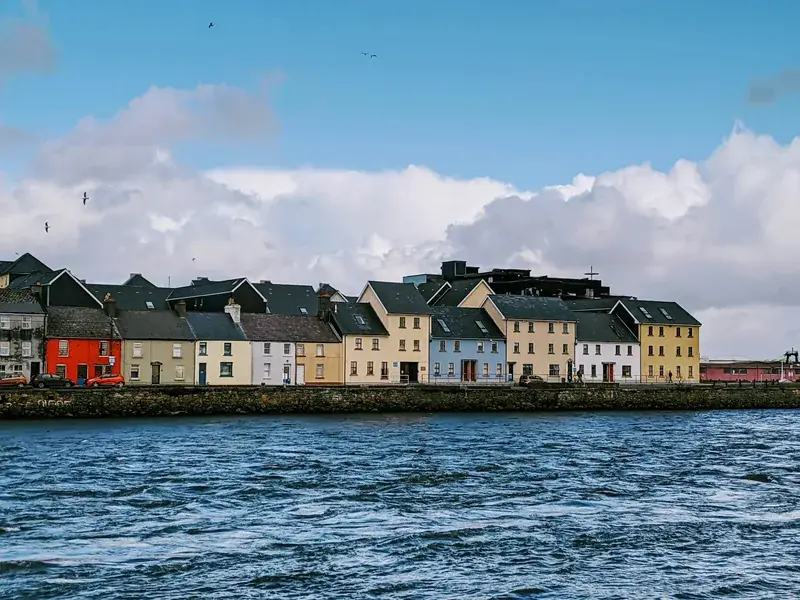
Where the quarter meets the river stands the Spanish Arch, built in 1584 as an extension of the town walls to shelter the quays, and now the city's favourite spot for sitting on the grass with the water in front of you. Beside it, Galway City Museum tells the story of the city's long relationship with the sea across three floors, including a traditional Galway hooker and the original statue of the Irish-language writer Pádraic Ó Conaire. Walk on past the arch and the Long Walk begins, a row of eighteenth-century houses in bright paint facing the harbour, five minutes from the arch and the best photograph in Galway.
Spanish Arch
Surviving arches of a sixteenth-century city wall on the old quays, damaged by the 1755 tsunami.
Galway City Museum
Riverside museum of local history, medieval stonework, maritime craft and a beloved writer's statue.
The Long Walk
Colourful row of quayside houses along the river mouth, beside the old stone arches.
Across the Corrib: the Claddagh and the Cathedral
Over the river lies the Claddagh, a fishing settlement far older than the walled town and the birthplace of the Claddagh ring. Claddagh Quay looks back across the harbour mouth to the Long Walk and the swans, and it is the place to be at sunset. Follow the Corrib upstream and the green dome of Galway Cathedral appears, completed in 1965 on the site of the old city jail and often called the last great stone cathedral built in Europe. The Salmon Weir Bridge beside it is the classic view, with anglers below and the dome above.
Claddagh Quay
Waterfront of a vanished Irish-speaking fishing village, birthplace of the famous Claddagh ring.
Galway Cathedral
Limestone cathedral with a soaring dome, raised on the site of a demolished county jail.
Salmon Weir Bridge
Five-span stone bridge over a rushing river, beside a weir where anglers cast for running salmon.
Salthill Prom and Blackrock
West of the city the Salthill Prom runs for about three kilometres along Galway Bay, with the Burren hills across the water and the Mutton Island lighthouse offshore. Locals kick the wall at the end to mark a completed walk, then watch the swimmers at the Blackrock Diving Board, where people plunge into the cold Atlantic in every month of the year.
Music, races and getting around
Galway's evenings belong to traditional music, and the Crane Bar on Sea Road in the West End is where sessions spill out of the door. In late July the Galway Races draw well over a hundred thousand people for the summer festival, and the Arts Festival, Film Fleadh and Oyster Festival each take over the town in turn. Everything in the centre is within a twenty-minute walk; Salthill is a short bus ride or a pleasant stroll along the bay.