
Zagreb is a city of two hills that spent centuries as rivals before becoming one capital. On one rise stood Kaptol, the bishop's town, founded when the Zagreb diocese was established in 1094; on the other stood Gradec, the merchants' town, granted free royal city status by King Béla IV's Golden Bull of 1242. The creek that ran between them became a street, the two towns were formally united in 1850, and the orderly 19th-century Lower Town grew out below them. The result is a compact, café-filled Central European capital that most visitors cross on the way to the Adriatic coast — and that rewards anyone who stays.
It is also an ideal city to explore with self-guided audio guides. The historic core is small enough to cover in a day or two, but every gate, church and square carries a story that a plaque can't fit — and each landmark below has an audio guide that tells it as you stand there. Begin at Ban Jelačić Square, the broad central plaza with its equestrian statue of the 19th-century ban (governor), where the Upper Town and Lower Town meet and the trams converge.

Kaptol: the cathedral and the belly of Zagreb
From the square it is a short climb to Kaptol, the old ecclesiastical town. Its centrepiece is the Cathedral of Zagreb, the tallest building in the city, whose neo-Gothic twin spires rose after an 1880 earthquake wrecked much of the medieval structure. Just below it, the red umbrellas of Dolac Market have earned it the nickname "the belly of Zagreb": a multi-level market where farmers from across Croatia sell produce, cheese and honey, with a flower section at the edge. Officially it runs until mid-afternoon, but most stalls have sold out by noon, so come early.
Cathedral of Zagreb
Neo-Gothic cathedral with twin stone spires, being rebuilt stone by stone after an earthquake.
Dolac Market
Raised open-air farmers' market of red-umbrella stalls, with covered meat, dairy and fish halls below.
Kaptol
Medieval bishop's hill crowned by a twin-spired neo-Gothic cathedral and fragments of old walls.
Gradec: St. Mark's, the Stone Gate and the noon cannon
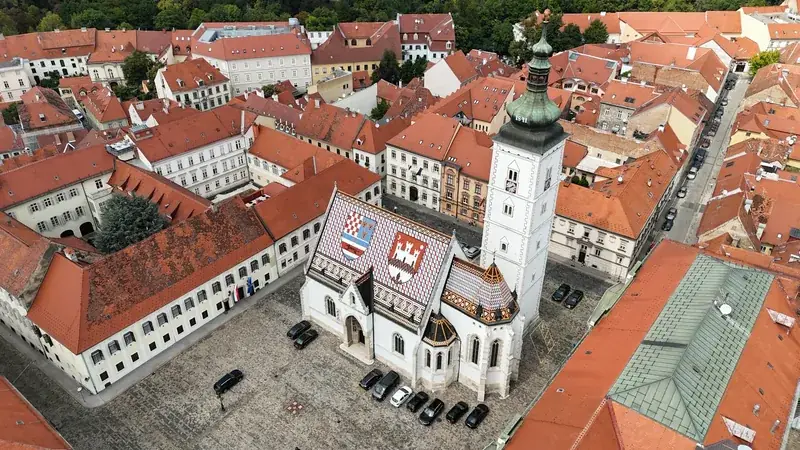
The other hill is Upper Town proper — Gradec, the walled civic town. Enter through the Stone Gate, the only surviving medieval gate, where a shrine to the Virgin draws people who stop to light a candle. A few streets on is St. Mark's Church, instantly recognisable by its colourful tiled roof bearing the coats of arms of Croatia, Dalmatia and Slavonia on one side and Zagreb on the other; it fronts the square where the Croatian parliament and government sit. At the southern edge stands Lotrščak Tower, completed in 1266 to guard the town gate. Its name comes from the Latin for "thieves' bell", rung from 1646 to signal that the gates were closing. Today the Grič cannon fires from its fourth-floor window every day at noon, a ritual kept since New Year's Day 1877 — set your watch by it. Beside the tower, the Uspinjača funicular, one of the world's shortest, shuttles between the two towns, and the tree-lined Strossmayer Promenade runs along the old southern wall with the best view over the Lower Town's roofs. Nearby, the Museum of Broken Relationships turns donated everyday objects into surprisingly moving stories about love and loss. Linger into evening: the Upper Town is still lit by gas lamps.
St. Mark’s Church
Medieval parish church with a Gothic sculpted portal and a roof of tiled coats of arms.
Stone Gate | Zagreb
Medieval town gate sheltering a candlelit shrine to a fire-surviving painting of the Virgin.
Lotrščak Tower
Medieval defence tower whose cannon fires every noon, with a rooftop lookout over the city.
Uspinjača
Steam-era funicular on a sixty-six-metre track, climbing to a tree-lined upper-town promenade.
Museum of Broken Relationships
Museum of donated break-up keepsakes, each displayed with its anonymous donor's own story.
Strossmayer Promenade
Shaded hilltop walk along old town walls, with city views and a bronze poet on a bench.
Tkalčićeva: the creek that became a street
Between the two hills ran the Medveščak creek, where tanners and millers once worked. The creek is gone, and Tkalčićeva Street now follows its course as Zagreb's great café street, its low workshop houses converted into bars, cake shops and boutiques. The little bridge-street that crosses it, Krvavi Most — "Bloody Bridge" — remembers the brawls between Kaptol and Gradec that gave the spot its name.
The Lower Town's parks and palaces
Below the hills, the Lower Town was laid out in the decades after 1880, when Zagreb adopted the grid of boulevards and squares it has today. Its spine is a chain of parks that begins with Zrinjevac Park, with its plane trees, fountains, wrought-iron bandstand and an old weather station, and continues south past the yellow Art Pavilion in Zagreb to the railway station. To the west, the Croatian National Theatre holds court on its own square in Habsburg yellow, and the Mimara Museum nearby houses one of the region's largest private art collections. This is Zagreb at its most Viennese — all grand façades, galleries and coffee-house pace.
Zrinjevac Park
Plane-tree promenade with a wrought-iron music pavilion, fountains and a marble weather column.
Art Pavilion in Zagreb
Glass-domed exhibition hall on an iron frame first raised in Budapest, ringed by painters' busts.
Croatian National Theatre
Grand opera and drama house with a painted ceremonial curtain and a sculpted fountain at its door.
Mimara Museum
Vast private art collection spanning millennia, housed in a neo-Renaissance former school building.
Mirogoj, Maksimir and the mountain
Three places outside the centre are worth the tram ride. Mirogoj cemetery, designed by Hermann Bollé, is reckoned among Europe's most beautiful burial grounds for its ivy-covered arcades, domes and finely sculpted tombs. Park Maksimir, opened in 1794, is the oldest public park in southeastern Europe, an English-style landscape of lakes, meadows and 19th-century pavilions. And rising behind the whole city is Nature Park Medvednica, whose summit, Sljeme, gives Zagrebians their weekend hikes and winter skiing, with the medieval fortress of Medvedgrad on its slopes.
Mirogoj cemetery
Park-like cemetery of ivy-clad arcades, copper domes and tree-lined avenues beneath Medvednica.
Park Maksimir
Historic English-style landscape park with oak woods, a chain of lakes and nineteenth-century pavilions.
Nature Park Medvednica
Forested mountain park with hiking trails, medieval castle ruins and a summit high above the capital.
Getting around
Zagreb's centre is flat except for the Upper Town, and almost everything in this guide is within a half-hour walk of Ban Jelačić Square. Blue trams cover the Lower Town and reach Mirogoj, Maksimir and Jarun lake; the funicular saves the climb to Gradec. December brings the Advent market to Zrinjevac, and in summer the city empties toward the coast — which is exactly when its cafés and terraces are at their most relaxed.