
Thessaloniki is Greece's second city and its most layered one: founded around 315 BC by Cassander of Macedon and named after his wife, a half-sister of Alexander the Great, it went on to be a Roman provincial capital on the Via Egnatia, the "co-capital" of the Byzantine Empire after Constantinople, and for nearly five centuries a multi-ethnic Ottoman port where churches, mosques and synagogues stood on the same streets. Unlike Athens, it never froze into a museum. Its Roman arches and Byzantine churches sit between cafés and bus stops, and the city itself is the exhibit.
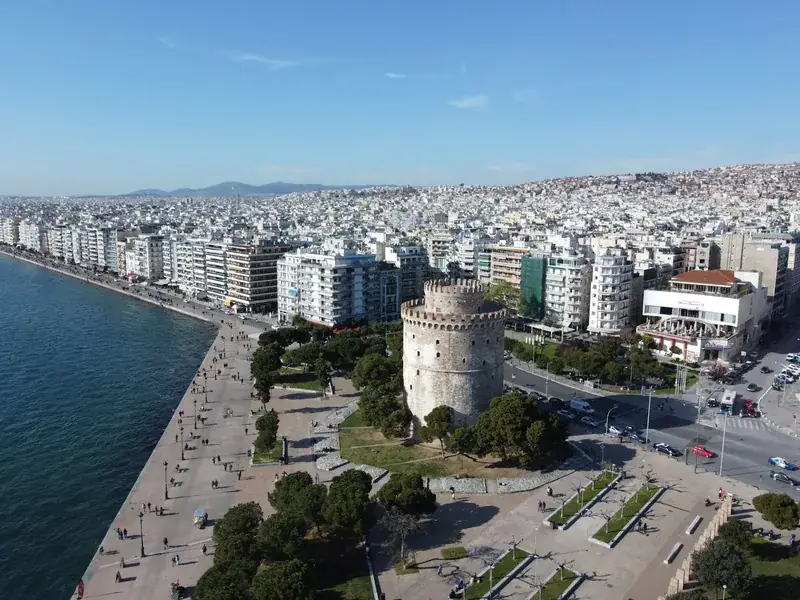
That is why it rewards exploring with self-guided audio guides. The monuments are scattered across a few square kilometres of ordinary streets, and each one has a story that is not on the plaque — an emperor's unused tomb, a prison tower renamed by a coat of whitewash, a quarter of olive-oil warehouses turned into the city's night out. Begin on the waterfront, where the White Tower of Thessaloniki has stood since Ottoman times; it was once a notorious prison nicknamed the Tower of Blood, and today it holds a museum of the city's history and a rooftop view that reaches Mount Olympus on a clear day. From there, the five-kilometre seafront promenade runs past the equestrian statue of Alexander the Great toward the Concert Hall, and it is the city's evening living room.

White Tower of Thessaloniki
Fifteenth-century Ottoman sea tower, once a prison, now a six-floor city museum with a rooftop terrace.
Thessaloniki Waterfront
Seafront promenade of gardens and sculptures stretching east from a landmark Ottoman-era tower.
Alexander the Great Statue
Bronze equestrian monument of a Macedonian conqueror on the seafront, backed by a battle relief.
The Galerian Mile: Arch, Rotunda and the Palace
At the turn of the fourth century the emperor Galerius made Thessaloniki an imperial capital, and his building programme still anchors the centre. The Arch of Galerius was raised in 298–299 and dedicated in 303 to celebrate his victory over the Persian king Narseh; its carved pillars still stand astride Egnatia, the street that follows the ancient Roman road. A short walk uphill is the Rotunda, built around 306, probably as the emperor's mausoleum — though Galerius was buried elsewhere, and the great brick dome stood empty until Theodosius turned it into a church. It served as a church for over twelve hundred years, became a mosque with a minaret in 1590, and was inscribed by UNESCO in 1988. Between the two, the excavated remains of the Palace of Galerius lie open to the street. Together they are the single best place to hear how Thessaloniki's Roman, Christian and Ottoman lives were lived in the same buildings.
Arch of Galerius
Roman triumphal arch of brick and carved marble celebrating an emperor's victory over Persia.
Rotonda
Massive Roman brick rotunda turned church and mosque, its vaults glittering with gold-glass mosaics.
Palace of Galerius
Ruined late-Roman imperial palace with basilica apse, heated halls and mosaics beside a lost hippodrome.
Byzantine Thessaloniki, from Saint Demetrius to Hagia Sophia
Thessaloniki's early Christian and Byzantine monuments, built from the fourth to the fifteenth century, were listed by UNESCO as a group in 1988 — more than a dozen churches and monasteries, most of them still in use. The Holy Church of Saint Demetrius is the heart of it: the basilica of the city's patron saint, whose relics rest in the crypt where pilgrims have come since the beginnings of Christianity. The eighth-century Hagia Sophia served as the city's cathedral until the early sixteenth century. Smaller churches hide the finest surprises — the fifth-century Hosios David of the Latomou Monastery keeps mosaics from the fifth and sixth centuries. The Museum of Byzantine Civilization, with more than three thousand artefacts, puts the mosaics and icons into context and makes a good first or last stop.
Holy Church of Saint Demetrius
Five-aisled Byzantine basilica of reused marble, rebuilt after fire, above a Roman bath crypt.
Holy Cathedral Church of Hagia Sophia
Byzantine domed basilica with a glittering Ascension mosaic of apostles among stylised trees.
Latomos Monastery - Holy Church of Hosios David
Fifth-century Byzantine chapel with a rare apse mosaic of a youthful Christ seated on a rainbow.
Museum of Byzantine Civilization
Public museum of Byzantine art and life, rich in painted early Christian tombs and wall paintings.
Up to Ano Poli and the walls
The Great Fire of 18 August 1917 burned for thirty-two hours, destroyed the old centre and left seventy-two thousand people homeless. The one district it spared was Ano Poli, the Upper Town, which still climbs the hillside in stone-paved lanes lined with Ottoman timber houses. At the top the Byzantine walls close around the Heptapyrgion, a seven-towered fortress that later served as a prison, and the Trigonion Tower, where the whole city, the gulf and, on a clear day, Olympus lay out below you at sunset. The walk down is the city's best audio tour: every bend passes a church or monastery far older than the houses around it.
Ano Poli
Hilltop old quarter of winding lanes, Byzantine walls and a square honouring a rebetiko composer.
Heptapyrgion of Thessaloniki
Hilltop fortress of ten towers in stone, brick and reused marble, later converted into a prison.
Trigonion Tower
Round Ottoman-era artillery tower wrapped around a Byzantine core, with views to the gulf and Olympus.
Markets, Ladadika and the city Hébrard rebuilt
After the fire, the French architect Ernest Hébrard redrew the centre with wide avenues and monumental squares. His showpiece is Aristotelous Square, a curved colonnade opening onto the sea that remains the city's meeting place. Just inland, the covered Agora Modiano and the open-air Kapani market sell olives, spices, cheese and fish, with tavernas tucked between the stalls. Toward the port, Ladadika was once the quarter of olive-oil warehouses; the low painted buildings now hold the restaurants and bars that keep Thessaloniki awake, and the narrow lanes are at their best after dark.
Aristotelous Square
Grand seafront plaza lined with arcaded Byzantine-style facades, rebuilt after a devastating fire.
Agora Modiano
Covered nineteen-twenties market hall under a steel roof, revived as a food hall with cafes and stalls.
Kapani Market
Arcaded Ottoman-era food market of spice, olive and fish stalls, ouzo bars and old trading lanes.
Ladadika
Former olive-oil warehouse quarter by the port, now cobbled lanes of tavernas, ouzeris and bars.
Jewish Thessaloniki
After 1492, close to twenty thousand Sephardic Jews expelled from Spain settled here, and from the sixteenth century into the twentieth Thessaloniki was the only Jewish-majority city in Europe — in 1890 almost half its people were Jewish. Of the forty-five thousand deported to Auschwitz from March 1943, about four percent survived. The Jewish Museum of Thessaloniki tells that story through photographs, documents and objects, and the Holocaust Memorial near the port remembers those who were deported. It is a quiet, necessary chapter of any visit.
Getting around
The centre is compact and flat between the waterfront and Egnatia, so most sights are within a twenty-minute walk of Aristotelous Square; only Ano Poli needs a climb or a short bus ride. The Thessaloniki Metro opened in 2024 and links the railway station with the centre and the eastern districts. Mornings belong to the markets, afternoons to the museums, and the promenade to the hour before sunset.