
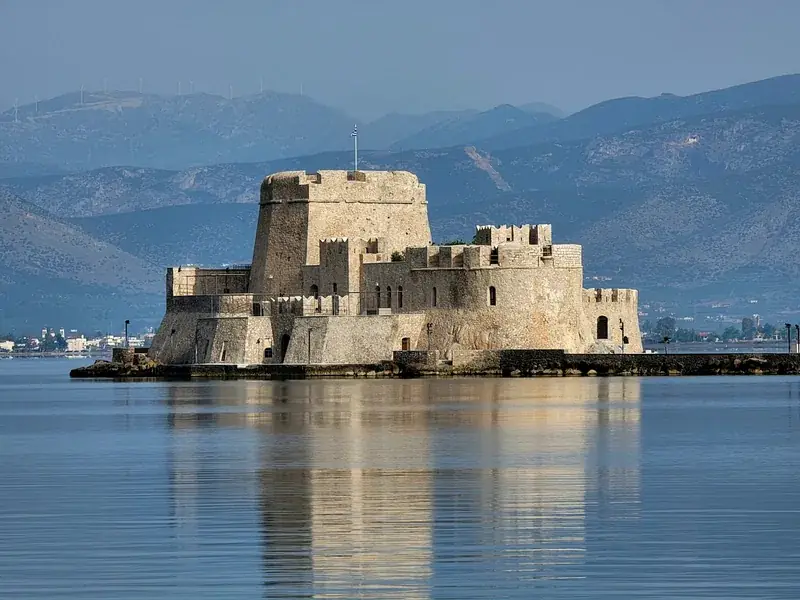

Nafplio is the small Peloponnesian port that was, for a few turbulent years, the capital of modern Greece. It sits on a stubby peninsula in the Argolic Gulf, under three fortresses: the ancient rock of Acronauplia at its back, the Venetian stronghold of Palamidi on the hill above, and the tiny island fort of Bourtzi floating in the harbour. Between them lies one of the best-preserved old towns in the country, a grid of Venetian mansions, Ottoman fountains and neoclassical balconies that opens onto a long, cafe-lined waterfront.
It is a city that rewards slow exploring, and that is how the audio guides here are built: each landmark has its own story, from Bronze Age Nauplia, the port of Argos, through Frankish crusaders, Venetian admirals and Ottoman pashas, to the year 1828, when Ioannis Kapodistrias stepped ashore as the first governor of a free Greece. Listen as you go, and the cobbles start to make sense.
Climb Palamidi, then look back at Bourtzi
Start with the view. Palamidi, built by the Venetians after they retook the town in 1686, is often called the last major Venetian fortress overseas; it rises about 216 metres above the water, and the stair that zigzags up from the old town is famously counted at 999 steps (you can also drive to the top). From the bastions you take in the whole gulf, and the audio guide tells how Greek fighters under Staikopoulos and Kolokotronis seized the fortress in November 1822, and how Kolokotronis himself was later jailed inside it. Below, Acronauplia stacks three levels of walls from pre-classical, Frankish and Venetian times, with views down to Arvanitia beach. Out in the bay, Bourtzi was fortified by the Venetians in the 1470s to seal the harbour with a chain, and later served as a prison and, briefly, a hotel; a short boat ride gets you there.
Palamidi Fortress
Hilltop Venetian fortress of eight bastions, reached by a long stone stair and later used as a prison.
Fortress of Acronauplía
Hilltop citadel of Venetian walls and gates, once a prison, overlooking the old town and gulf.
Bourtzi Fortress
Venetian island fortress built onto bare bedrock, guarding the harbour mouth since the fifteenth century.
Syntagma Square and the first parliament
Nafplio's living room is Syntagma Square, a broad cobbled space ringed by buildings that each belong to a different ruler. The Archaeological Museum of Nafplio occupies a Venetian fleet warehouse on one side; on another, the Vouleftiko, a former Ottoman mosque, is where the first parliament of the Greek state sat. Pick up the audio guides here to hear how a square built for Venetian commerce became the stage for a new nation.
Syntagma Square - Nafplio
Café-lined old-town square framed by a Venetian arsenal, a former mosque and the first parliament.
Archaeological Museum of Nafplio
Venetian naval warehouse of 1713 housing Argolid finds, including a full Mycenaean bronze panoply.
Vouleftiko - First Parliament of Greece
Domed eighteenth-century Ottoman mosque that housed the first Greek Parliament and a famous treason trial.
Kapodistrias, Otto and the streets of the old town
The most dramatic chapter is a few lanes away at the Church of Saint Spyridon, where Kapodistrias was assassinated on its steps on 9 October 1831 by members of the Mavromichalis family. The young King Otto arrived in 1833 and moved the capital to Athens the following year, and the town settled into the quieter rhythm you find today along Staikopoulou, a street of mansions, tavernas and shops. Two small museums catch the character of the place: the Komboloi Museum, with around a thousand strings of worry beads dating from 1700 to 1950, and the Basil Papantoniou Foundation, the former Peloponnesian Folklore Foundation, with its costume and craft collections.
Church of Saint Spyridon
Domed 1702 Orthodox church where Greece's first governor was assassinated, a bullet mark by its door.
Staikopoulou
Old-town street home to a museum and workshop devoted to centuries of Greek worry beads.
Komboloi Museum
Private museum of worry beads and world prayer beads, with a bead-making workshop downstairs.
Basil Papantoniou Foundation
Folk-costume museum in a neoclassical family house, with textiles, toys and designer fashion.
The Arvanitia promenade and the beaches
When you need sea air, the Promenade d'Arvanitia is a roughly one-kilometre cobbled path that curls around the base of Acronauplia from the quay to Arvanitia Square, with the Argolic Gulf on one side and cliffs on the other. The small pebble beach at Arvanitia is the town's swimming spot; a few kilometres further on, Karathona is a long sandy bay with shallow water, and Tolo, about ten kilometres away, is the big organised resort beach.
Promenade d’Arvanitia
Cliff-hugging seaside walkway beneath fortress walls, with gulf views and a chapel built into the rock.
Paralia Arvanitias
Organized town beach beneath sheer cliffs and fortress walls, linked to the harbour by a seaside path.
Καραθόνα
Long sandy bay below wooded hills, with seaside chapels and a cave hermitage reached by coastal paths.
Tolo Beach
Long, shallow sandy beach on a sheltered bay, facing rocky islets and a lit island chapel.
Day trips: Tiryns, Mycenae and Epidaurus
Nafplio is the natural base for the Bronze Age Argolid. The Mycenaean citadel of Tiryns, with its Cyclopean walls, is only about four kilometres out of town; Mycenae, home of Agamemnon's legend and the great beehive tomb known as the Treasury of Atreus, is roughly twenty. Further east, the ancient theatre at the sanctuary of Asklepios at Epidaurus is one of the best-preserved in the Greek world. Each site has its own audio guide, so a hire car and a morning are all you need.
Mycenean Acropolis of Tiryns
Bronze Age citadel ringed by Cyclopean walls, its palace once painted with hunting scenes.
Archaeological site of Mycenae
Bronze Age citadel ruins entered through a lion-crowned gate, beside a circle of royal shaft graves.
"Treasury of Atreus" or "Tomb of Agamemnon"
Bronze Age beehive tomb with a vast corbelled dome, long corridor and a colossal stone lintel.
Ancient Theatre at the Asklepieion of Epidaurus
Limestone theatre of the fourth century BC, famed for its acoustics and serving a healing sanctuary.
Getting around
The old town is compact and car-free in its core, so everything from the harbour to Syntagma Square is a few minutes on foot; Palamidi is a stiff climb or a short drive. Buses link the nearby towns, but schedules are limited, so a car or a booked driver is the practical way to reach Tiryns, Mycenae and Epidaurus in one day.