
Mykonos, the White Jewel of the Cyclades
Mykonos is the Cyclades at their most dazzling — a small Greek island of whitewashed cubes, blue-domed chapels and bougainvillea-draped lanes that became the Mediterranean's jet-set playground in the 1960s, when artists and free spirits first discovered its light. Beneath the glamour lies a layered story of Venetian merchants, pirate raids and one of antiquity's holiest sanctuaries — and the best way to hear it is with a self-guided audio tour in your ear, letting each landmark tell its own story at your own pace.
A Maze Built to Fool Pirates
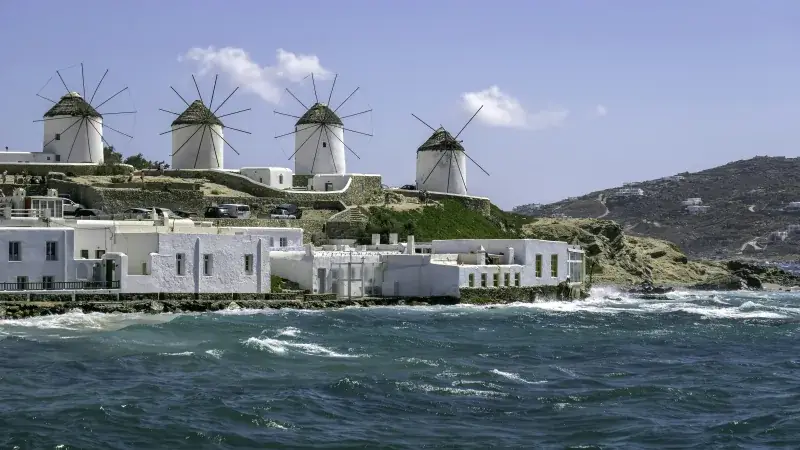
The island's capital, Chora (Mykonos Town), is a deliberate labyrinth: its narrow, winding alleys were laid out to confuse raiding pirates, and today they funnel you past galleries, cafés and the boutiques of Matogianni street. Follow them toward the water and you reach the icons that anchor any audio walk through town. On a low rise stand the Kato Mili windmills, first built under Venetian rule in the 16th century to grind grain for the island's maritime trade. Just below, the sea slaps against Little Venice, a row of medieval-era captains' and merchants' houses whose painted balconies hang directly over the waves — the classic Mykonos sunset spot. Nearby, the Church of Panagia Paraportiani fuses five small chapels into one sculptural, asymmetrical white mass, among the most photographed churches in Greece.
Windmills of Mykonos
Whitewashed stone windmills on a hilltop, sails once trimmed by hand to grind grain in the meltemi wind.
View of Alefkandra (Little Venice)
Waterfront row of captains' houses with wooden balconies suspended directly above the sea.
Holy Church of Panagia Paraportiani
Five whitewashed chapels fused into one asymmetrical church beside a ruined Venetian castle gate.
Sacred Delos, a Short Sail Away
A brief boat ride from the old harbour lies Delos, the uninhabited, UNESCO-listed island revered in myth as the birthplace of Apollo and Artemis. Once a Panhellenic sanctuary and later a booming Roman free port, it is now one of Greece's greatest archaeological sites — and with an audio guide, the Terrace of the Lions (marble guardians dedicated by the Naxians in the 7th century BCE), the ancient theatre and the mosaic-floored villas come vividly back to life.
Archaeological Site of Delos
Sacred ruins of a pan-Hellenic sanctuary where birth and death were once forbidden by law.
Terrace of the Lions
Row of snarling archaic marble lions guarding a sacred lake, replicas of a seventh-century offering by Naxos.
Ancient Theatre of Delos
Marble tiers for thousands, above a rainwater cistern on a sanctuary once barred to birth and death.
Beaches, Villages and the Slower Island
The southern coast is a string of celebrated sands — glamorous Psarou, party-famous Super Paradise, and the family-friendly bays of Platis Gialos and Ornos. Inland, the village of Ano Mera gathers around the 16th-century Monastery of Panagia Tourliani, proof that beyond the beach clubs an older, quieter island endures. Between swims, the Archaeological Museum by the harbour ties Mykonos back to Delos and the deep Aegean past. Come for the glamour, stay for the stories — and let the audio guides fill the whitewashed lanes with the voices of their history.
Psarou beach
Sandy cove turned launchpad for one of the world's most imitated beach club concepts.
Paralia Super Paradise
Sheltered south-coast cove of golden sand and turquoise water, famed since the seventies as an all-day beach club party.
Platis Gialos
Sheltered, south-facing cove of soft sand and shallow turquoise water, calm even when island winds blow hard.
Ornos Beach
Sheltered, shallow bay of fine sand once worked by fishing boats, now lined with windsurfing and waterskiing schools.
Monastery of Tourliani
Whitewashed island monastery guarding an icon locals credit to the apostle Luke himself.
Archaeological Museum of Mykonos
Grave stelae and funerary urns exhumed from a sacred island's ancient burial purge, alongside a rare relief pithos of the Trojan Horse.