
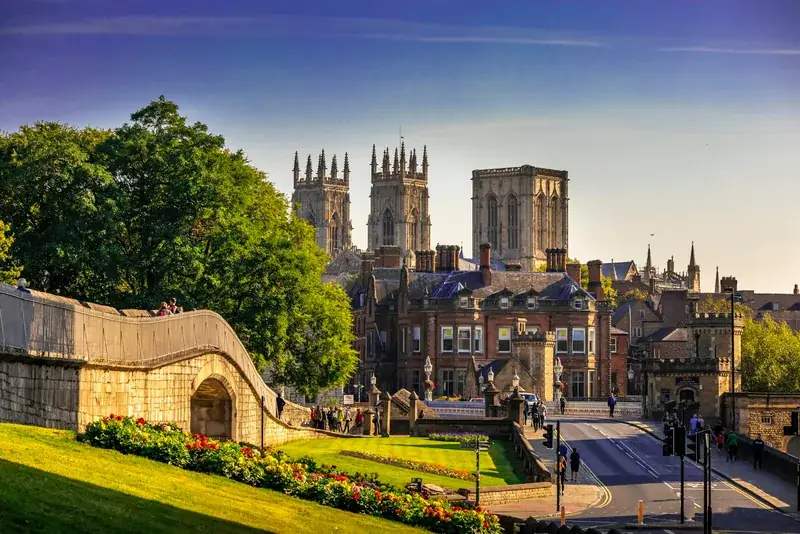

York is a city you can read like a book, layer by layer. The Romans founded it as Eboracum in AD 71, when the Ninth Legion raised a wooden fortress above the River Ouse; Constantine the Great was proclaimed emperor here in 306. The Vikings took it in 866 and renamed it Jorvik, and at its peak their trading town was second in size only to London. The Normans built a castle, the Middle Ages left a cathedral and a complete ring of walls, and the Victorians added railways and chocolate. Almost all of it is still standing, packed inside a historic core small enough to cross in twenty minutes.
That density is what makes York such a rewarding city to explore with self-guided audio guides. Every gate, church and crooked street has a story, and the story is usually better than the plaque. Start with York Minster, the second-largest Gothic cathedral in northern Europe and the largest completed during the Gothic period. Work began in 1220 under Archbishop Walter de Gray and finished in 1472, and the Great East Window, commissioned from John Thornton in 1405, holds the largest expanse of medieval stained glass in the country. Beneath the south transept, excavations in the 1960s and 70s found the headquarters of the Roman fortress, so the cathedral literally stands on the city's first chapter.

Walk the walls from Bootham Bar
The York City Walls run for 2.11 miles (3.4 km), the longest circuit of town walls in England, and most of it is a raised walkway you can follow at your own pace. The four main gatehouses, called bars, each have their own character. Bootham Bar, closest to the Minster, keeps some stonework from the eleventh century. Monk Bar is the tallest and most elaborate, a four-storey early fourteenth-century gatehouse whose portcullis still works. Walmgate Bar has the only surviving barbican on a town gate in England, with an Elizabethan house built out over the gateway. Micklegate Bar was the ceremonial entrance for monarchs arriving from the south, and the place where the heads of traitors were displayed. The audio guides for each bar tell those stories as you pass through.
York City Walls
Medieval stone ramparts with gatehouse bars and a raised wall-walk circling the historic centre.
Bootham Bar
Medieval gatehouse on a Roman gate site, with a portcullis slot and stone figures above its arch.
Monk Bar
Fortified fourteenth-century gatehouse with a working portcullis and a tiny Elizabethan prison cell.
Walmgate Bar
Medieval gatehouse with England's only surviving town-gate barbican, portcullis and Tudor timber house.
Micklegate Bar - Proof of York
Medieval royal gateway where traitors' heads were once displayed, now an artist's gallery and shop.
The Shambles and the medieval streets
The Shambles is the street everyone photographs, and with good reason. Its timber-framed buildings, many of them from between 1350 and 1475, lean so far over the lane that their upper floors nearly touch. The name comes from an Old English word for a butcher's stall; by 1426 it was recorded as the Great Flesh Shambles, and the shaded position kept meat fresh while the waste drained down the gutters. The last butchers closed in the early twentieth century, but some fronts still carry their meat hooks. A shrine on the street remembers Margaret Clitherow, the butcher's wife who was martyred for sheltering Catholic priests. Behind it, Shambles Market fills the space once known as Newgate Market, and nearby Stonegate carries the same medieval line past old shop signs and hidden courtyards toward the Minster.
Shambles
Narrow medieval butchers' lane of overhanging timber-framed shops, with surviving meat hooks.
Shambles Market
Daily open-air market of food, meat and fish stalls beside a medieval butchers' street.
Stonegate
Medieval lane of timber-framed shops, once the printers' quarter, guarded by a carved red devil.
Vikings, Normans and Clifford's Tower
Dig a few metres under Coppergate and you reach Jorvik, the Viking town; the JORVIK Viking Centre was built on the excavation site and recreates the tenth-century streets, smells included. A short walk south, Clifford's Tower rises on the motte William the Conqueror's men raised in 1068. In 1190 the wooden keep that stood here became the scene of one of the darkest episodes in English medieval history, when around 150 of York's Jews died rather than surrender to a mob. Henry III rebuilt it in stone between 1245 and 1272 in an unusual four-lobed quatrefoil plan, and an explosion on St George's Day 1684 gutted the interior while leaving the walls standing. Since 2022 a new roof deck has opened up the view over the whole city. Beside it, the York Castle Museum occupies the old prison buildings of the castle and tells the everyday side of the city's story.
JORVIK Viking Centre
Underground Viking street rebuilt on its original dig site, toured by ride with sounds and smells.
Clifford's Tower, York
Stone keep crowning a medieval castle mound, site of a notorious massacre in eleven ninety.
York Castle Museum
Social history museum in a Georgian prison, with a recreated Victorian street of real shop fronts.
Museum Gardens and the Roman wall
The quietest corner of the old city is the Museum Gardens beside the Ouse, where the ruins of St Mary's Abbey, once one of the great Benedictine houses of the north, stand on the lawns. Here you also find the Multangular Tower, the most intact Roman structure left in York, added to the fortress corner around 310 to 320 and still showing small Roman stonework below the larger medieval blocks above. The Yorkshire Museum on the same grounds holds the Roman, Viking and medieval finds that explain what you have just been walking over.
Museum Gardens
Riverside botanic gardens around medieval abbey ruins, once the open-air stage for mystery plays.
St Mary's Abbey
Ruined Benedictine abbey church amid riverside gardens, once among England's wealthiest monasteries.
Multangular Tower
Ten-sided Roman corner tower with a red tile band, medieval upper stonework and Roman stone coffins.
Yorkshire Museum
Archaeology museum of Roman, Viking and medieval treasures set in ruined abbey gardens.
Railways and chocolate
George Hudson brought the railway to York in 1839, and by 1900 trains and sweets were the city's two great industries. The National Railway Museum, opened in 1975 just behind the station, is the largest of its kind in the world, with famous locomotives lined up under one roof. Rowntree's, founded by Henry Isaac Rowntree in 1862, gave the world the Kit Kat, and Terry's was the city's other great chocolate employer; York's Chocolate Story tells how Quaker grocers turned York into a sweet-making capital. For the city's best-known afternoon ritual, join the queue at Bettys Café Tea Rooms on St Helen's Square.
National Railway Museum York
National collection of locomotives and royal carriages, from Victorian saloons to record-breaking steam.
York's Chocolate Story
Interactive chocolate museum tracing a city's confectionery dynasties, with tastings and hands-on making.
Bettys Café Tea Rooms
Art Deco tea room modelled on an ocean liner, with a wartime mirror engraved by bomber crews.
Getting around
York's historic centre sits inside the walls and is almost entirely walkable; the station is a ten-minute stroll from the Minster across Lendal Bridge. Direct trains link York with both London and Edinburgh, which makes it an easy stop between the two capitals. Allow two days to do the city justice, and a third for Castle Howard or Fountains Abbey in the countryside beyond.