

Oxford began as a Saxon river town — Oxenaforda, the ford of the oxen — at the point where the Cherwell meets the Thames, which locals still call the Isis. Teaching had begun here by the eleventh century, and by the late twelfth the university was taking shape, folding itself into the streets rather than walling itself off. That is why Oxford feels the way it does: a working city of about 166,000 people threaded through with medieval quadrangles, honey-coloured stone and towers you glimpse down every lane.
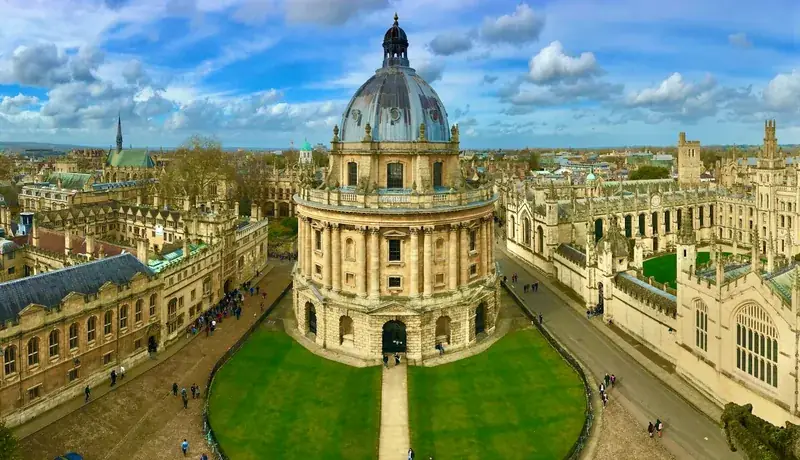
It is a city of thresholds. A plain wooden gate on the High Street opens onto a silent cloister; an alley behind a pub leads to a college older than most countries. The self-guided audio guides are built for exactly this — stop at a gatehouse, press play, and hear who built it, who studied inside, and why the bell still rings at a strange hour. Start with the Radcliffe Camera, the domed library at the city's heart, and the rest of Oxford unfolds around it.

Start at Christ Church
Cardinal Wolsey founded his college here in 1525 on the lands of St Frideswide's Priory; Henry VIII refounded it as Christ Church in 1546. The old priory church became both the college chapel and the cathedral of the Diocese of Oxford — a double role no other college can claim. Thirteen British prime ministers studied here, and so did Lewis Carroll, whose Alice wandered out of these grounds and into Wonderland. Stand in Tom Quad at five past nine in the evening and you will hear Great Tom, in Christopher Wren's gate-tower, strike one hundred and one times — once for each of the original scholars, plus one. The audio guide for Christ Church unpicks that odd number, and the one for Christ Church Cathedral takes you inside. Then walk out through the meadow, where English Longhorn cattle still graze within sight of the spires.
Christ Church
Tudor college and cathedral behind a Wren-designed gate tower whose great bell tolls nightly.
Christ Church Cathedral
Norman and Gothic cathedral chapel holding the rebuilt medieval shrine of a Saxon princess saint.
Christ Church Meadow
Riverside flood meadow with tree-lined walks, grazing longhorn cattle and views of college spires.
The Bodleian and Radcliffe Square
Radcliffe Square is the postcard, and it earns it. The Radcliffe Camera was built between 1737 and 1749 to James Gibbs's design, paid for by the £40,000 that physician John Radcliffe left for a library; today it is a Bodleian reading room, with a store for around 600,000 books hidden beneath the square. Around it cluster the Bodleian Library itself, the fan-vaulted Divinity School, and the Sheldonian Theatre, where the university still holds its ceremonies. A few steps along New College Lane, the Hertford Bridge — the one everyone calls the Bridge of Sighs — spans the street. Each has its own audio guide, so you can take the square one building at a time rather than as one overwhelming view.
Bodleian Library
Historic research library with a medieval reading room and an oath readers still swear aloud.
The Divinity School
Fifteenth-century vaulted hall for theology teaching, its ceiling studded with hundreds of carved bosses.
The Sheldonian Theatre
Wren-designed ceremonial hall guarded by bearded stone heads, with a painted ceiling of the Arts.
The Hertford Bridge
Stone skyway linking two college quadrangles over a narrow lane, carved with heraldic shields.
Museums on Parks Road and Beaumont Street
Oxford's museums are small, free-spirited and unusually strange. Walk through the Oxford University Museum of Natural History, under its iron-and-glass roof, and you emerge into the Pitt Rivers Museum, founded in 1884 and holding more than half a million objects, photographs and manuscripts. It arranges things by type rather than by place or period — a "democracy of things" — so masks from three continents sit in one case. Across town on Beaumont Street, the Ashmolean Museum spans everything from Egyptian mummies to Pre-Raphaelite painting. The audio guides help you pick a thread through collections that could otherwise swallow a day.
Oxford University Museum of Natural History
Natural history museum where Darwin's theory of evolution was famously debated in eighteen sixty.
Pitt Rivers Museum
Ethnography museum of crowded Victorian cases, reached through a natural history hall.
Ashmolean Museum
Museum of art and archaeology behind a two-stone Greek Revival front, with a light-filled modern core.
The Covered Market and the High
The Covered Market opened on 1 November 1774, built to clear the "untidy, messy and unsavoury" stalls off the main streets; John Gwynn, who also designed Magdalen Bridge, drew the High Street front with its four entrances. Butchers still make Oxford sausage here, alongside bakeries and gift shops. Follow the High Street east and it curves past college fronts to Magdalen College, with its cloisters, deer park and tower, and the Oxford Botanic Garden across the road on the banks of the Cherwell. Listen to the guides as you go — the High is a street best taken slowly.
The Covered Market
Eighteenth-century indoor market of narrow avenues lined with butchers, bakers, florists and cafés.
Magdalen College
Medieval college with a soaring bell tower where choristers sing to the dawn crowds every May Day.
Oxford Botanic Garden
Walled seventeenth-century physic garden by a river, with glasshouses and an ornate stone gateway.
Rivers, meadows and the edge of town
Ten minutes north of the centre, Oxford stops pretending to be a city. Port Meadow is open common land grazed by horses and cattle, with the Thames running along its western edge; the Victorian terraces of Jericho sit beside it, once the printing district and now full of cafés. Walk the towpath far enough and you reach the Trout Inn, a riverside pub with a view of the Godstow ruins. Oxford's industrial side is out here too: William Morris started building cars in the city in 1910, and his Cowley works later produced the Mini.
Port Meadow
Ancient riverside common grazed by ponies and cattle under rights recorded in the Domesday Book.
Jericho
Victorian streets of former press workers' terraces, crowned by an Italianate church bell tower.
The Trout Inn
Seventeenth-century stone riverside inn beside a roaring weir and a medieval Thames bridge.
Getting around
The historic centre is compact and largely car-free, so you will be on foot, by bicycle or on one of the frequent buses from the railway station and the park-and-ride sites. Most colleges open to visitors in the afternoon, and some close during exams, so check before you plan your route. The audio guides work in any order — start wherever the nearest gate happens to be open.