
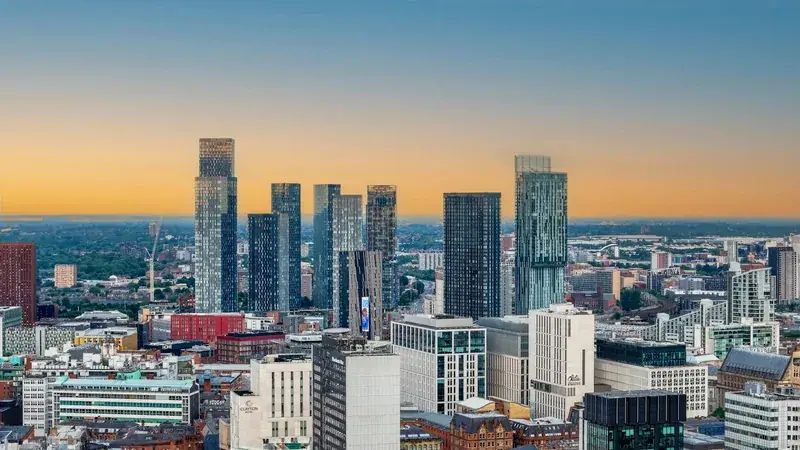
Manchester calls itself the world's first industrial city, and it earned the title: the cotton trade of the Victorian era made it "Cottonopolis", the world's largest marketplace for cotton goods, and the mills, warehouses and canals that fed that trade still shape the streets. But this is not a museum city. Red brick has been turned into lofts, studios and bars, the music that came out of here (the Smiths, the Haçienda, Oasis) still hums under everything, and two of the biggest football clubs on earth play on either side of town.
It is also a city of ideas and arguments: the Peterloo Massacre of 1819, the birth of the suffragette movement, Marx and Engels reading side by side in a seventeenth-century library. Every landmark has an audio guide that tells its story, so you can walk, tram or canal-hop between them at your own pace and let each place explain itself. A good place to start is the Gothic Revival Manchester Town Hall on Albert Square, the civic heart of the city and the showpiece of its Victorian confidence.

Castlefield, where the city began
In AD 79 the Roman general Agricola ordered a fort called Mamucium built on a sandstone bluff above the rivers Medlock and Irwell. The Mamucium Roman Fort Reconstruction marks the spot, and around it the Castlefield Urban Heritage Park is the oldest corner of Manchester: cobbles, canal basins and old warehouses along the Bridgewater Canal, which opened in 1761 as Britain's first wholly artificial waterway. Overhead, the National Trust - Castlefield Viaduct has turned a disused railway bridge into an elevated garden. A few steps away, the Science and Industry Museum occupies the former Liverpool Road station, where the world's first intercity passenger railway opened in 1830. Inside are working textile machines, the Manchester Baby computer and the last stationary steam engine built to power a mill.
Mamucium Roman Fort Reconstruction
Rebuilt Roman gateway, rampart and ditches marking a first-century fort above two rivers.
Castlefield Urban Heritage Park
Canal basin district of restored warehouses, viaducts and a rebuilt Roman fort at the cradle of industry.
National Trust - Castlefield Viaduct
Victorian steel railway viaduct reborn as a sky park of community gardens above the canals.
Science and Industry Museum
Museum of industry and invention set in the world's oldest surviving railway terminus.
Libraries, protest and the radical city
Manchester's reading rooms are among its most surprising sights. Chetham's Library, opened in 1653, is the oldest free public reference library in the English-speaking world, with chained books and the table where Karl Marx and Friedrich Engels worked together. The John Rylands Library on Deansgate, opened in 1900 by Enriqueta Rylands in memory of her husband, is a neo-Gothic cathedral of books holding a fragment that is the oldest known piece of the New Testament. On the Irwell, the People's History Museum fills a converted Edwardian pumping station with two centuries of protest and social movements, from Peterloo to the Labour Party. Nearby, the Emmeline Pankhurst Statue honours the Manchester-born leader of the suffragettes.
Chetham's Library
Fifteenth-century college buildings housing a public library founded in 1653, once with chained books.
The John Rylands Library
Neo-Gothic Victorian library with a church-like reading room, rare books and marble statues.
People's History Museum
National museum of democracy and protest in a former pump house, with hundreds of historic banners.
Emmeline Pankhurst Statue
Bronze suffragette leader standing on a chair, facing the hall where militant protest began.
The Northern Quarter and Ancoats
North-east of Piccadilly, the warehouses and textile mills of the Northern Quarter now hold street art, vinyl shops and late-night bars. Afflecks is the indoor emporium of vintage and oddities that anchors the district, and the Manchester Craft and Design Centre, in a former fish market, has working studios where you can talk to the makers. Keep walking into Ancoats, often described as the world's first industrial suburb, where mill complexes such as Murrays' Mills have been reborn as apartments and restaurants.
Afflecks
Indie market emporium of quirky stalls, with tile mosaics of local legends on its outer wall.
Manchester Craft and Design Centre
Victorian fish and poultry market turned light-filled hall of maker studios in the original stalls.
Murrays' Mills
Georgian brick cotton-spinning complex around a canal basin, among the oldest surviving steam mills.
Salford Quays and the waterfront
The docks of the Manchester Ship Canal, dug between 1888 and 1894, are now a glassy waterfront about twenty minutes by tram from the centre. Lowry is the glass-fronted arts centre with theatre, comedy and the city's collection of L. S. Lowry's matchstick-figure paintings; across the water stands IWM North, Daniel Libeskind's jagged Imperial War Museum, free to enter. MediaCityUK, home to the BBC and ITV, completes the set.
Lowry
Waterfront arts centre with theatres and galleries holding a major collection of L. S. Lowry paintings.
IWM North
War museum built as three shards of a shattered globe, with hourly wall-sized archive projections.
MediaCityUK
Waterside media district of TV studios and glass towers built on a former dock pier.
Football: two clubs, one city
Manchester United has played at Old Trafford, in neighbouring Trafford, since 1910; the United Trinity statue of Best, Law and Charlton waits outside. Manchester City's Etihad Stadium in east Manchester was built for the 2002 Commonwealth Games and converted into a football ground the following year. For the whole story of the game, the National Football Museum behind Exchange Square keeps Maradona's "Hand of God" shirt and the original Premier League trophy.
Old Trafford
Towering football stadium whose high-sided stands make growing its famous pitch a year-round battle.
Etihad Stadium
Cable-hung football stadium roofed from twelve outdoor steel masts, built first for the Commonwealth Games.
National Football Museum
Museum devoted to the history of football, its famous trophies, players and fans.
Getting around
The centre is compact and flat, and Metrolink, the UK's first modern tram system (opened 1992), links the city centre with Salford Quays, Old Trafford and the Etihad. Canal towpaths run from Castlefield into the suburbs, and the Alan Turing Memorial in Sackville Gardens, by Canal Street in the Gay Village, makes a quiet stop between districts.