
Liverpool is a port city that never stopped performing. For two centuries the Mersey made it one of the busiest harbours on earth, and the money that flowed through its docks built a skyline of clock towers, copper birds and neoclassical halls that still looks like it expects a liner to arrive any minute. Then four local lads picked up guitars, and the city became famous for a second reason that it has never let anyone forget.
It is a compact city that rewards wandering with headphones on. The waterfront, the Beatles trail, the cathedral hill and the cultural quarter around Lime Street all sit within a short walk of each other, and each landmark along the way has its own self-guided audio guide, so you can hear the story of a dock or a doorway at the moment you are standing in front of it. Start on the Liverpool Waterfront, where almost every chapter of the city's story begins.

Start at the Pier Head and the Three Graces
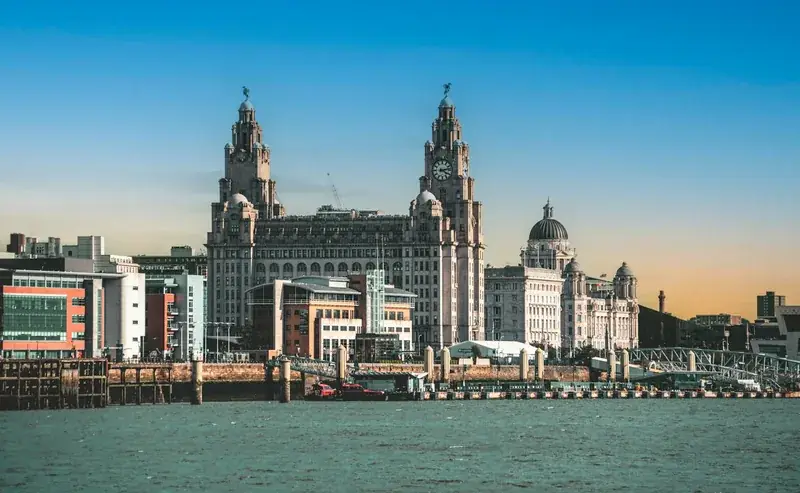
The Pier Head is Liverpool's front door. Three Edwardian giants stand shoulder to shoulder here: the Royal Liver Building, the Cunard Building and the Port of Liverpool Building, known together as the Three Graces. The Royal Liver Building opened in 1911 as a radical early experiment in reinforced concrete, with four clock faces each 7.6 metres across and a pair of 5.5-metre copper Liver Birds on its towers. Since 2019 you can climb inside its west clock tower, and the audio guides for all three buildings explain who paid for them, who sailed from them, and why the birds supposedly must never fly away.
Royal Liver Building
Edwardian waterfront office tower crowned by two copper Liver Birds atop its twin clock towers.
Cunard Building
Palazzo-style shipping headquarters carved with allied crests, zodiac signs and a bronze war memorial.
Port of Liverpool Building
Domed Edwardian harbour-board headquarters on a filled-in dock, with mermaid-and-dolphin iron gates.
Royal Albert Dock and its museums
A few minutes south along the river, the Royal Albert Dock is the city's great survivor. Opened by Prince Albert in 1846 and designed by Jesse Hartley and Philip Hardwick, it was the first non-combustible warehouse system in the world, built in brick, stone and cast iron so that sugar, tobacco and silk could be unloaded straight from ship to store. It closed in 1972, sat derelict, and was brought back to life in the 1980s; its five warehouses now form the largest group of Grade I listed buildings in the UK. Inside them you will find Tate Liverpool, the Maritime Museum, the International Slavery Museum and The Beatles Story, and an audio guide at the water's edge ties the whole basin together before you pick a door.
Royal Albert Dock Liverpool
Fireproof iron-and-brick warehouse dock where ships unloaded straight into the stores above.
Tate Liverpool
Modern and contemporary art gallery inside a converted Victorian dock warehouse with Doric columns.
Maritime Museum
Dockside museum of ships, emigration and disaster, with a Lusitania propeller on its quay.
International Slavery Museum
National museum on transatlantic slavery, its legacies and freedom struggles, beside a historic dock.
The Beatles Story Museum, Liverpool
Waterfront Beatles museum with recreated Cavern scenes, original instruments and personal artefacts.
Mathew Street and the Beatles trail
Beatles pilgrims head inland to Mathew Street, where The Cavern Club still runs live music in the cellar where the band played its early years. Back on the waterfront, The Beatles Statues, unveiled in 2015, catch the four mid-stride between the Three Graces. For the suburban chapter of the story, take a bus or taxi out to Penny Lane and Strawberry Field, the two ordinary places the songs made extraordinary. Each stop has its own audio guide, so the trail works just as well in pieces as in one long afternoon.
The Cavern Club
Rebuilt cellar music club where the Beatles played hundreds of shows and met their future manager.
Mathew Street
Narrow former fruit-market lane, home of the rebuilt cellar club where the Beatles rose to fame.
The Beatles Statues
Larger-than-life bronze of four bandmates striding along the waterfront, gifted by a famous music club.
Penny Lane
Former tram and bus terminus street whose barber, bank and roundabout shelter inspired a Beatles song.
Strawberry Field
Former Salvation Army children's home behind red gates, the garden that inspired a Beatles classic.
Hope Street and the two cathedrals
Hope Street runs along the ridge above the city with a cathedral at each end, which is why locals call it the street with a cathedral at both ends. At the south is Liverpool Cathedral, the Anglican giant consecrated in 1924 and one of the tallest non-spired church buildings in the world. At the north is the Liverpool Metropolitan Cathedral, Frederick Gibberd's circular concrete crown completed in 1967 and affectionately nicknamed Paddy's Wigwam. Between them lies the Georgian Quarter, where Hope Street was named the best street in the UK and Ireland in 2013. Stop at The Philharmonic Dining Rooms, a Grade II* listed pub, before a concert at the Royal Liverpool Philharmonic hall, built in 1936 to 1939 after its predecessor burned down.
Liverpool Cathedral
Vast red sandstone Anglican cathedral with a towering belfry and sweeping rooftop views.
Liverpool Metropolitan Cathedral
Circular modernist cathedral of concrete and glass, crowned by a lantern of vivid stained glass.
The Philharmonic Dining Rooms
Ornate Victorian gin palace with Art Nouveau gates, copper panels, mosaics and famed marble-look urinals.
Royal Liverpool Philharmonic
Streamlined art deco concert hall with gilded Apollo reliefs, etched glass and a rising cinema screen.
St George's Hall and William Brown Street
Step out of Lime Street station and you are facing St George's Hall, opened in 1854 to a design that Harvey Lonsdale Elmes won at the age of 25. Its Great Hall hides a Minton floor of more than 30,000 tiles under a protective cover and an organ that was the largest in the country until the Royal Albert Hall outdid it in 1871. The neoclassical parade continues up William Brown Street with the Walker Art Gallery and the World Museum, a run of civic grandeur best understood with the audio guide explaining what Victorian Liverpool was trying to prove.
St George's Hall
Neoclassical hall of courts and concert rooms with a pioneering Victorian air-conditioning system.
Walker Art Gallery
Victorian public art gallery whose paintings include Rossetti's vast Dante's Dream.
World Museum
Grand museum of world cultures, ancient Egypt, natural history and space, rebuilt after wartime fire.
Anfield, the Baltic Triangle and the coast
Liverpool's other religion lives at Anfield, home of Liverpool FC, and even non-fans find the stadium's stories worth hearing. South of the centre, the Baltic Triangle has turned old warehouses into a district of street food, studios and nightlife. And if you want to see where the river finally meets the sea, ride out to Crosby beach for Another Place by Antony Gormley, where cast-iron figures stare out across the tide.
Anfield
Historic football stadium with a main stand topped by a huge steel roof truss.
Baltic Triangle
Former timber-trade warehouse quarter turned creative district of studios, venues and street food.
Another Place by Antony Gormley
Hundred cast-iron human figures gazing out to sea across two miles of tidal sand and mud.
Getting around
The centre is walkable, and the Merseyrail network links Lime Street and the city-centre stations to Anfield, the southern suburbs and Crosby. The Mersey Ferries cross from the Pier Head to the Wirral and give the best view back at the Three Graces. Most of the sights above are within twenty minutes on foot of each other, so download the audio guides, start at the river and let the city tell its own story.