

Glasgow is Scotland's largest city, a Victorian powerhouse on the River Clyde that once called itself the second city of the British Empire. Its name is usually read as the Brittonic for "green hollow", and the affectionate gloss dear green place has stuck — fitting for a city with more than ninety parks and gardens threaded between sandstone terraces. The money came from the river: by the late nineteenth century the Clyde was launching more than half of Britain's shipping tonnage, and that wealth built the City Chambers, the Mitchell Library and the Kelvingrove galleries.
It is a city that rewards being told stories about, because so much of what you see — a cone on a statue, a cast-iron crane with nothing left to lift, a cathedral older than the kingdom around it — only makes sense once someone explains it. Every landmark below has its own audio guide, so you can wander the grid of the centre or the lanes of the West End at your own pace and let each place speak for itself. A natural first stop is George Square, the civic heart, where the opulent City Chambers face the statues and the Christmas lights.

Start at Glasgow Cathedral and the Necropolis
The medieval city grew around Glasgow Cathedral, the church of St Mungo, which survived the Reformation almost intact. Climb the hill just east of it and you cross the Bridge of Sighs, completed in 1836 over the Molendinar Burn, into the Glasgow Necropolis — a thirty-seven-acre garden cemetery opened in 1833 where around fifty thousand people lie beneath some three and a half thousand monuments. The Doric column at the summit, raised to John Knox in 1825 before the cemetery even existed, is where the grandest tombs cluster, and the view back over the cathedral roof is the best in the old town. Across the road, Provand's Lordship, the city's oldest surviving house, shows what medieval Glasgow looked like at street level.
Glasgow Cathedral
Medieval Gothic cathedral built over Saint Mungo's tomb, which survived the Reformation largely intact.
The Glasgow Necropolis
Victorian garden cemetery on a hilltop, crowded with ornate tombs, obelisks and sculpted monuments.
Provand's Lordship
Fifteenth-century stone house of a hospital chaplain, later a pub and sweetshop, now a museum.
Kelvingrove and the West End
The West End is grand Victorian terraces, independent cafés and the long green sweep of Kelvingrove Park, which hosted the city's great International Exhibitions in 1888, 1901 and 1911. Kelvingrove Art Gallery and Museum opened for the second of those and is now marking its 125th year: twenty-two galleries covering everything from Ancient Egypt to the Glasgow Style, a Spitfire hanging in the west court, Salvador Dalí's Christ of St John of the Cross on the ground floor, and a free recital every day on the 1901 Lewis organ. Admission is free. Up the hill, the Gothic Revival spire of the University of Glasgow presides over the whole scene, and further along, the Glasgow Botanic Gardens shelter the glass dome of the Kibble Palace.
Kelvingrove Art Gallery and Museum
Red sandstone museum of art and natural history, home to Dalí's Christ of Saint John of the Cross.
University of Glasgow
Gothic Revival university on a hilltop, with cloisters, quadrangles and centuries of famous alumni.
Glasgow Botanic Gardens
Victorian botanic garden with a domed iron glasshouse, tree ferns, orchids and a riverside arboretum.
The Clyde: Riverside Museum and Finnieston
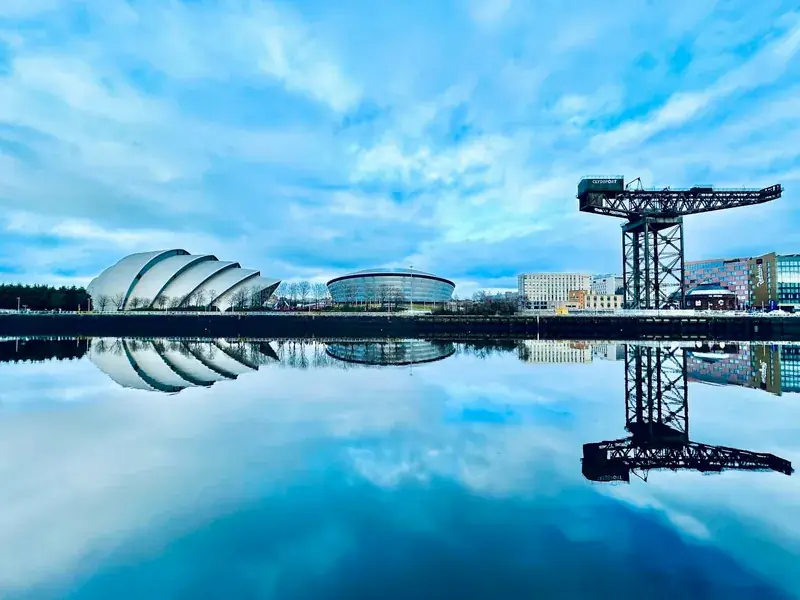
Shipbuilding made this city, and the river still tells the story. The Riverside Museum, European Museum of the Year in 2013, gathers trams, locomotives, ship models and a recreated Glasgow street under a zig-zag roof on the old Pointhouse quay, with the Tall Ship Glenlee moored alongside. Just upstream, the Finnieston Crane stands as the monument the shipyards left behind, towering over what is now one of Glasgow's trendiest districts — Finnieston, a former dockland that runs from acclaimed seafood restaurants to the OVO Hydro arena.
Riverside Museum
Award-winning transport museum on a former shipyard, with a Victorian tall ship moored alongside.
The Tall Ship Glenlee
Restored Victorian three-masted barque berthed on the river, with decks and holds open to explore.
Finnieston Crane
Giant cantilever crane that once loaded steam locomotives onto ships, now a riverside icon.
Mackintosh's Glasgow
Charles Rennie Mackintosh is the city's architectural signature. His masterpiece, the Glasgow School of Art building of 1909, has been gravely damaged by fire (first in 2014) and is still being restored, but his work is all over town: the reconstructed Mackintosh Tearooms on Sauchiehall Street, House for an Art Lover in Bellahouston Park, built decades after his death from his competition drawings, and the school museum on Scotland Street. The audio guides pick up the thread of a designer who was undervalued at home and celebrated abroad.
The Glasgow School of Art
Art nouveau art school by Charles Rennie Mackintosh, gutted by fire and awaiting faithful rebuilding.
The Mackintosh Tearooms
Art nouveau tearooms designed inside and out by Mackintosh, with a restored silver-and-purple salon.
House for an Art Lover
Mackintosh house design from a 1901 contest, finally built in a park with richly crafted rooms.
Merchant City, murals and music
East of George Square, the Merchant City is the old trading quarter, its warehouses and tobacco lords' mansions now full of restaurants and cocktail bars. Outside the Gallery of Modern Art, the equestrian statue of the Duke of Wellington has worn a traffic cone on its head for decades — a joke the city refuses to give up. The surrounding streets carry the mural trail, from the giant Saint Mungo on High Street to Billy Connolly's portrait. Glasgow is also Scotland's UNESCO City of Music: the sprung floor of the Barrowland Ballroom, Celtic Connections every January and the TRNSMT festival on Glasgow Green keep that reputation honest.
Merchant City
Georgian grid of merchant streets, restored warehouses, bars and galleries built on tobacco wealth.
Duke of Wellington
Bronze equestrian statue from eighteen forty-four, famously crowned with an orange traffic cone.
Barrowland Ballroom
Legendary sprung-floor dancehall turned gig venue above a market, crowned by a flashing neon sign.
Southside: the Burrell Collection and Pollok Country Park
Take the train a few stops south to Pollok Country Park, where Highland cattle graze in the fields and the Burrell Collection — a shipping magnate's extraordinary gift of medieval tapestries, Chinese ceramics and French painting — sits in a glass pavilion at the edge of the woods. Pollok House, the Maxwell family's eighteenth-century home, is a short walk away across the park.
The Burrell Collection
Woodland-edge art museum whose glass galleries and walls incorporate medieval stone doorways.
Pollok Country Park
Wooded riverside estate park with a historic weir, water-powered sawmill and Victorian stables.
Pollok House
Georgian country mansion with Spanish paintings, Edwardian pavilions and riverside parkland walks.
Getting around
The centre is a compact grid, easy to cover on foot, and the small circular Subway links it to the West End and the Southside in minutes. Trains from Glasgow Central and Queen Street reach Pollok, the Clyde coast and Edinburgh, and most of the big museums — Kelvingrove, Riverside, the Burrell, GoMA — are free to enter.