

Cambridge is a university town that never stopped being one. Students have been arguing, praying and rowing here since 1209, when scholars fleeing trouble in Oxford settled beside the River Cam, and the city that grew up around them is still gloriously unmodernised: a compact medieval centre of stone gatehouses, lawns you are not allowed to walk on, and bicycles everywhere. It is an hour from London, flat enough to cross in an afternoon, and so dense with stories that the best way to see it is slowly, with a self-guided audio guide in your ears telling you what happened behind each wall.
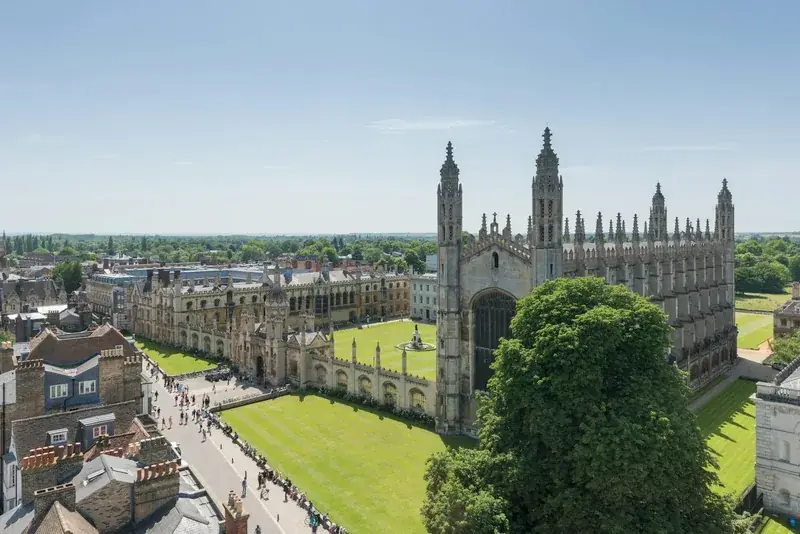
The skyline belongs to King's College Chapel, the most recognisable building in the city and a feat of sixteenth-century engineering, its fan-vaulted ceiling hanging over a nave that still fills with a schoolboy choir for evensong six days a week in term. King's College itself was founded in 1441 by Henry VI, and its story (royal ambition, civil war, a chapel that took decades to finish) is the natural first chapter of any visit.

Start at King's Parade
Everything radiates from King's Parade, the street that runs past the chapel's long flank. Climb the 123 steps of the tower at Great St Mary's, the University Church, for the one panoramic view of the spires. A few paces away, at the corner of Bene't Street, crowds gather around The Corpus Clock: a gilded dial with no hands, topped by a grasshopper-like creature called the Chronophage, the "time eater", which appears to devour each second as it passes. It was conceived and paid for by alumnus John Taylor and unveiled by Stephen Hawking in 2008. Round the corner is The Eagle, a coaching inn open since 1667, where on 28 February 1953 Francis Crick walked in at lunchtime and told the room he and James Watson had "discovered the secret of life". Look up in the back bar: Allied airmen burned their squadron numbers into the ceiling with candles and lipstick during the war. The audio guide here tells both stories.
King's Parade
Historic street of college facades, shops and cafés, overlooked by a golden time-eating clock.
Great St Mary's, the University Church
Medieval university church where a Reformation theologian's dust lies under a brass plate.
The Corpus Clock
Golden clock with no hands, ridden by a giant time-eating grasshopper that devours each minute.
Eagle
Seventeenth-century coaching inn where DNA's double helix was toasted, with a wartime airmen's ceiling.
Trinity, St John's and the Bridge of Sighs
North along Trinity Street the colleges grow grander. Trinity College, Newton's college, keeps its treasures in the Wren Library, where A. A. Milne's original manuscript of Winnie-the-Pooh sits among the cases. Next door, St John's College was founded in 1511 by Lady Margaret Beaufort, mother of Henry VII, and its nineteenth-century Bridge of Sighs, a covered stone crossing modelled on the Venetian original, is the most photographed bridge on the river. You cannot walk across it, but the view from the river or the neighbouring Kitchen Bridge is the one everyone wants.
Trinity College
Tudor-founded college around a vast enclosed court, guarded by a medieval gate tower that moved.
Wren Library
Wren-designed college library of limewood carvings, marble busts and treasures from Newton to Milton.
St John's College
Tudor college of red-brick Gothic courts, a grand dining Hall and a riverside Bridge of Sighs.
Bridge of Sighs
Covered Gothic Revival stone bridge with barred windows, linking two college courts over the river.
Punting the Backs
The signature Cambridge experience is a punt: a flat-bottomed boat pushed along with a pole, drifting under eight bridges past the backs of seven colleges. The Backs are the strip of green between the river and the college walls, and from the water you see the colleges the way they were meant to be seen. Scudamore's has run punts here since 1910; you can hire your own, but a guided trip or an audio guide playing from your pocket turns the drift into a narrative. Watch for the timber Mathematical Bridge at Queens' College, rebuilt in 1902 and wrapped in myths about Newton and missing bolts, and for the gardens of Clare College, among the oldest and loveliest on the river.
The Backs
Riverside lawns and college gardens along the Cam, with grazing cattle and chapel views.
Mathematical Bridge
Wooden footbridge across the river, its graceful arch built entirely from straight timbers.
Queens' College
Riverside college of medieval brick courts and the wooden Mathematical Bridge spanning the Cam.
Clare College
Fourteenth-century college with a classical stone court and a seventeenth-century bridge over the river.
Museums: from the Fitzwilliam to Kettle's Yard
Cambridge's museums are free, numerous and mostly walkable from one another. The Fitzwilliam Museum, a neoclassical palace on Trumpington Street, is strongest in Egyptology and Roman sculpture but ranges across Old Masters and armour. Across Magdalene Bridge, Kettle's Yard is something else entirely: a row of converted cottages that was the home of Tate curator Jim Ede and his wife Helen, kept exactly as they lived in it, with Brancusi and Ben Nicholson arranged among pebbles and houseplants. Smaller university collections round it out, from the Sedgwick's 4.5-billion-year walk through earth history to The Polar Museum and its Scott expedition relics.
The Fitzwilliam Museum
Neoclassical art and antiquities museum behind a columned portico, founded by a collector's bequest.
Kettle's Yard
Modernist house of art, pebbles and light, kept exactly as its collector arranged it.
The Polar Museum
Free polar exploration museum holding Captain Scott's last letters, in a 1930s memorial institute.
Beyond the colleges: Castle Mound, Grantchester and Ely
The town is older than the university. The Romans built a fort called Duroliponte on Castle Hill around AD 70, and William the Conqueror raised a castle there in 1068; the grassy Castle Mound that survives is the best free viewpoint in town. Follow the river upstream through Grantchester Meadows to the village the Cam flows from, a two-mile walk that students have been making for centuries. On Parker's Piece, the open green east of the centre, the first rules of association football were played out. With more time, take the short train to Ely Cathedral, whose octagon lantern tower rises over the flat fens like a ship.
Castle Mound
Grassy Norman motte on the city's highest point, all that survives of a royal stone castle.
Grantchester Meadows
Riverside meadows with grazing cattle, wild swimming and a footpath to village tea gardens.
Parker's Piece
Flat open common crossed by paths, once the scene of a vast coronation feast for thousands.
Ely Cathedral
Romanesque and Gothic cathedral crowned by a unique timber-and-lead octagonal lantern over the crossing.
Getting around
Direct trains run from London, Norwich, Brighton and Birmingham, and the station is a twenty-minute walk or a quick bus ride from the centre. Once there, leave the car behind: Cambridge is flat, well served by cycle paths, and small enough that an audio-guided walk from King's Parade to the Backs and over to Kettle's Yard fits comfortably into a single day. Check college opening hours before you go; some are free to enter, others charge or close during exams.