

Bath is a small city built on hot water. Around 1.17 million litres of mineral-rich water rise from the ground here every day at 46 °C, and that spring has pulled people in for two thousand years: the Romans, who raised a temple and a bathing complex over it around 60–70 AD, and the Georgians, who turned the resort into the most fashionable town in England and wrapped it in honey-coloured limestone. The whole city is a UNESCO World Heritage Site — the only one in the UK listed in its entirety — and since 2021 it carries a second listing as one of the Great Spa Towns of Europe.
It is also a city that rewards slow exploration. The centre is compact, almost everything is within a twenty-minute walk, and the stories hide in plain sight — in a lead-lined Roman pool, in a crescent of thirty houses that share one façade, in a bridge you can cross without noticing it is a bridge. Our self-guided audio guides let you stand in front of each of these and hear why it matters, at your own pace and in your own order.
Begin at the Roman Baths
Start where Bath started. The Roman Baths sit at the heart of the city, below modern street level, and the Great Bath — still lined with Mendip lead — steams quietly as it did when the Romans dedicated the spring to Sulis Minerva. The museum holds the gilt bronze head of the goddess herself. Next door, the Neoclassical Pump Room, begun by Thomas Baldwin in 1789, is where Georgian society came to drink the waters (you still can — the water contains more than forty minerals, and tastes like it). If you would rather bathe than sip, Thermae Bath Spa, opened in 2006, draws the same thermal water from modern boreholes and has a rooftop pool with the city's skyline all around you. The audio guide for the Baths tells the story of the spring from sacred source to spa.
The Roman Baths
Roman temple and bathing complex built around a sacred hot spring, beside the Georgian Pump Room.
The Pump Room Restaurant
Georgian spa hall serving afternoon tea beneath a Tompion clock and Beau Nash's marble statue.
Thermae Bath Spa
Natural thermal spa with a rooftop pool, fed by hot springs inside restored Georgian bath buildings.
Bath Abbey and the old centre
A few steps from the Baths, Bath Abbey fills the square with its late Perpendicular Gothic west front. Bishop Oliver King began rebuilding it in 1500 on the site of a far older church, and it was finished just before the priory was dissolved in 1539. Inside, fifty-two windows and a fan vault make it one of the lightest great churches in England. The lanes around it are the medieval and Georgian core: Sally Lunn's claims one of the oldest houses in the city and the bun that bears her name, and the Victorian Guildhall Market is where locals still shop. Listen to the Abbey's guide and then let the streets take you uphill.
Bath Abbey
Late-Gothic church with fan-vaulted ceilings and stone angels climbing ladders on its west front.
Sally Lunn’s Historic Eating House & Museum
Historic bakehouse and tearoom serving a famous buttered bun, with a cellar kitchen museum.
Bath Guildhall Market
Domed Victorian market hall of small independent stalls, with an eighteenth-century trading pillar.
The Circus and the Royal Crescent
This is the Bath on the postcards, and it is the work of two men with the same name. John Wood the Elder laid out The Circus around 1760, three curved terraces forming a perfect ring, inspired by the Colosseum in Rome, with Doric, Ionic and Corinthian columns rising floor by floor. His son John Wood the Younger then carried the idea west to the Royal Crescent, built between 1767 and 1774: thirty houses behind one sweeping Ionic façade, overlooking a lawn. Each buyer bought a stretch of the front and hired their own architect for the back, so the rears are a jumble — locals call it "Queen Anne fronts and Mary-Anne backs." No. 1 Royal Crescent has been furnished as it might have looked in the 1770s, and the nearby Assembly Rooms, where Georgian Bath danced and gambled, were gutted by bombs in 1942 and rebuilt. Each has its own audio guide, so you can hear how a speculative housing scheme became a masterpiece.
The Circus - Bath
Ring of Georgian townhouses crowned with stone acorns, laid out to echo Stonehenge.
Royal Crescent
Sweeping Georgian terrace of thirty houses behind one Ionic-columned palace front, facing a lawn.
No. 1 Royal Crescent
Georgian townhouse museum at the end of a sweeping crescent, restored with its servants' kitchen wing.
National Trust - Bath Assembly Rooms
Georgian ballroom, tea room and octagon lit by original eighteenth-century crystal chandeliers.
Across Pulteney Bridge
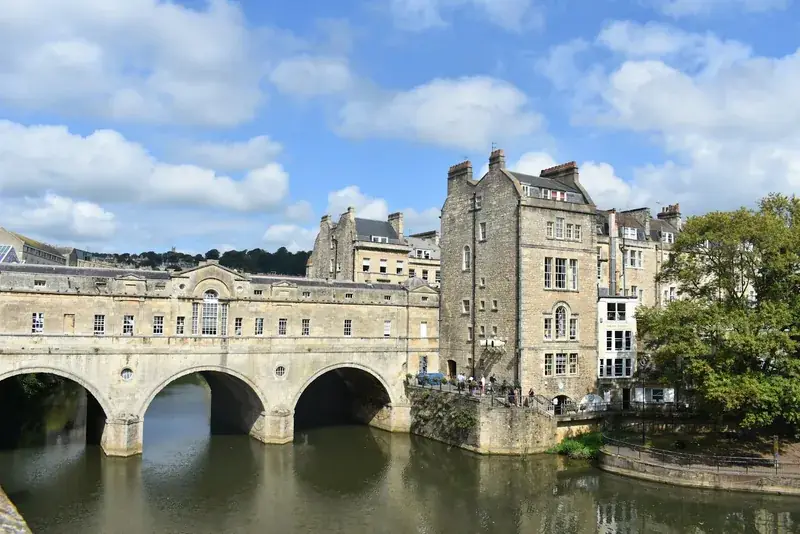
Robert Adam designed Pulteney Bridge around 1770 on an unused Palladio design for the Rialto in Venice, and lined both sides with shops — one of only a handful of such bridges left in Europe. Below it, the horseshoe curve of Pulteney Weir is the most photographed stretch of the River Avon. Cross over and Great Pulteney Street opens out, more than a thousand feet long and a hundred wide, the grandest boulevard in the city, ending at the Holburne Museum and its art collection. The guides here trace the Pulteney family's ambition to build a second Bath on the far bank.
Pulteney Bridge
Georgian shop-lined bridge on three stone arches over the river, inspired by Palladio's Rialto design.
Pulteney Weir
Horseshoe-shaped river weir below a shop-lined Georgian bridge, rebuilt for flood control.
Great Pulteney Street
Broad Georgian boulevard lined with grand Corinthian-pilastered terraces stretching from a fountain square.
The Holburne Museum
Art museum in a former pleasure-garden hotel, holding a Trafalgar veteran's collection of fine objects.
Jane Austen's Bath
Austen lived in the city in the early 1800s and set much of Northanger Abbey and Persuasion on these streets; the Gravel Walk below the Royal Crescent is where Anne Elliot and Captain Wentworth finally come to an understanding. The Jane Austen Centre on Gay Street puts her years here in context, and once you have heard its guide, every drawing room and assembly in the novels has an address.
Climb to the skyline
Bath sits in a bowl of hills, and the best views come from the rim. Prior Park was Ralph Allen's estate — the quarry owner whose Combe Down stone built the Georgian city — and its landscape garden drops down a valley to a Palladian bridge with the city laid out beyond. On the opposite hill, Beckford's Tower marks the end of the mile-long garden that the eccentric collector William Beckford laid out from his house on Lansdown Crescent. The National Trust's Bath Skyline walk links the high ground around the city with meadows, woods and a folly or two. Load the guides before you set off; the signal is fine, but the views are better without looking down.
Prior Park
Eighteenth-century landscape garden with serpentine lake, cascade and a crossable Palladian bridge.
Beckford's Tower and Museum
Gilded-lantern hilltop tower built as a collector's library retreat, now a museum beside a cemetery.
National Trust - Bath Skyline
Six-mile circular trail of woods and meadows on high ground, with sweeping views over the city.
Getting around
Bath Spa station is at the southern edge of the centre, about ninety minutes from London Paddington by train and fifteen from Bristol. Nothing in the central sections above is more than a short walk apart, though the Circus and Crescent are uphill from the Abbey. The hill sections take a little longer — allow a half day for Prior Park or the Skyline — and the stone pavements are uneven, so comfortable shoes beat elegant ones, whatever Beau Nash would have said.