
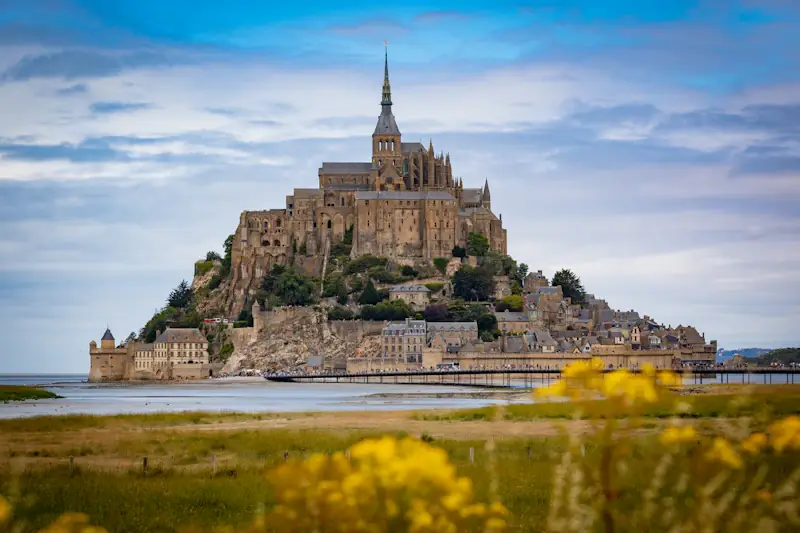

Mont-Saint-Michel is a granite islet off the Normandy coast crowned by a Benedictine abbey, with a walled medieval village clinging to its slopes. Legend has it that in 708 the Archangel Michael appeared to Aubert, bishop of Avranches, and ordered a sanctuary built on the rock; thirteen centuries later the abbey still rises from the summit, the village still has a mayor, a parish church and a cemetery, and the bay around it still empties and fills with the highest tides in continental Europe, a range of up to 14 metres. Mont-Saint-Michel and its bay were among the first sites inscribed on the UNESCO World Heritage List, in 1979, and today more than three million people a year make the crossing.
It is a place best explored at your own pace, with a self-guided audio guide in your ear: the Mont's story runs from pilgrims and copyist monks through sieges and a century as a prison, and every gate, tower and terrace on the way up has a chapter of it to tell. Allow at least half a day, and pick a tide table before you pick a date.

Through the gates and up the Grande Rue
Three gates stand between the causeway and the village: the Porte de l'Avancée, the Porte du Boulevard and finally the Porte du Roi, a drawbridge gate with the King's Lodging above it, built when the Mont was a frontier fortress. Beyond it the Grande Rue climbs roughly 200 steps between tightly packed stone houses of the 15th and 16th centuries, their medieval shop signs now hanging over crêperies and souvenir stalls. Halfway up, the parish church of Saint-Pierre has been the official seat of devotion to Saint Michael since 1886, and near the bottom the inn opened by Annette and Victor Poulard in 1873 still serves the wood-fired soufflé omelette that made La Mère Poulard a name known far beyond Normandy.
Porte et logis du Roi
Fortified medieval gateway with drawbridge and iron portcullis, topped by the royal officer's lodging.
Church of Saint-Pierre - Le Mont-Saint-Michel
Rock-backed parish church whose choir arches over a lane, home to a silver-clad archangel.
Hotel La Mère Poulard
Historic inn famed for soufflé omelettes whisked in copper bowls and cooked over an open wood fire.
The abbey and the Merveille
The abbey is the reason the Mont exists. Its church sits on the very peak of the rock, propped on crypts that were built simply to give it a level floor, and on the north face the thirteenth-century Merveille, the "Marvel", stacks refectory, guest hall and cloister three storeys high above the sea. The cloister, a garden of slender twin columns suspended between sky and bay, is the moment most visitors remember. A self-guided visit takes between 45 minutes and an hour and a half and around 150 more steps, and the West Terrace at the top gives the full panorama of the bay. The audio guide for the abbey follows the monks, the English besiegers of 1423 and 1433 who never took the rock, and the prisoners held here until 1863.
Ramparts, towers and the village museums
Ramparts built from the Hundred Years' War onward gave the Mont its reputation as impregnable, and seven towers are linked by a public walkway that doubles as a quieter route to the abbey. The Tour Gabriel, from around 1524, once worked as a windmill and later as a lighthouse for boats entering the Couesnon. Tucked among the houses are small museums: the Logis Tiphaine, the fortified home associated with the wife of the constable Bertrand du Guesclin, and the Musée Historique, with its collection of the Mont's long and sometimes grim past. Above the church, the village cemetery holds the tomb of the Poulards and some of the best views on the island.
Tour Gabriel
Round sixteenth-century cannon tower, later topped by a windmill and a tiny lighthouse.
Logis Tiphaine
Fourteenth-century knight's house with period furniture, armour and an astrologer's cabinet.
Musée Historique
Wax-figure museum of the abbey's prison years, with recreated cells, torture tools and an old periscope.
Cimetière du Mont Saint-Michel
Tiny terraced churchyard with bay views, resting place of a famed innkeeper and a modern sculptor.
Tides, the bay and the crossing
The bay is the Mont's other monument. When the tidal coefficient passes 110 the sea cuts the village off for a few hours and the rock becomes a true island again; medieval pilgrims called it "Saint Michael in peril of the sea". Since 2014 visitors arrive over the Passerelle, a slender footbridge by Dietmar Feichtinger that replaced the old causeway, while the Barrage on the Couesnon flushes the river at each tide to keep the sands from silting up around the rock. Out in the bay, the bare granite outcrop of Tombelaine sits a few kilometres north, and at the foot of the Mont the little Chapelle du Saint-Aubert and the fountain of the same name mark the bishop of the legend. Never walk the sands without a guide: quicksand and a tide said to come in as fast as a galloping horse are not folklore.
Passerelle d'accès au Mont Saint-Michel
Slender stilted footbridge over the tidal bay, built so the sea can flow freely around the abbey rock.
Barrage du Mont-Saint-Michel
Tidal river dam whose eight giant gates flush silt seaward, with a promenade facing the abbey island.
Tombelaine
Rocky islet and bird reserve crowned by ruins of a razed seventeenth-century fortress.
Chapelle du Saint-Aubert
Romanesque granite chapel on a tidal rock outcrop, tied to the legend of the abbey's founding bishop.
Fontaine St. Aubert
Ruined conical fountain tower over a legendary spring that once watered a medieval abbey.
Beyond the Mont: Avranches and the shore
Across the bay, Avranches is where the Mont's manuscripts ended up. The Scriptorial, on the Place d'Estouteville, displays the illuminated books the abbey's copyist monks produced, and the town's Jardin des Plantes looks straight out over the bay to the silhouette of the Mont. On the coast, the Plage du Bec d'Andaine is the classic starting point for guided bay crossings, and the headland of the Pointe du Grouin du Sud is the spot locals choose to watch the tidal bore race in.
Scriptorial
Museum of medieval illuminated manuscripts from a Benedictine abbey, set within old town ramparts.
Jardin des Plantes d'Avranches
Hilltop botanical garden with a relocated Romanesque chapel portal and sweeping views over the bay.
Plage du Bec d'Andaine
Sandy point of dunes and salt meadows, the classic starting spot for guided walks across the bay.
Pointe du Grouin du Sud
Rocky headland of lichen-stained ancient rock overlooking tidal flats, seal sandbanks and a tidal bore.
Getting there and timing your visit
Cars stop on the mainland; a free shuttle or a 40-minute walk over the footbridge brings you to the gates. The village is free to enter year-round and is all stairs, so it is hard going with pushchairs or limited mobility. In high season arrive before 10:00 or come late in the afternoon, when the day-trippers have left and the ramparts are lit; spring and autumn are quieter still. Book the abbey online, and if you want to see the rock surrounded by water, plan around a spring tide.