
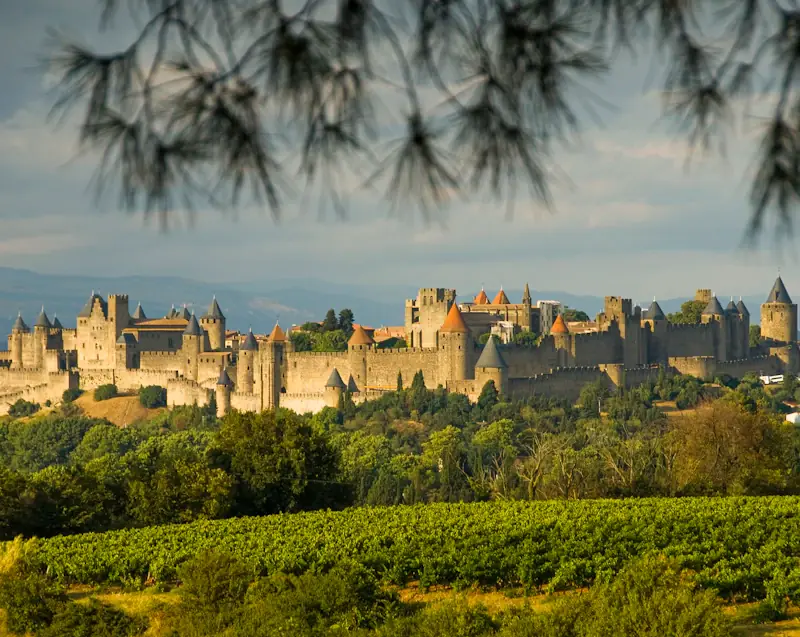

Carcassonne is two towns facing each other across the River Aude. On the hill stands the Cité, a double ring of ramparts and 52 towers that is the largest fortified medieval city in Europe and a UNESCO World Heritage Site since 1997. Below it lies the Bastide Saint-Louis, the grid-planned lower town founded by Saint Louis in the 13th century, where the locals actually live, shop and eat. The hill has been fortified since before the Romans, held by Visigoths and Saracens, sheltered the Cathars under the Trencavel viscounts, fell to the Albigensian Crusade in 1209, and spent two centuries as a crumbling ruin before Eugène Viollet-le-Duc began his famous — and still argued-over — restoration in the 1850s.
That layered story is why Carcassonne rewards exploring with self-guided audio guides rather than just a map. Every gate, tower and square has an episode to tell, and the guides let you hear it on the spot: the siege that ended the Trencavels, the Inquisition tower, the slate roofs Viollet-le-Duc added in a northern style that purists still grumble about. The Cité itself is free to walk; only the castle and its wall-walk charge admission.

Through the Porte Narbonnaise
Most visitors enter the way medieval traders did, across the drawbridge at the Porte Narbonnaise, the massive twin-towered eastern gate. Inside, Rue Cros Mayrevieille climbs between stone houses toward the castle; it is named for the local archivist who, with Prosper Mérimée, fought the 1849 government order to demolish the walls as redundant. The grassy lices between the inner wall (reworked around 1280 on Gallo-Roman foundations) and the outer wall (added around 1320) were once used for tournaments and make the best circuit for a first look at the fortifications.
The Château Comtal and the ramparts
The Château Comtal was built in the 12th century by the Trencavel viscounts and later turned by royal garrisons into a fortress-within-a-fortress, with its own moat, drawbridge and wooden hoardings. The ticket covers its two courtyards, a lapidary museum of carved stone rescued from the site, and access to the wall-walk, where the views stretch to the Pyrenees on a clear day. From the ramparts you can pick out landmarks like the Tour du Tréseau and understand how the double enclosure worked as a defensive machine.
Château Comtal
Medieval hilltop castle grown from a twelfth-century palace, ringed by moat, towers and ramparts.
Château et remparts de la cité de Carcassonne
Medieval fortress with a counts' castle, double ring of ramparts and dozens of towers.
Tour du Tréseau
Late-medieval defensive tower with a stepped gable, corner lookouts and a rock-cut cellar.
Basilique Saint-Nazaire and the quiet west end
At the far end of the Cité, near the Porte d'Aude, the Basilique Saint-Nazaire served as cathedral until 1801. Its Romanesque nave is bare and dark, then opens into a luminous Rayonnant Gothic chevet whose 13th- and 14th-century stained glass is among the finest in southern France. The surrounding lanes are calmer than the main drag, and the Museum of the Inquisition nearby recalls the darker side of the 13th-century church with its collection of torture devices.
Basilique Saint Nazaire
Gothic basilica with luminous medieval stained glass, choir statues and bishops' tombs inside a walled citadel.
Porte d’Aude
Fortified western gate reached by a steep hairpin ramp once swept by fire from the ramparts.
Museum of the Inquisition
Seventeenth-century house displaying torture instruments and the story of heresy trials.
Down the hill: Pont Vieux and the Bastide Saint-Louis
Leave by the Porte d'Aude and the path drops to the Pont Vieux, a 14th-century stone bridge of twelve arches that is now pedestrian-only and offers the classic postcard view of the walls — and the best vantage point for the July 14 fireworks. Across it, the Bastide Saint-Louis is where Carcassonne stops being a monument and becomes a town. Its straight streets, laid out with a cord in the 1260s and rebuilt after the Black Prince burned them in 1355, converge on Place Carnot, a café-ringed square around the 18th-century Fontaine de Neptune that hosts a market several mornings a week. The Gothic Cathédrale Saint-Michel, the Musée des Beaux-Arts and the covered Halles are all a few minutes' walk away.
Pont Vieux
Medieval stone bridge of twelve arches over the Aude, linking the walled hilltop citadel to the lower town.
La Bastide Saint-Louis
Thirteenth-century planned grid town of straight streets, walled blocks and a lively central square.
Place Carnot
Market square around an eighteenth-century marble Neptune fountain, shaded by plane trees.
The Canal du Midi
Carcassonne is a stop on the Canal du Midi, the 17th-century waterway linking the Atlantic to the Mediterranean and itself a UNESCO World Heritage Site. The port sits right in front of the railway station at the top of the Bastide; from the Capitainerie you can join a two-hour cruise through the plane-tree-shaded locks or simply walk the towpath. It is a gentle counterpoint to the battlements above.
Cathar castles beyond the walls
With a car, Carcassonne is the base for the so-called Cathar castles of the Aude. The Quatre Châteaux de Lastours, four ruined fortresses on a single ridge in the Montagne Noire, are about 25 minutes north. South toward the Pyrenees, Château de Peyrepertuse and Château de Quéribus cling to limestone crags, and Château de Montségur, where the last Cathar stronghold fell in 1244, is a steep but moving climb. The medieval village of Minerve and the abbey at Lagrasse make gentler detours.
Les Quatre Châteaux de Lastours
Four ruined medieval castles strung along a rocky spur above two deep river gorges.
Château de Peyrepertuse
Ridge-top fortress ruin stretching along a limestone crest, with a royal keep reached by rock-cut stairs.
Château de Quéribus
Clifftop Cathar fortress with a Gothic pillared hall and sweeping views to the Pyrenees and the sea.
Château de Montségur
Hilltop castle ruin on a sheer Pyrenean rock, the last Cathar stronghold besieged in 1243-44.
Getting around
The Cité and the Bastide are a 20-minute walk apart via the Pont Vieux, and a shuttle bus links them in season. Trains reach Carcassonne from Toulouse in under an hour and from Paris in about five with a change at Narbonne; the small airport has direct Ryanair flights. Parking by the Cité is metered and fills early in July and August — arrive before 10 or come after 5, when the day-trippers leave and the lanes empty out.