
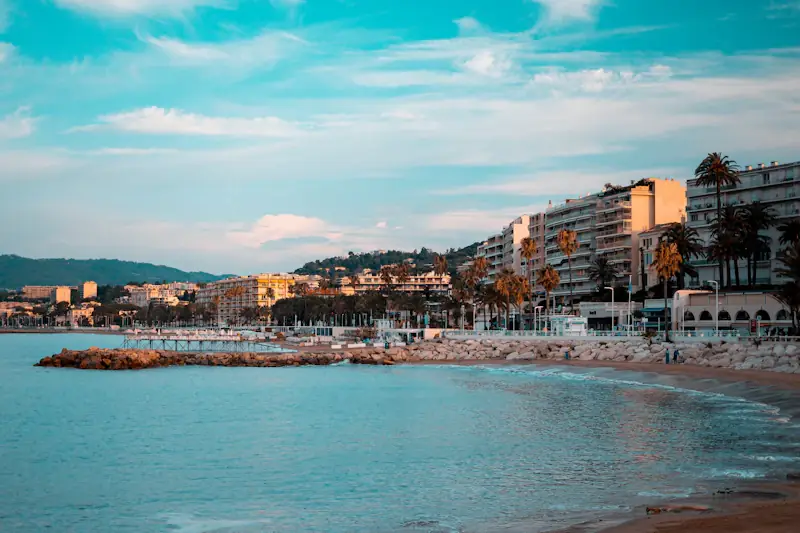
Cannes is the French Riviera distilled: a palm-lined bay, a hilltop old town, two monastic islands a quarter-hour offshore, and a red carpet that the world watches every May. It started as a Ligurian fishing village and a port of call for the monks of Lérins, who ruled it for centuries and raised a castle on the hill in 1035. The resort era began in the 1830s, when the British statesman Lord Brougham built a villa at Croix des Gardes and the English aristocracy followed him into the winter sun. The Film Festival, founded in 1946, turned a genteel spa town into a global byword for glamour, and in 2021 UNESCO named it a City of Film.
It is a compact city, which makes it ideal to explore at your own pace with self-guided audio guides: the seafront, the old town and the harbour are all within a twenty-minute stroll of each other, and every landmark here carries a story that is better heard than read. The spine of it all is the Boulevard de la Croisette, the two-kilometre promenade with grand hotels and designer boutiques on one side and the beaches on the other.

The Palais and the red carpet
At the western end of the Croisette stands the Palace of Festivals and Congresses, the concrete bunker that becomes the centre of the film universe for twelve days each spring. Outside festival time you can climb the famous steps yourself, and the audio guide fills in who climbed them before you. Just beside it, the Chemin des Etoiles on the Esplanade Pompidou holds the handprints of more than three hundred actors and directors pressed into the pavement. Further along the boulevard, the Regent Carlton Cannes is the Belle Époque palace hotel whose twin cupolas are the most photographed façade on the Riviera and the backdrop to Hitchcock's To Catch a Thief.
Palace of Festivals and Congresses of Cannes
Concrete festival hall on the seafront, home of the Film Festival's red-carpeted twenty-four steps.
Le Chemin Des Etoiles
Walk of fame of stainless steel celebrity handprints and signatures set around a festival hall.
Regent Carlton Cannes
Belle Époque seafront palace with twin domes, host to a nineteen twenty-two peace conference.
Climb into Le Suquet
Above the old harbour rises Le Suquet, the oldest quarter of Cannes on Mont Chevalier, a knot of steep cobbled lanes, flowered balconies and small squares. At the top, the Musée des explorations du monde occupies the former château of the Lérins monks and the Chapelle Sainte-Anne, with collections from the Himalayas, the Arctic and Oceania and a watchtower you reach by 109 uneven medieval steps; the reward is the whole bay laid out below. Next door, the Église Notre-Dame d'Espérance, built between the sixteenth and seventeenth centuries, is the parish church of the old town and the setting for summer concerts on its forecourt.
Le Suquet, quartier historique de Cannes
Medieval hilltop quarter of steep lanes, crowned by a monks' castle, watchtower and world museum.
Musée des explorations du monde
Hilltop medieval monastery-fortress holding world antiquities, instruments and a climbable watchtower.
Église Notre-Dame d'Espérance de Cannes
Hilltop Gothic church of honey-coloured stone, sheltering a gilded Virgin crowned by papal consent.
Market mornings at Forville
At the foot of the Suquet, the covered Marché Forville is where Cannes actually shops: open every morning except Monday, it is the place for socca, panisses and the fish landed a few hundred metres away. From there, Rue Meynadier runs pedestrian-only towards the centre, lined with cheese shops, confectioners and small boutiques at prices the Croisette would not recognise. Finish at the IGY Vieux-Port de Cannes, where traditional pointu fishing boats share the water with superyachts and the ferries leave for the islands.
Marché Forville
Covered Provençal food hall of local growers and bay fishermen, set in a listed 1930s building.
Rue Meynadier
Narrow pedestrian lane of cheese shops, bakers and old family trades, once the road out to Antibes.
IGY Vieux-Port de Cannes
Historic harbour of stone jetties and yacht pontoons beneath the old hilltop quarter.
Across the water to the Lérins Islands
The Lérins Islands are the quietest fifteen-minute boat ride on the Riviera. Île Sainte-Marguerite, the larger island, is a wooded reserve of eucalyptus and Aleppo pine wrapped around the Fort Royal, where the Man in the Iron Mask spent eleven years in a cell you can still enter; the audio guide weighs the theories about who he really was. Off its northern shore lies an underwater museum of six sculptures by Jason deCaires Taylor, free to visit with a snorkel. The smaller Île Saint-Honorat has been home to monks almost continuously since around AD 410, and the Cistercians of the Abbaye de Lérins still tend an eight-hectare vineyard, make honey and the herbal liqueur Lérina, and open their church to visitors.
Lérins Islands
Pine-covered Mediterranean islands with a working abbey, a medieval sea tower and a coastal fort.
Île Sainte-Marguerite
Pine-forested island with a star fort, Roman cisterns and a museum of ancient shipwreck cargoes.
Fort Royal de l'Île Sainte-Marguerite
Seventeenth-century island fortress and state prison holding the Man in the Iron Mask's barred cell.
Île Saint-Honorat
Monastic island of pine woods, hand-worked vineyards, a fortified abbey tower and quiet swimming coves.
Abbaye de Lérins
Island abbey with a medieval fortified tower-monastery, cloisters and monks' vineyards by the sea.
Beyond the bay: Grasse, Mougins and the Esterel
Cannes is a good base for day trips. Twenty minutes inland, Grasse has been the perfume capital of the world since the eighteenth century, and the Musée International de la Parfumerie traces four thousand years of scent before you visit the working factories. The hilltop village of Mougins, between the two, was Picasso's home for his final years. To the west, the red porphyry Massif de l'Esterel drops into the sea along the Corniche d'Or, one of the most dramatic coastal roads in France.
Grasse
Hilltop perfume town of steep medieval lanes, fragrance houses and a painter's family villa.
Musée International de la Parfumerie (MIP)
Perfume museum around a medieval rampart, with a rooftop greenhouse of jasmine and tuberose.
Massif de l'Esterel
Rugged red volcanic massif of jagged peaks, pine forest and hiking trails plunging to the sea.
Getting around
Nice Côte d'Azur airport is about 24 km east, with direct trains and buses to Cannes station, which sits a few blocks back from the Croisette. The centre is flat and walkable; only the Suquet involves a climb. Ferries to Sainte-Marguerite leave from the Vieux-Port, while the monks run the only boats to Saint-Honorat from the Albert-Edouard jetty beside the Palais. Avoid the festival fortnight in May unless you are here for it; June and September bring the best balance of warmth and space.