
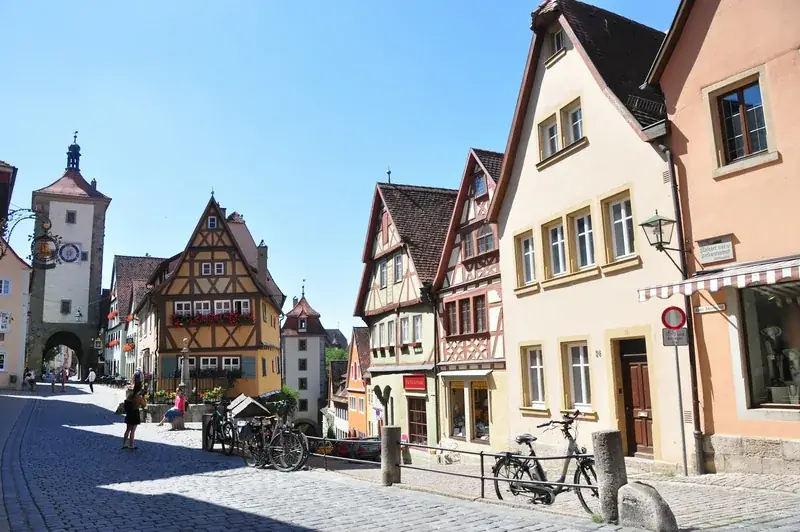

Rothenburg ob der Tauber is the medieval town that other medieval towns are measured against. Perched above a bend of the River Tauber in northern Bavaria, it is one of only a handful of German towns whose walls still run unbroken around the whole old core, and inside them almost nothing has been allowed to break the spell: half-timbered gables, cobbled lanes that tilt with the hillside, gate towers at the end of every street. It was a Free Imperial City from 1274 until 1803, briefly one of the twenty largest cities in the Holy Roman Empire, and then it simply stopped growing. That poverty is the reason the seventeenth-century town is still here.
It is also a town that tells stories about itself, which makes it ideal ground for exploring with self-guided audio guides. Every gate, fountain and altar has a tale attached, and at the Plönlein you meet the most famous view in Germany: a narrow yellow house wedged between two streets, one climbing to the Siebersturm, the other dropping to the Kobolzeller gate, with timbered houses leaning in from both sides. An audio guide here is a good first stop, because the picture on every postcard turns out to be a small lesson in how the town grew in layers.

Start on the Marktplatz
The Marktplatz is where Rothenburg has gathered for seven centuries, and the Town Hall sums the place up in one building: a Gothic half from around 1250 at the back, a Renaissance front begun in 1572 facing the square, and a tower roughly sixty-one metres high that you can climb, two hundred and twenty steps, for the classic rooftop view. Beside it stands the former councillors' tavern, the Ratstrinkstube, whose clock-face windows open on the hour to replay the Meistertrunk, the legend of mayor Georg Nusch saving the town from General Tilly in 1631 by draining a tankard of more than three litres of wine in one go. The story is almost certainly invented, appearing in no chronicle for over a century, but the town stages it as a play every year regardless. The audio guides for the square tell both versions, the legend and the harder history of the Thirty Years' War and the plague that followed.
Marktplatz Rothenburg ob der Tauber
Historic market square before the town hall, whose dungeon vaults once held a fallen mayor.
Town Hall
Gothic and Renaissance seat of the old imperial city, crowned by a tower with sweeping rooftop views.
Ratstrinkstube Clock Tower
Former councillors' tavern whose clock windows open to replay a legendary wine-drinking wager.
St. Jakob and the Riemenschneider altars
A block north of the square, St.-Jakobs-Kirche took almost two hundred years to build and was consecrated in 1485 as a station on the pilgrim road to Santiago de Compostela. Climb to the west gallery for the Holy Blood Altar, carved by Tilman Riemenschneider between 1500 and 1505, a Last Supper in limewood with Judas, not Christ, at the centre of the composition. If you walk down into the valley, the little church of St. Peter und Paul in Detwang, older than Rothenburg itself, holds a second Riemenschneider altar, the Altar of the Holy Cross. The two make a quiet pilgrimage of their own.
Walk the town wall
The Stadtmauer is the thing to do here. Just under four kilometres of covered walkway circle the town, with forty-two towers and six gates, and the sentry path is open and free at all hours. The Rödertor on the east side is one of the few towers you can climb; the Kobolzeller Turm, standing since 1360, guards the steep road down to the river, and the Siebersturm marks the point where the walls were pushed outward to swallow the hospital quarter. Walk it with an audio guide and the stones start talking: on 31 March 1945 bombs destroyed about a third of the houses and six hundred metres of wall, and the town was saved from artillery only because an American official who loved it ordered the guns held back.
Stadtmauer Rothenburg
Medieval ramparts with a walkable tower trail, partly rebuilt by donors after the war.
Rödertor
Layered medieval east gate with customs houses, bastion and a climbable lookout tower.
Kobolzeller Turm
Fourteenth-century gate tower with a sloping walled forecourt and a stone bay called the devil's pulpit.
Siebersturm
Fourteenth-century gate tower with a clock, framing a famous fountain square and half-timbered house.
The Castle Garden and the Tauber valley
Where the town narrows to a point at its western end, the Castle Garden occupies the site of the imperial castle that an earthquake brought down in 1356. Nothing of the castle remains, but the view from the terrace is the best in Rothenburg: the walls and towers stacked up the hillside and, far below, the Double Bridge, a two-tiered stone crossing of the Tauber more than six hundred years old. Down there too is Toppler Castle, the squat tower-house that the town's most powerful mayor, Heinrich Toppler, built as a summer retreat before his own council turned on him and he died in its prison.
Castle Garden
Hilltop garden on a vanished imperial castle site, with a medieval chapel and Tauber valley views.
Double Bridge
Two-tiered medieval stone arch bridge over the river, rebuilt after wartime demolition.
Toppler Castle
Fourteenth-century moated tower house with overhanging half-timbered floors on a slender stone base.
Crime, Christmas and craft: the museums
Rothenburg's museums are small and strange in the best way. The Medieval Crime Museum lays out a thousand years of law and punishment, shame masks and scold's bridles included, and is the largest museum of legal history in Europe. The German Christmas Museum, behind the Käthe Wohlfahrt shop on Herrngasse, traces how the German Christmas took shape from the 1870s to the 1950s. The Rothenburg Museum, in a former Dominican convent, keeps the town's own story, from the Peasants' War of 1525 to the convent's own medieval kitchen.
Medieval Crime Museum
Legal-history museum of torture devices, shame masks and executioner's tools across four floors.
German Christmas Museum
Museum of German Christmas customs, with antique tree ornaments, Advent calendars and nutcrackers.
Rothenburg Museum
Former Dominican convent holding eight centuries of town history, weapons, Judaica and a medieval kitchen.
Getting there and around
Rothenburg is a highlight of the Romantic Road and sits roughly midway between Würzburg and Nuremberg; trains arrive via a short branch line from Steinach, and the station is a ten-minute walk from the Rödertor. Inside the walls everything is on foot, and the audio guides are built for exactly that: queue them up for the gate you happen to be standing at and let the town explain itself as you go. Try to stay the night. The day coaches leave by late afternoon, the lanes empty, and the Night Watchman makes his rounds from the Marktplatz with a lantern and a halberd.