
Nuremberg is a city that carries two histories at once. For centuries it was the unofficial capital of the Holy Roman Empire: first mentioned in 1050 as the site of an imperial castle, it became a Free Imperial City, hosted the Imperial Diets from 1211 to 1543, and kept the Imperial Regalia for more than three hundred years. Then, in the twentieth century, the Nazis chose that same imperial backdrop for their rallies, Allied bombers levelled about eighty percent of the medieval centre in a single hour on 2 January 1945, and the Allies came back to hold the war-crimes trials in its Palace of Justice. Walk its sandstone lanes today and both stories are still in the walls.
That is what makes Nuremberg such a rewarding city to explore with self-guided audio guides. The rebuilt half-timbered Old Town on the Pegnitz looks serene, but almost every corner has a story the facade does not tell on its own, and the landmarks below each have an audio guide that fills it in while you stand in front of them.

Start at the Imperial Castle
The Kaiserburg sits on a sandstone ridge above the northern Old Town and is the natural place to begin. This is where emperors stayed when they came to Nuremberg, and it was rebuilt to its pre-war appearance after lying in ruins in 1945. From the ramparts you get the whole skyline, red roofs stepping down to the river and the twin towers of the city's two great churches. Just beneath the castle walls, the little Burggarten is a quiet spot to pause before descending into the streets.
Dürer's corner below the castle
The steep square of Tiergärtnertorplatz, ringed by half-timbered houses and a medieval gate tower, is where locals gather on summer evenings. On its edge stands the Albrecht Dürer House, a four-storey timber-framed home built in 1420 where the painter lived and worked from 1509 until his death in 1528. It has been a museum since 1871, and the audio guide here explains why a Renaissance artist of Dürer's stature chose to stay in Nuremberg rather than Venice or Antwerp.
Hauptmarkt and the two great churches
Down the hill, the Hauptmarkt is the heart of the Old Town, a daily produce market most of the year and home to Germany's most famous Christkindlesmarkt in Advent. Its star is the Schöner Brunnen, a nineteen-metre Gothic spire of a fountain from the late fourteenth century, crowded with forty painted figures that lay out the medieval worldview, from philosophers and prophets to the emperor himself. The one on the square is a century-old replica; the original lives in the Germanisches Nationalmuseum. Find the seamless golden ring in the railings, turn it, and make a wish. Across the square the Frauenkirche, built for Emperor Charles IV, runs its mechanical clock figures every day at noon.
The city grew up around two parish churches on either side of the river. St. Sebald, begun in 1237 on the castle side, was enlarged to cope with pilgrims visiting the saint's tomb. St. Lorenz on the southern bank took from 1250 to 1477 to build and in 1525 became one of the first churches in Germany to turn Lutheran, yet kept its treasures, including Adam Kraft's soaring stone tabernacle of 1493, held up by a figure that is the sculptor's own self-portrait.
Hauptmarkt
Lopsided medieval market square laid out on a cleared quarter, facing a Gothic church.
Schöner Brunnen
Gothic spire fountain with forty painted figures and a wrought-iron grille holding a wishing ring.
Frauenkirche
Fourteenth-century Gothic church with a ceremonial balcony and a noon clock of circling electors.
St. Sebald - Sebalduskirche Nürnberg
Gothic hall church housing a bronze saint's shrine cast by a master founder and his five sons.
St. Lorenz
Soaring Gothic hall church with twin towers, a stone tabernacle and a carved Annunciation over the choir.
Along the Pegnitz
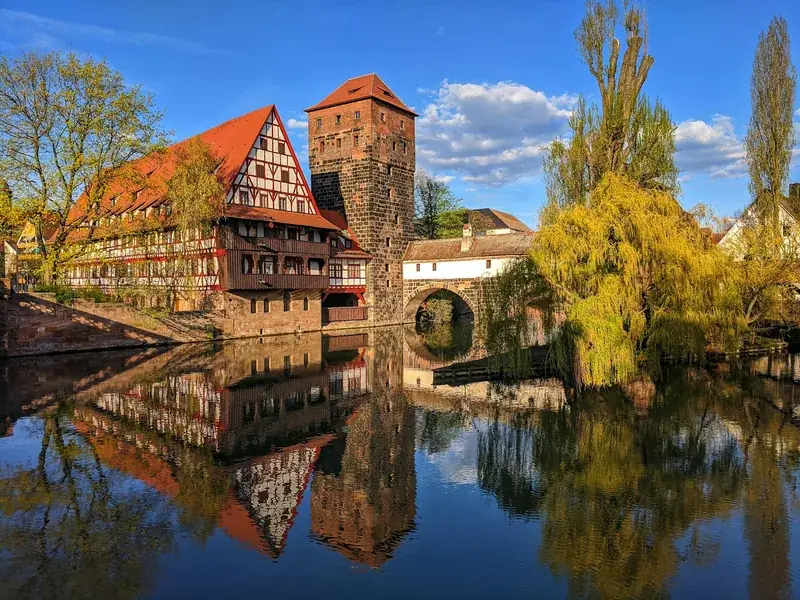
The river threads through the middle of the Old Town, and its banks are the most photographed part of the city. Weißgerbergasse, the old tanners' lane, is the best-preserved run of half-timbered houses in Nuremberg. A little downstream, the covered wooden Henkersteg footbridge led to the executioner's tower, which is exactly the kind of story an audio guide was made for. The long arcaded Heilig-Geist-Spital, a medieval hospital foundation that straddles the water on arches, is the postcard view from the Museumsbrücke.
Weißgerbergasse
Cobbled lane of restored half-timbered artisan houses, once home to the medieval white tanners.
Henkersteg
Covered wooden footbridge over the river, once the executioner's lonely route into town.
Heilig-Geist-Spital
Medieval hospital over the river, with an arcaded courtyard holding a stone Crucifixion by Adam Kraft.
The Rally Grounds and Courtroom 600
Southeast of the centre, around the Dutzendteich lake, Albert Speer's vast parade grounds were never finished. The Documentation Center Nazi Party Rally Grounds occupies a corner of the Kongresshalle, a never-completed hall meant to seat fifty thousand, and traces how the rallies worked and what they led to. A short walk away is the Zeppelinhaupttribüne, the three-hundred-metre grandstand from which Hitler addressed the crowds, left standing stripped of its symbols. Back near the Old Town, the Memorium Nuremberg Trials at the Palace of Justice tells the story of 1945 and 1946, when the surviving leaders of the regime were tried in Courtroom 600. These are heavy sites, and the audio guides treat them as the sober places they are.
Documentation Center Nazi Party Rally Grounds
Museum in the unfinished Nazi congress hall, pierced by a diagonal glass-and-steel walkway.
Zeppelinhaupttribüne
Limestone Nazi rally grandstand by Albert Speer, with Hitler's rostrum facing a vast parade field.
Memorium Nuremberg Trials
Historic courtroom where Nazi leaders faced an international tribunal, with a museum upstairs.
Museums, toys and the first railway
Nuremberg has long been a city of makers. The Germanisches Nationalmuseum is the largest museum of German cultural history, and the place to see the original Schöner Brunnen figures and Dürer's works. The Toy Museum explains why the city hosts the world's largest toy fair, and the German Railway Museum celebrates the Bavarian Ludwigsbahn, Germany's first railway, which ran from Nuremberg to neighbouring Fürth in 1835.
Germanisches Nationalmuseum
Vast museum of German art and culture, home to the oldest surviving globe of the Earth.
Toy Museum
Museum of historic toys, from dolls and dollhouses to tin toys, behind a Renaissance facade.
German Railway Museum Nuremberg
Railway history museum with a replica of the first German steam engine and royal saloon coaches.
Getting around
The Old Town is compact and walkable, ringed by its medieval walls, with the main station just outside the southern gate. Trams and the U-Bahn reach the Rally Grounds and the Palace of Justice in minutes. Pace yourself with the local staples, finger-sized Nürnberger Rostbratwürste and spiced Lebkuchen gingerbread, which have been made here for centuries.